Karsan Level 4 driverless midibus trialled by Tper on Imola’s autodromo
Bologna’s public transport operator Tper and Karsan have completed a Level 4 autonomous bus trial at the Imola circuit, testing real-world public transport operations in a simulated urban environment. Although Italy still lacks a regulatory framework allowing the regular operation of driverless buses on public roads, the potential of autonomous technology is already being tested […]
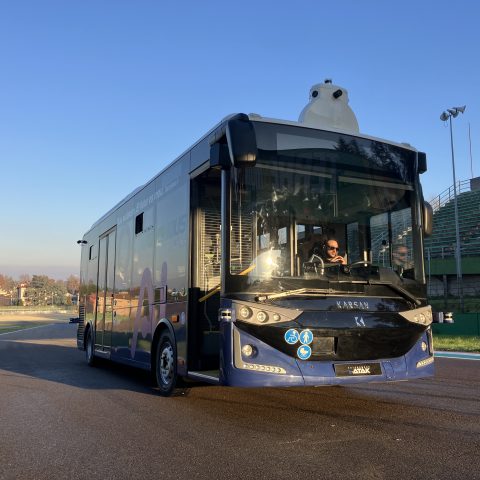
Bologna’s public transport operator Tper and Karsan have completed a Level 4 autonomous bus trial at the Imola circuit, testing real-world public transport operations in a simulated urban environment.
Although Italy still lacks a regulatory framework allowing the regular operation of driverless buses on public roads, the potential of autonomous technology is already being tested within the country. Following a closed-track trial held in Bolzano one year ago, the Karsan Autonomous e-Atak – currently the only 8-metre midibus on the market featuring Level 4 autonomous driving – took centre stage in a new test conducted with Tper at the Autodromo di Imola.
The vehicle is in operation in several European contexts, including Stavanger, Gothenburg, Arbon, and at the airports of Rotterdam and Frankfurt.
With more than 150,000 kilometres driven in autonomous mode, over 60,000 passengers transported, and operational reliability close to 99%, the vehicle has demonstrated solid performance even under extreme climatic conditions down to –25°C.
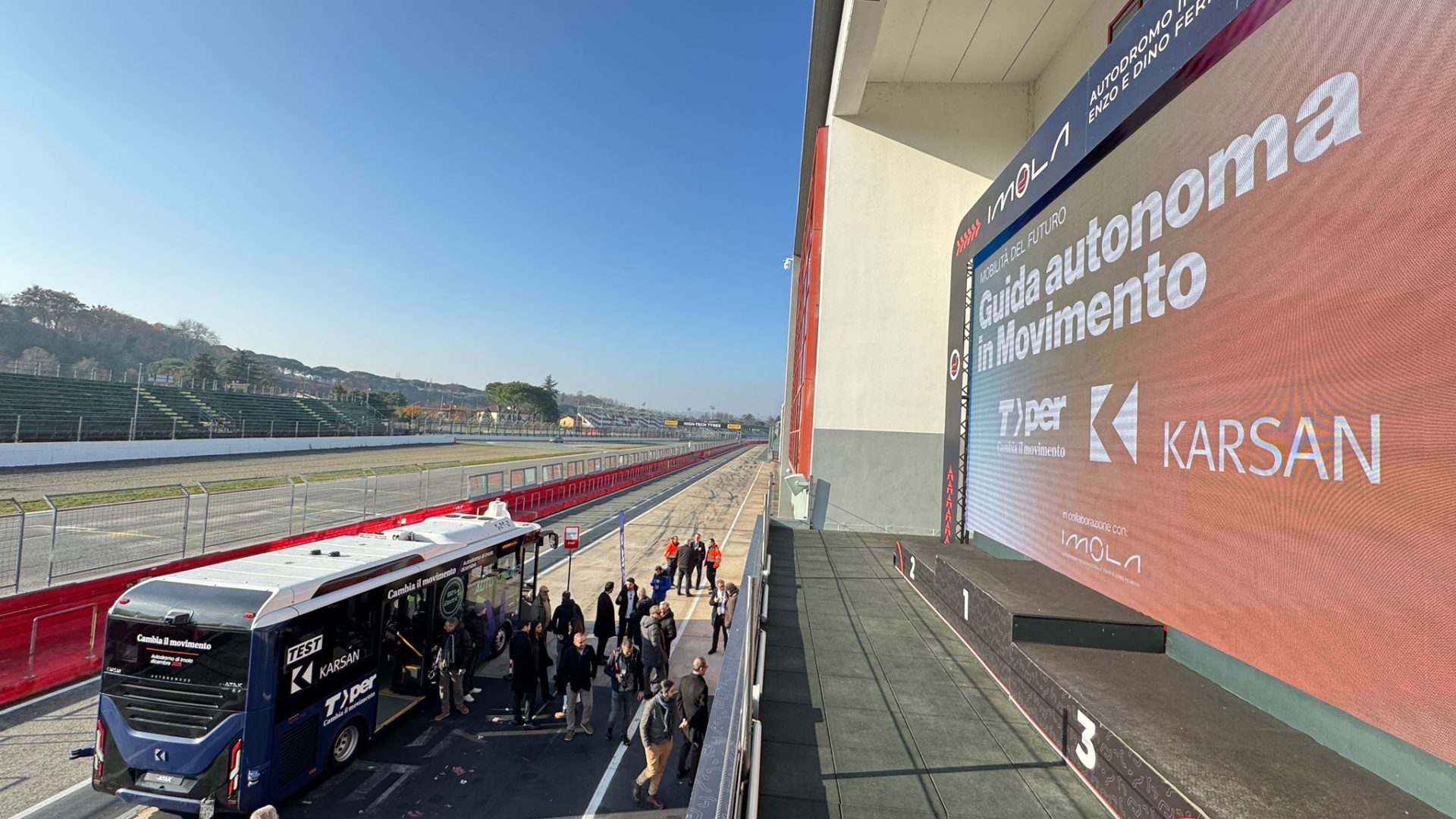
Tper and Karsan, autonomous driving as a pilot
The trial on the historic asphalt of the Autodromo Internazionale Enzo e Dino Ferrari, a motorsport landmark, was carried out within a simulated urban environment set up on the track. The objective was to directly assess how a public transport vehicle could operate without human intervention.
Departing from a stop arranged in the paddock area of the racetrack, the vehicle opened its doors, closed them once passengers had boarded, and then set off along a predefined route. Operating fully autonomously and without a driver, the bus proceeded by stopping at red traffic lights, restarting when the light turned green, respecting pedestrian crossings when occupied, and observing the other stops installed along the route.
The autonomous Karsan vehicle is equipped with advanced technology supplied by the US company Adastec. This includes cameras, radar, and LiDAR (Light Detection and Ranging) remote sensing systems, which use laser technology to map the surrounding environment and detect obstacles in real time. Radar and cameras enable the recognition of road signs, pedestrians and other obstacles, while artificial intelligence processes data collected by the sensors and makes real-time decisions. High-precision navigation systems ensure safe vehicle operation.
Autonomous driving: when in Italy?
Tper underlines in its press note that “Currently, there are still no official regulations in Italy governing the use of this technology on the road, but – based on international experience – the debate surrounding its approval is already underway and tests are being planned in various areas. In general, the focus is on limiting the maximum speed for this type of vehicle to 40 km/h. On this basis, the Imola test was carried out with the bus, which, along the 2.6 km simulated route, modulated its speed by accelerating and decelerating according to road conditions and within the set speed limits. The Karsan bus took about 10 minutes to complete the route, a speed that is absolutely in line with the urban mileage of vehicles currently operated by human drivers”.
Giuseppina Gualtieri, President and Chief Executive Officer of Tper, stated: “For a company that aims to be able to face both current and future challenges, it is important to work also in research and collaboration areas that go beyond the implementation of today’s investments and innovations. The topic of autonomous driving, which is linked to the development of intelligent and interconnected systems, represents one of the frontiers of a new ‘industrial revolution of mobility’, and therefore also of public transport. For this reason, it is important to be involved proactively, to grow knowledge and expertise, through relationships and collaborations that are essential in scenarios of continuous change.”