Twenty BYD electric buses enter operation in western Germany’s Birkenfeld district
20 electric buses by BYD have been officially commissioned by Nahverkehrsbetriebe Birkenfeld to serve regional and urban public transport services in the Nationalparklandkreis. The new fleet was presented at the exhibition centre in Idar-Oberstein during a formal commissioning event attended by representatives from politics, transport authorities, and the operating company. The Nationalparklandkreis refers to Landkreis […]
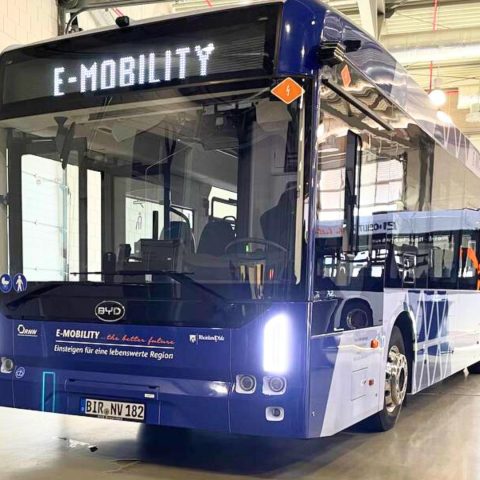
20 electric buses by BYD have been officially commissioned by Nahverkehrsbetriebe Birkenfeld to serve regional and urban public transport services in the Nationalparklandkreis.
The new fleet was presented at the exhibition centre in Idar-Oberstein during a formal commissioning event attended by representatives from politics, transport authorities, and the operating company.
The Nationalparklandkreis refers to Landkreis Birkenfeld, a rural district in the federal state of Rhineland-Palatinate in western Germany. Public bus services in the district are operated by Nahverkehrsbetriebe Birkenfeld, a district-owned company acting within the Rhein-Nahe Nahverkehrsverbund, the regional public transport authority. Since August 2022, NVB has also been responsible for urban bus services in the city of Idar-Oberstein.
BYD electric buses for NVB
The 20 battery-electric buses, delivered in the corporate livery of the Rhein-Nahe Nahverkehrsverbund, are expected to cover around three quarters of NVB’s annual operating performance, equivalent to approximately 1.5 million kilometres per year. The vehicles are supplied by BYD and will primarily be deployed on urban routes in Idar-Oberstein.
Four buses are assigned to interurban services connecting Idar-Oberstein with Sien, as well as routes via Leisel and Birkenfeld to Neubrücke.
The total investment amounts to around €11 million, including approximately €10 million for vehicle procurement and €1 million for charging infrastructure, the district points out. Federal funding exceeding €4.3 million was granted by the German Ministry for Digital and Transport after an initial application was rejected. Project representatives referred to both the funding process and delivery constraints as factors contributing to delays in the fleet rollout.
Charging infrastructure has been installed at several locations across the network. Each bus has access to a dedicated charging point at the NVB depot in Almerich. Additional charging facilities are located at Oberstein station, in the Vollmersbachtal district of Idar, and in Sien, with two charging points available at each site. Electricity for the fleet is supplied by the local energy provider OIE.
Operating structure and workforce preparation
NVB is jointly owned by the medium-sized transport companies Westrich-Reisen, bkr mobility (Bohr, König, Reuter), and Zarth. To support the transition to electric bus operations, the shareholders entered into a partnership with Luxembourg-based operator Voyages Emile Weber, which operates a fleet of around 150 electric buses, it is said in the press release.
The company employs 85 staff members from 15 countries, including around 50 drivers. As part of the introduction of the electric fleet, drivers completed dedicated training programmes, including vehicle handling and safety training sessions conducted at the Nürburgring.