DB Regio subsidiary Weser-Ems-Bus deploys a CaetanoBus hydrogen bus fleet in Friesland, Germany
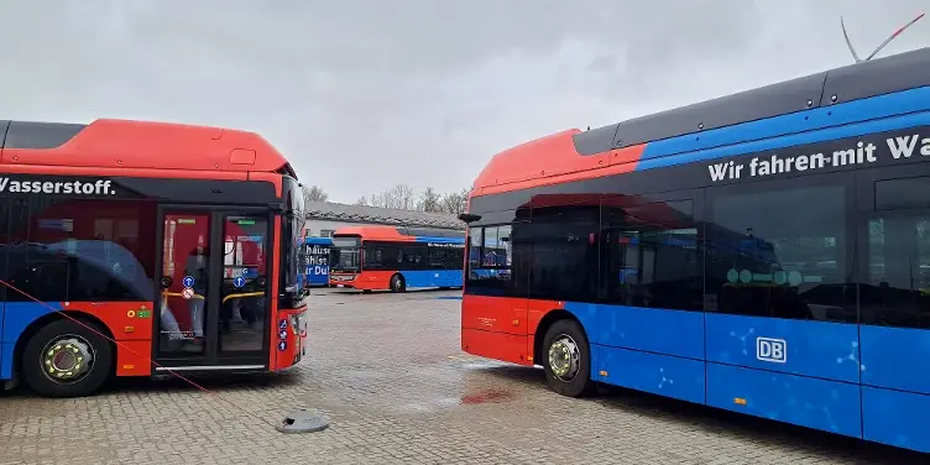
DB Regio subsidiary Weser-Ems-Bus has launched a hydrogen bus fleet in Friesland with six Caetano vehicles. The rollout fits Deutsche Bahn’s broader strategy to expand alternative drivetrains across its bus networks and increase the share of zero-emission operations. Friesland is a rural district (Landkreis) in northwestern Germany, located in the state of Lower Saxony. Fuel […]

DB Regio subsidiary Weser-Ems-Bus has launched a hydrogen bus fleet in Friesland with six Caetano vehicles.
The rollout fits Deutsche Bahn’s broader strategy to expand alternative drivetrains across its bus networks and increase the share of zero-emission operations.
Friesland is a rural district (Landkreis) in northwestern Germany, located in the state of Lower Saxony.
Fuel cell buses in Friesland
The vehicles will initially refuel at a mobile hydrogen station installed at the operator’s Jever depot. The temporary setup was developed jointly with the Technology Transfer Centre (ttz) Bremerhaven and hydrogen producer Lhyfe to enable immediate fleet deployment. A permanent public station operated by Score is planned for 2026 in the JadeWeserPark in Schortens, positioned to serve both public transport and regional logistics users, Deutsche Bahn points out in a press note.
For Weser-Ems-Bus, the introduction of fuel cell buses represents the first stage in a wider transition. Two battery-electric buses will follow in the Ihlow service area, bringing the share of emission-free vehicles at DB Regio Bus Nord in Lower Saxony, Bremen, Hamburg and Schleswig-Holstein to around ten percent. The conversion is supported by two funding packages from the Federal Ministry of Transport amounting to roughly €16.5 million, which finance not only vehicle procurement but also associated workshop and charging infrastructure. The district of Friesland contributes an additional €450,000 to cover remaining costs and advance its regional mobility strategy.
The new buses offer low-floor layouts with dedicated spaces for wheelchairs, bicycles and pushchairs. Passenger-facing features include illuminated stop buttons with Braille, air conditioning, free Wi-Fi and USB charging at every seat. Safety systems such as CCTV and a turn-assist function are standard.
Manufactured by Caetano, the buses are equipped with Toyota fuel cell systems and carry 37.5 kilograms of hydrogen in roof-mounted tanks. They offer a stated range of up to 590 kilometres, with the fuel cell continuously charging the onboard battery that powers the electric drivetrain. The procurement forms part of DB Regio Bus Nord’s larger plan to introduce 152 alternative-drive buses, supported under the federal funding guideline for low-emission bus technologies. Funding for the programme is also provided through Germany’s Recovery and Resilience Plan and the EU’s NextGenerationEU facility, coordinated by NOW GmbH and implemented by Project Management Jülich.
Arne Schneemann, Member of the Executive Board of DB Regio Straße, says: “We are actively shaping the future of mobility and take our responsibility for climate protection seriously. With the help of BMV funding and in cooperation with the district of Friesland, we have taken a big step in the right direction. The new buses are eye-catching and offer our passengers a high level of comfort and quiet. Last but not least, they are also an attractive tool for our driving staff. All of this increases the value of public transport in the region.”
Patrick Schnieder, Federal Minister of Transport: “Zero-emission buses are the basis for attractive and climate-friendly public transport. The Federal Ministry of Transport is actively promoting the conversion of fleets to climate-neutral buses and is supporting DB Regio Bus Nord with £16.5 million for the conversion. Soon, one in ten DB buses in Lower Saxony, Bremen, Hamburg and Schleswig-Holstein will be emission-free – an important step for climate-friendly mobility in northern Germany.”
Sven Ambrosy, District Administrator of Friesland: “I am proud that we can now put our hydrogen bus project into operation. Especially in our World Heritage region, we are challenged to continue pursuing our climate protection goals. Frieslandtakt and new vehicles are an attractive offer for passengers, both tourists and locals. Hydrogen mobility is still pioneering work in Germany, and such a project can only be realised through good partnership. I would like to thank everyone involved who contributed their expertise and perseverance!”