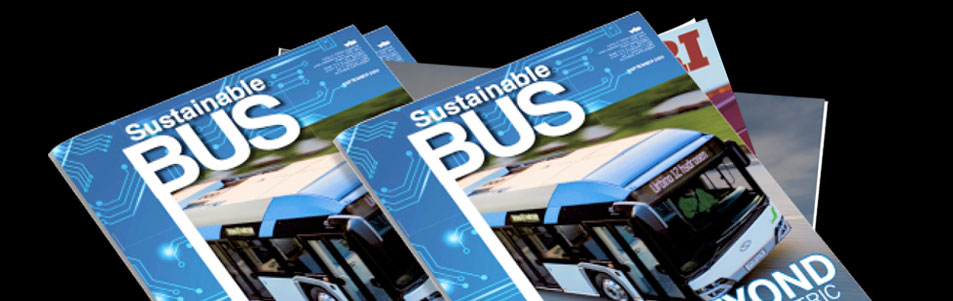
“The Battery Cycle” launched: a 2026 special feature exploring batteries between rigor and clarity
Understanding batteries has become a prerequisite for managing electric vehicles fleets. State of Charge, State of Health, degradation mechanisms, charging dynamics, data ownership and battery chemistries are now brought together in a single structured publication with the launch of The Battery Cycle, a new monographic special feature accompanying Sustainable Bus four issues throughout 2026 and […]
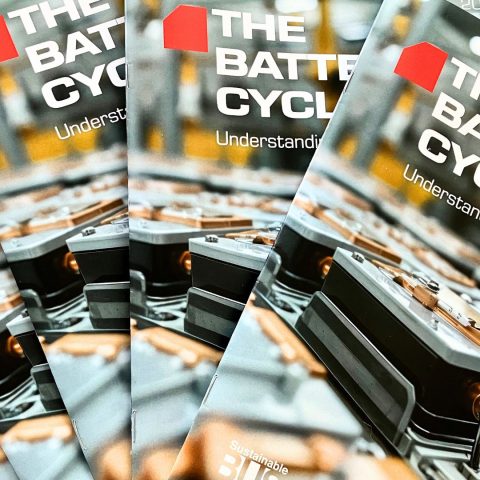
Understanding batteries has become a prerequisite for managing electric vehicles fleets. State of Charge, State of Health, degradation mechanisms, charging dynamics, data ownership and battery chemistries are now brought together in a single structured publication with the launch of The Battery Cycle, a new monographic special feature accompanying Sustainable Bus four issues throughout 2026 and based on texts by Claudius Jehle, CEO of German battery analytics company volytica diagnostics.
The special feature is conceived as a standalone publication within the magazine’s editorial ecosystem. The initiative will run across all four 2026 issues and will be distributed globally at no fewer than ten trade exhibitions, in addition to reaching readers through the magazine’s digital e-reader channels and subscriber base.
The monograph will circulate not only among Sustainable Bus readers but also within the broader professional communities addressed by its sister platforms Sustainable Truck&Van and Powertrain International, strengthening the cross-sector technical dialogue between bus, truck and powertrain domains.
The Battery Cycle: aiming to opening the black box
The initiative is based on a defined editorial premise: as electric buses and trucks scale up across global markets, batteries have become strategic industrial assets requiring structured technical understanding rather than simplified interpretation. Battery systems influence vehicle availability, operational planning, lifecycle management, safety frameworks and residual value, and are increasingly central to procurement and fleet strategy discussions.
Every battery must be used to its true potential. Yet even today, too many batteries are replaced too early, misunderstood, or trusted blindly because they sit inside a black box. The Battery Cycle is our way of opening that box. Together with Sustainable Bus, a partner we’ve worked with almost from the beginning, we aim to share knowledge, spark curiosity, and encourage operators to ask better questions. Not to turn anyone into a battery scientist, but to make sure decisions about such critical critical assets are based on understanding, not assumptions. If this series makes you rethink your fleet, your data, or your strategy, we encourage you to start the conversation.
Claudius Jehle, CEO & Co-Founder, volytica diagnostics
The Battery Cycle – Understanding the heart of BEVs gathers and updates a series of technical contributions authored by Claudius Jehle, CEO of volytica diagnostics. Originally published on the Sustainable Bus website starting 2021, these articles have been revised to reflect technological, regulatory and market developments and reorganized into a coherent monographic format.

The launch of The Battery Cycle reflects the integrated structure of Vado e Torno Edizioni. Sustainable Bus is part of a wider specialist publishing group that includes Sustainable Truck&Van and Powertrain International.
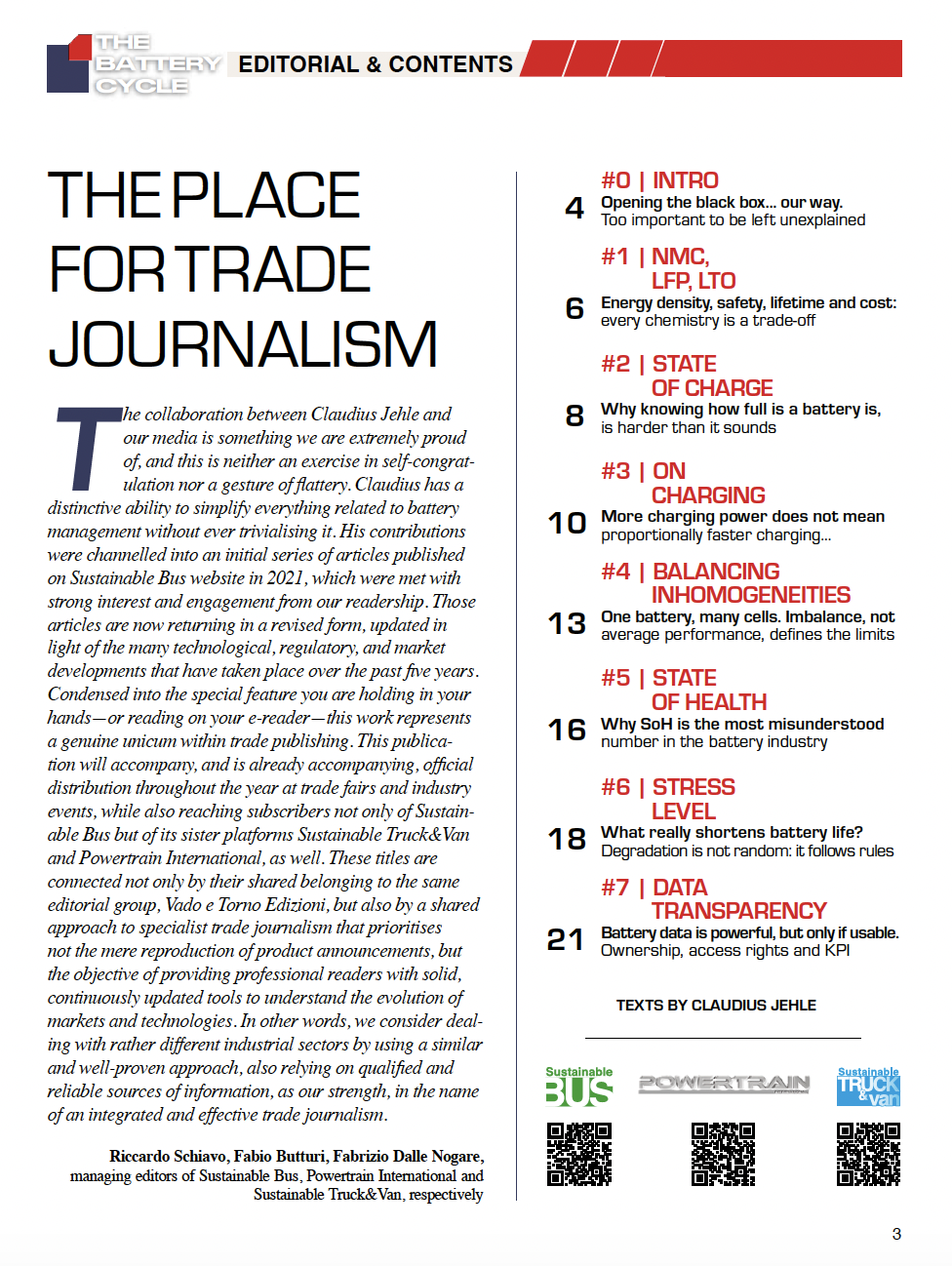
The publication systematically addresses lithium-ion chemistries such as NMC, LFP and LTO; the complexities behind SoC estimation; the interpretation of SoH and its contractual implications; the interaction between charging power and CCCV behavior; the role of balancing in multi-cell systems; degradation drivers linked to temperature, C-rate and operating windows; and the implications of data transparency under evolving European regulation.
At the crossroads between technical precision and divulgative approach
A key element of the project is its divulgative approach. Complex electrochemical mechanisms and battery management logics are presented through clear explanations, analogies and operational examples, without reducing technical accuracy. The objective is not to turn operators into battery scientists, but to provide fleet managers, engineers and decision-makers with accessible tools to interpret battery behavior in real-world conditions and to engage in informed technical discussions with OEMs and suppliers.
“The Battery Cycle special feature will accompany, and is already accompanying, official distribution throughout the year at trade fairs and industry events, while also reaching subscribers not only of Sustainable Bus but of its sister platforms Sustainable Truck&Van and Powertrain International, as well. These titles are connected not only by their shared belonging to the same editorial group, Vado e Torno Edizioni, but also by a shared approach to specialist trade journalism that prioritises not the mere reproduction of product announcements, but the objective of providing professional readers with solid, continuously updated tools to understand the evolution of markets and technologies“. In other words, we consider dealing with rather different industrial sectors by using a similar and well-proven approach, also relying on qualified and reliable sources of information, as our strength, in the name of an integrated and effective trade journalism“, reads the editorial by Riccardo Schiavo, Fabio Butturi, Fabrizio Dalle Nogare, managing editors of Sustainable Bus, Powertrain International and Sustainable Truck&Van, respectively.
“Every battery must be used to its true potential. Yet even today, too many batteries are replaced too early, misunderstood, or trusted blindly because they sit inside a black box. The Battery Cycle is our way of opening that box. Together with Sustainable Bus, a partner we’ve worked with almost from the beginning, we aim to share knowledge, spark curiosity, and encourage operators to ask better questions. Not to turn anyone into a battery scientist, but to make sure decisions about such critical critical assets are based on understanding, not assumptions. If this series makes you rethink your fleet, your data, or your strategy, we encourage you to start the conversation“, states Claudius Jehle, CEO & Co-Founder, volytica diagnostics.