Germany’s e-bus fleet reaches 4,752 units (14%) as 50% of new city buses go zero-emission
In 2025, nearly half of newly registered city buses in Germany were zero-emission vehicles. Germany’s public transport sector added 1,397 emission-free buses in 2025, bringing the total fleet to 4,752 vehicles in operation nationwide, according to PwC’s E-Bus Radar 2026. The data positions electric drivetrains at around 14% of the country’s city bus fleet of […]
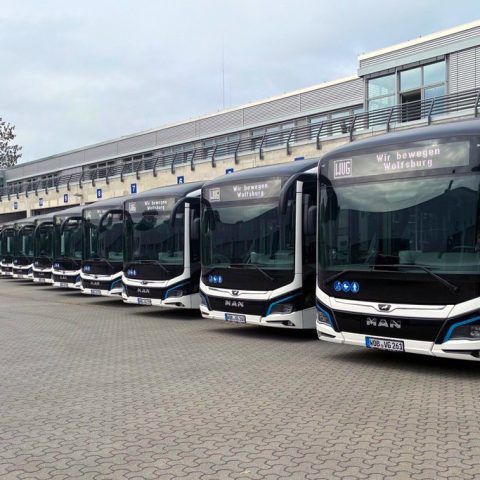
In 2025, nearly half of newly registered city buses in Germany were zero-emission vehicles.
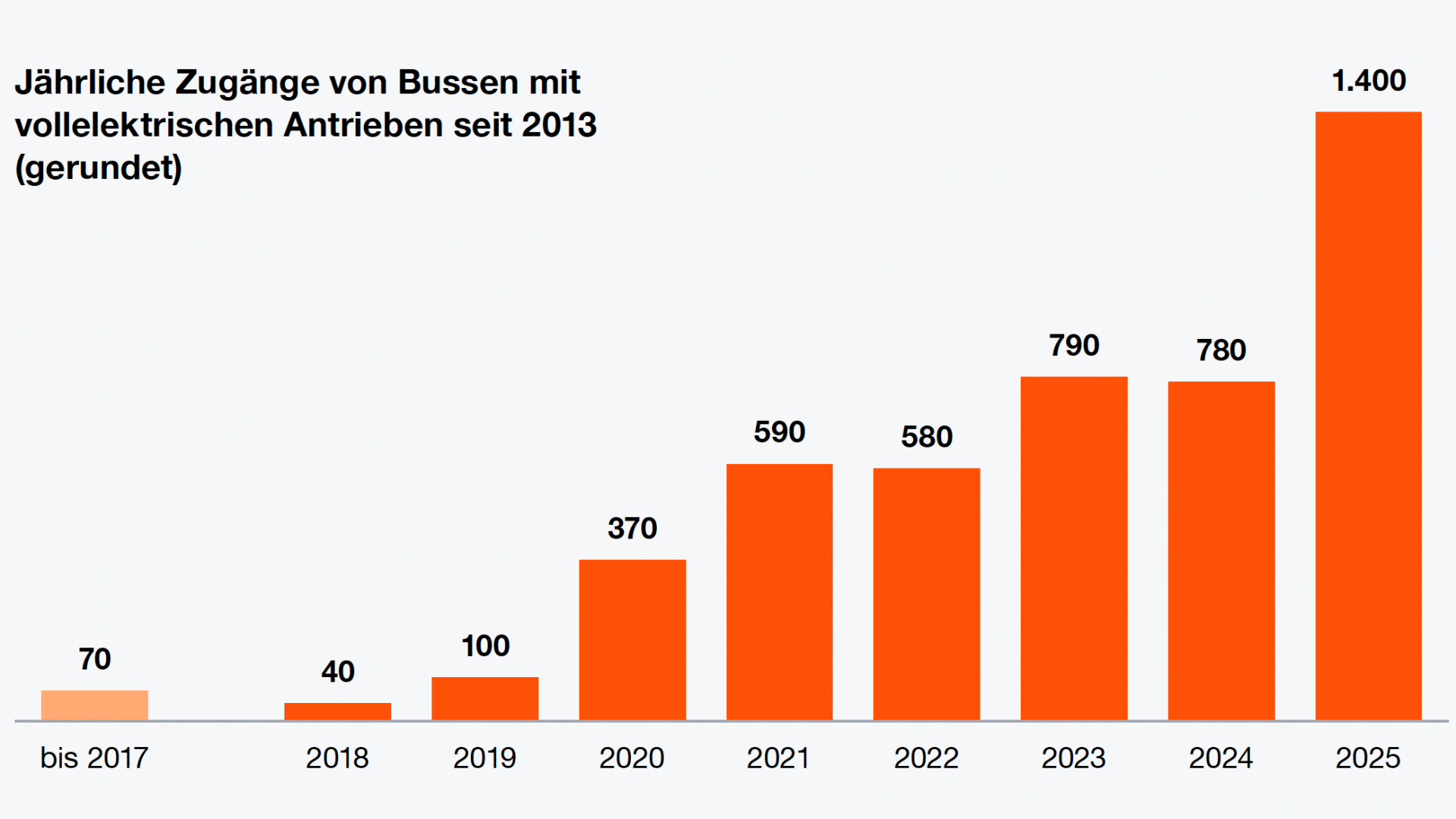
Germany’s public transport sector added 1,397 emission-free buses in 2025, bringing the total fleet to 4,752 vehicles in operation nationwide, according to PwC’s E-Bus Radar 2026. The data positions electric drivetrains at around 14% of the country’s city bus fleet of approximately 35,000 units and documents a significant increase in annual deployments compared to 2024, when 780 units entered service.
The eighth edition of the analysis provides a detailed overview of fleet composition, manufacturer shares, regional distribution and procurement planning, based on operational data as of 31 December 2025.
According to the report, German operators have outlined procurement plans for around 6,400 additional zero-emission buses by 2030, bringing the total fleet to over 11,000 vehicles (a substantial increase compared to the 8,500 forecasted in 2023 by the same PwC).
Annual procurement levels indicate that around 2,900 city buses are purchased each year in Germany, with approximately 1,400 of these being zero-emission vehicles in 2025, corresponding to a share close to 48% of new registrations.
PwC, E-Bus Radar 2026
Battery-electric accounts for 85% of ZE fleet in Germany
Battery-electric buses represent the majority of zero-emission vehicles currently in service. Out of the total fleet, 4,034 buses are battery-electric, corresponding to approximately 85%, while 628 units are fuel cell buses and 90 are trolleybuses.
Source: PwC, E-bus radar 2026
Fuel cell buses recorded the highest relative growth in 2025, increasing from 330 to 628 units year-on-year. Battery-electric buses also expanded significantly, with a 37% increase compared to 2024.
Annual procurement levels indicate that around 2,900 city buses are purchased each year in Germany, with approximately 1,400 of these being zero-emission vehicles in 2025, corresponding to a share close to 48% of new registrations.
Six manufacturers account for 90% of vehicles in operation
The German zero-emission bus market is concentrated among a limited number of manufacturers. Six OEMs account for 4,275 vehicles in operation, equivalent to 90% of the total fleet.
Daimler Buses leads with 1,853 vehicles, followed by Solaris (735) and MAN (723). VDL (405), Ebusco (312) and BYD (247) complete the group.
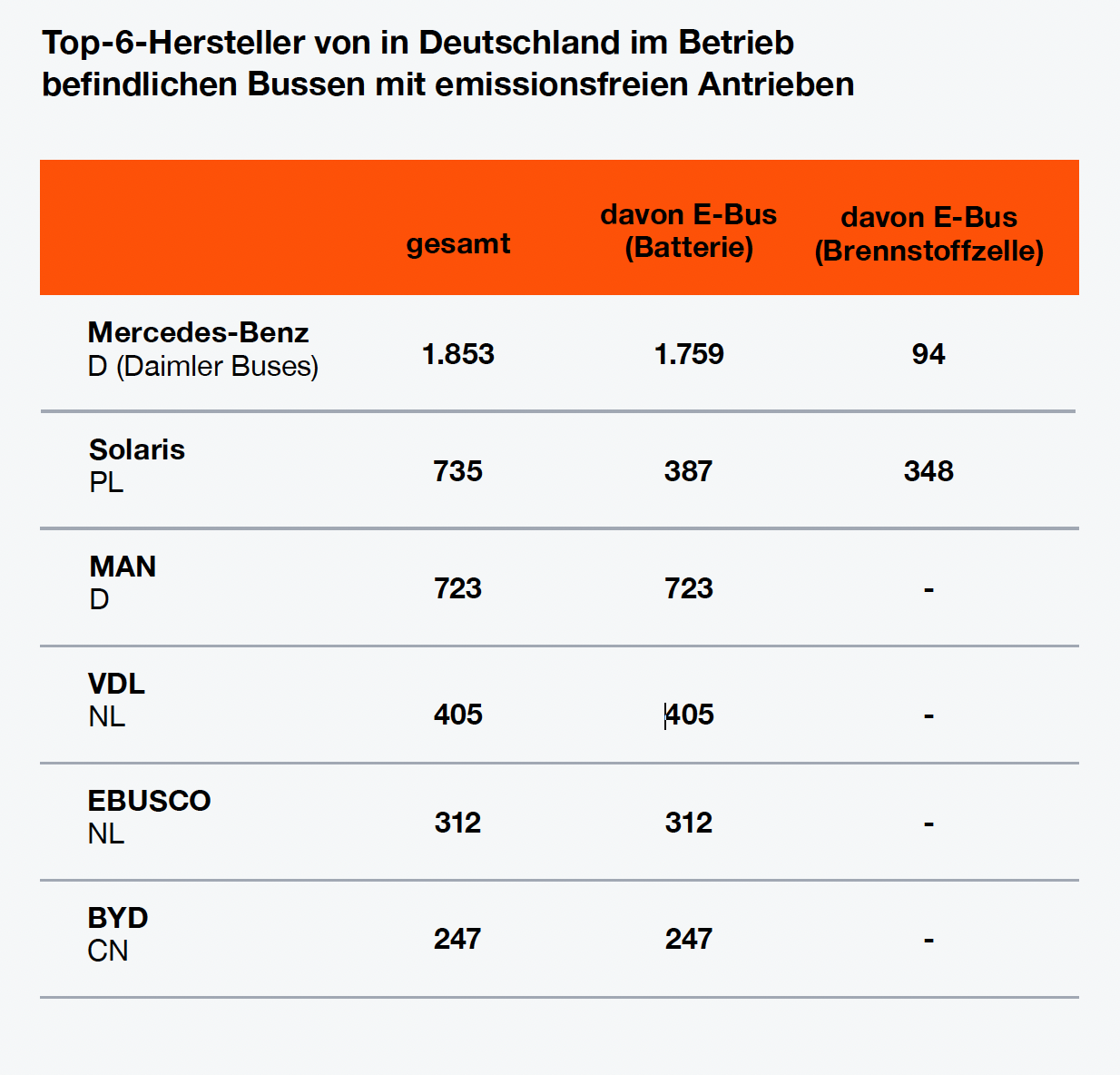
Fleet composition varies by manufacturer. Daimler Buses operates both battery-electric and fuel cell vehicles, while Solaris has a substantial fuel cell component (covering over half of the market in the last couple of years). The fleets of MAN, VDL, Ebusco and BYD in Germany consist entirely of battery-electric buses, as known.
Operators have announced plans to procure approximately 6,400 additional zero-emission buses by 2030. Based on current fleet levels, this would increase the total to more than 11,000 vehicles.
PwC, E-Bus Radar 2026
Across all propulsion technologies, total planned procurements amount to around 9,660 buses. These figures reflect currently known operator plans and projects.
Deployment reaches 222 cities and regions
Electric buses are now deployed across a broad geographic range. In 2025, they were in operation in 222 cities and regions, compared to 180 in 2024 and 90 in 2020.
Hamburg remains the largest deployment area, with 709 vehicles in operation, followed by Berlin with 277 units. At regional level, North Rhine-Westphalia exceeded 1,000 electric buses for the first time. Eight federal states recorded fleets of more than 200 zero-emission buses.
Nearly half of all electric buses running in Germany are concentrated in North Rhine-Westphalia, Hamburg and Bavaria.
Investment levels and funding structures
The report documents a continued gap in acquisition costs between electric and diesel buses. A standard 12-metre battery-electric bus is priced at approximately €580,000, compared to around €310,000 for a diesel equivalent.
In addition to vehicle procurement, operators are investing in charging infrastructure, grid connections and depot upgrades. These include expansion of depot capacity, installation of high-power charging systems and integration with local energy networks.
Funding programmes remain a key component of procurement. According to PwC, more than 60% of the zero-emission buses expected to be in operation by 2030 will have been supported by federal funding schemes. All recent funding calls have been oversubscribed.
Germany’s Federal Minister for Transport Patrick Schnieder announced a few weeks ago that that a new funding directive for zero-emission buses will be published in spring 2026, with up to €500 million earmarked for this year.
Procurement pipeline and regulatory framework to 2030
Operators have announced plans to procure approximately 6,400 additional zero-emission buses by 2030. Based on current fleet levels, this would increase the total to more than 11,000 vehicles.
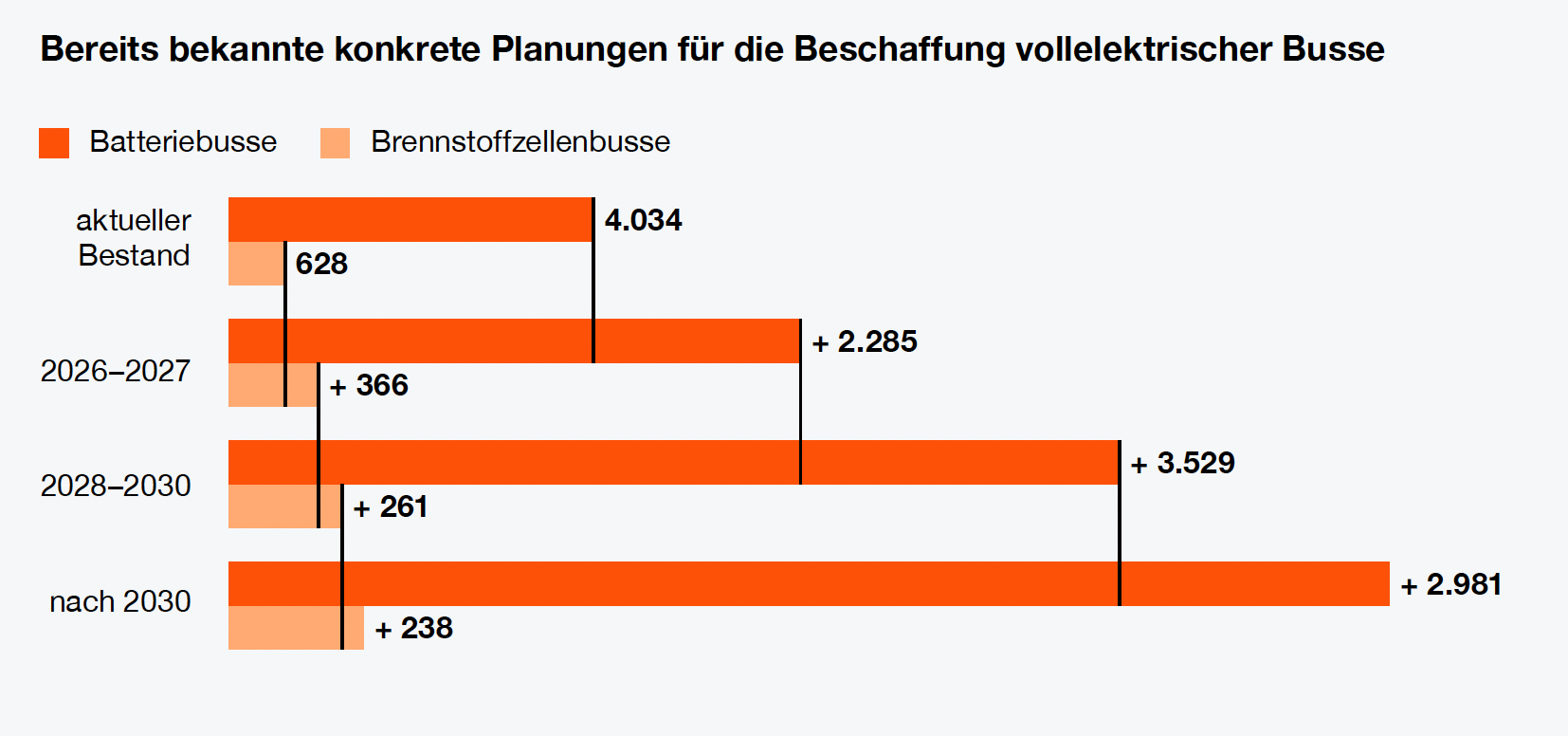
Across all propulsion technologies, total planned procurements amount to around 9,660 buses. These figures reflect currently known operator plans and projects.
Regulatory requirements continue to define procurement volumes. The Clean Vehicles Directive sets minimum shares for “clean” and zero-emission buses, rising to 65% and 32.5% respectively in the 2026–2030 period. Based on current procurement volumes, this corresponds to approximately 940 zero-emission buses per year.