India electric bus market reaches 4,441 units (+19%), with Switch up six-fold while Tata declines 84%
India registered 4,441 electric buses in 2025, up from 3,730 units in 2024, according to Vahan Dashboard data. The Indian electric bus market expanded by 711 units year-on-year, with volumes increasing by approximately 19%. PMI Electro Mobility, Olectra Greentech and Switch Mobility led the market, while Tata registered a dramatic decrease. The same three players […]
India registered 4,441 electric buses in 2025, up from 3,730 units in 2024, according to Vahan Dashboard data.
The Indian electric bus market expanded by 711 units year-on-year, with volumes increasing by approximately 19%. PMI Electro Mobility, Olectra Greentech and Switch Mobility led the market, while Tata registered a dramatic decrease. The same three players were dominating the market in the first half of the year.
Switch Mobility grew six-fold
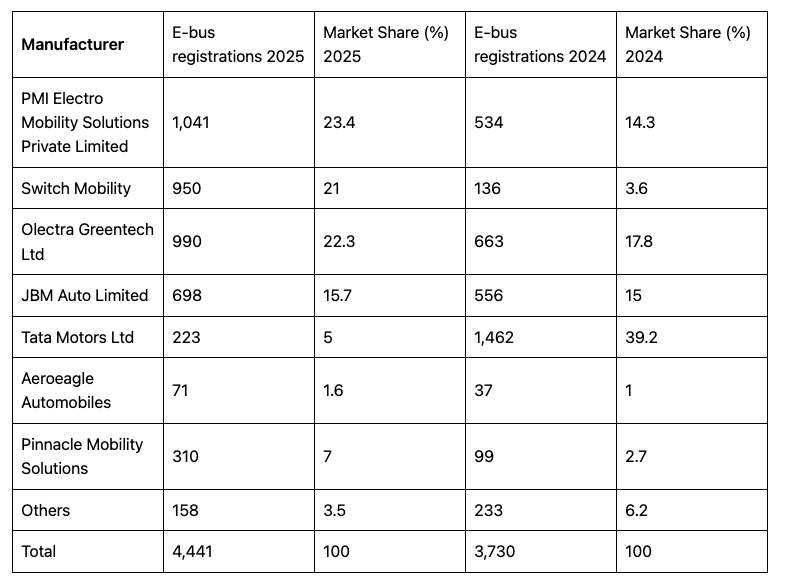
PMI Electro Mobility Solutions recorded 1,041 units in 2025, compared to 534 units in 2024, adding 507 buses year-on-year, then doubling its volumes and moving its market share from 14.3% to 23.4%.
Olectra Greentech reached 990 units in 2025, up from 663 units in 2024, an increase of 327 buses. Its share rose from 17.8% to 22.3%, corresponding to a gain of 4.5 percentage points.
What is remarkable, Switch Mobility registered 950 units in 2025, compared to 136 units in 2024, an increase of 814 buses… and a trend growth of nearly 600%. Its market share moved from 3.6% to about 21%, representing an increase of roughly 17.4 percentage points.
JBM Auto reported 698 units in 2025, up from 556 units in 2024, with a volume increase of 142 buses. Its market share rose slightly from 15% to 15.7%.
Pinnacle Mobility Solutions increased registrations from 99 to 310 units, adding 211 buses year-on-year. Its market share moved from 2.7% to 7%, a gain of 4.3 percentage points.
It’s worth mentioning that Tata Motors is listed with 223 units in 2025 compared to 1,462 units in 2024: -84%. Its market share moved from 39.2% to 5%, a reduction of 34.2 percentage points.
With support in reporting from Usha Praveen