Italy: e-buses covered +40% of the city bus market in Q1 2025
In the first quarter of 2025, Italy registered 1,123 new buses over 8 tons, marking a 7.4% decline compared to the same period in 2024 (1,213 units), according to data from ANFIA covered on our sister media Autobusweb. Despite the overall contraction, strong performances in the coach and electric segments show clear signs of a […]
In the first quarter of 2025, Italy registered 1,123 new buses over 8 tons, marking a 7.4% decline compared to the same period in 2024 (1,213 units), according to data from ANFIA covered on our sister media Autobusweb. Despite the overall contraction, strong performances in the coach and electric segments show clear signs of a transforming market. And it should be reminded that 2024 was a record-breaking year in Italy, thus a slight decrease would be physiological.
Urban buses made up the largest share of registrations with 418 units (+15% YoY), accounting for 37.2% of total volumes. Intercity buses, on the other hand, experienced a sharp drop: from 620 units in Q1 2024 to 344 this year (–44.5%), now representing 30.6% of the market.
What is worth stressing, coaches posted the strongest growth, jumping 60.3% to 359 units (up from 224), and now represent an even 32% market share.
Italian Q1 2025 traction by traction
Electric buses continue their upward trajectory. A total of 172 battery-electric buses were registered, a 118% increase from 79 units in Q1 2024. This segment now represents 15.3% of total registrations—accounting for 41% of Class I and 4.4% of Class II vehicles.
Diesel buses still lead the market but are losing momentum. In Q1 2025, diesel accounted for 530 units (47.2% of the total), down 24.7% year-over-year.
CNG is gaining traction: 286 natural gas buses were registered (+48.2%), making up 25.5% of total registrations. One additional vehicle powered by LNG was also recorded.
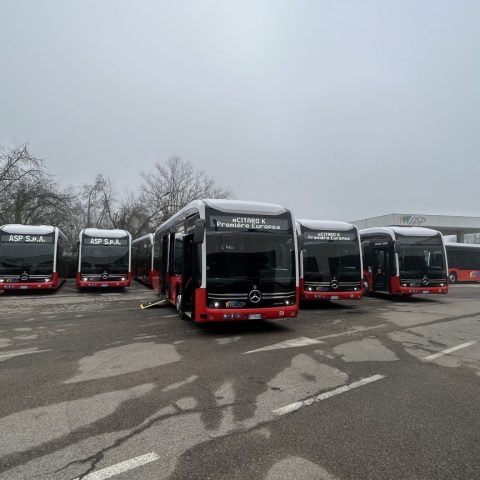
Hydrogen made a quiet but noteworthy entry: 5 fuel cell buses were registered, all Mercedes-Benz eCitaro G units from Daimler Buses.
Looking at the whole market, Iveco Bus maintained its leadership with 344 registrations, though the figure represents a steep 41.5% drop compared to Q1 2024. Its market share now stands at 30.6%.
Daimler Buses is closing in rapidly, registering 253 Mercedes-Benz units (+72%) and 35 Setra buses (–34%). Combined, the group holds a 25.6% share. Solaris takes third place with 107 registrations (+149%), capturing 9.5% of the market.
Putting the battery-electric segment under the lens, Daimler Buses leads with 49 electric units, followed by Karsan (39), Yutong (20), and Iveco Bus (18).