Rinko Bus, Toshiba and Drive Electro launch electric bus trial in Japan with 10-minute pantograph charging
Rinko Bus, Toshiba and Drive Electro Technology have launched a demonstration project in Kawasaki, Japan, involving a retrofitted electric bus equipped with a pantograph charging system capable of recharging the vehicle in approximately 10 minutes. The project, announced on 15 October 2026, will see the vehicle enter passenger service on local routes around December 2026, […]
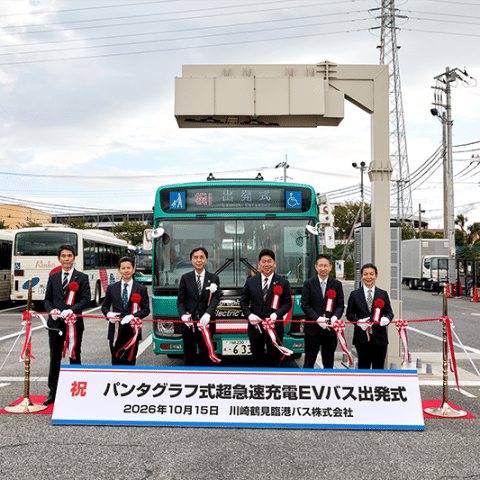
Rinko Bus, Toshiba and Drive Electro Technology have launched a demonstration project in Kawasaki, Japan, involving a retrofitted electric bus equipped with a pantograph charging system capable of recharging the vehicle in approximately 10 minutes.
The project, announced on 15 October 2026, will see the vehicle enter passenger service on local routes around December 2026, in what the three companies describe as Japan’s first application of pantograph charging to an electric bus operating on regular public roads. The demonstration will assess vehicle performance, charging duration and operational efficiency under real service conditions.
The initiative involves Kawasaki Tsurumi Rinko Bus Co., Ltd., Toshiba Corporation and Drive Electro Technology K.K., with the charging infrastructure installed at Rinko Bus’s Shiohama depot in Kawasaki, south of Tokyo.
Rinko Bus electric bus demonstration: diesel retrofit and Toshiba SCiB batteries
The vehicle used for the demonstration is an existing diesel bus owned by Rinko Bus and converted to battery-electric propulsion by Drive Electro Technology. The retrofit includes Toshiba SCiB lithium-ion battery technology, with Toshiba responsible for manufacturing the battery modules and Drive Electro Technology handling the vehicle conversion, including the design and manufacture of the necessary components.
According to the three companies, preliminary test runs have already been completed, while preparations are under way for the beginning of passenger operations.
Rinko Bus will be responsible for verifying the vehicle’s performance in regular service. The demonstration will examine charging times and operational efficiency alongside the bus’s performance on routes operated from the Shiohama depot.
The project draws on results from an earlier demonstration of electric buses equipped with fast-charging systems in Putrajaya, Malaysia, commissioned by Japan’s New Energy and Industrial Technology Development Organization (NEDO).
Pantograph charging in approximately 10 minutes
The pantograph charger was installed at Rinko Bus’s Shiohama depot in April 2026. According to Toshiba, the system can recharge the converted electric bus in approximately 10 minutes, compared with the several hours required by conventional plug-in charging.
The charging infrastructure also incorporates a stationary energy storage system based on repurposed Toshiba SCiB lithium-ion batteries.
The storage system is designed to reduce the load on the electricity grid during high-power charging operations. Toshiba also identifies the possibility of using the batteries as an emergency power supply, extending their application beyond their initial service life.
Drive Electro Technology is responsible for manufacturing the pantograph charging equipment, in addition to its role in converting the diesel vehicle to electric propulsion.
The companies have not disclosed the bus’s battery capacity, charging power rating, operating range or energy consumption figures in the announcement.
A public pantograph charging station is planned
Beyond the initial demonstration at the Shiohama depot, the three partners are working on the development of pantograph charging infrastructure for installation in public spaces.
The initiative is supported by a 2026 programme of Japan’s Ministry of the Environment aimed at promoting advanced systems for decarbonising transport and other sectors.
Rinko Bus will lead the planned installation of a pantograph charging station at the Kawasaki Station East Exit Bus Terminal, where electric buses could recharge during scheduled operations.
According to the project partners, the objective is to develop a charging system that enables electric buses to achieve operational efficiency comparable to diesel-powered vehicles through charging during service.
The companies also envisage infrastructure accessible to multiple bus operators, rather than charging installations dedicated exclusively to individual fleets.
The project was formally inaugurated on 15 October at the Shiohama depot, with representatives of the three companies and local and national government officials attending the launch ceremony.
The companies have not announced a commissioning date for the proposed charging installation at Kawasaki Station.
In brief
- When will the Rinko Bus electric bus enter passenger service? Demonstration operations are scheduled to begin around December 2026 on routes operated from the Shiohama depot in Kawasaki.
- How long does pantograph charging take? According to Toshiba and its project partners, the system can recharge the electric bus in approximately 10 minutes.
- Which batteries are used in the project? The retrofitted bus uses Toshiba SCiB lithium-ion batteries. Repurposed SCiB batteries are also used in the stationary energy storage system.
- Where is the next pantograph charging installation planned? Rinko Bus is leading plans for a public charging installation at Kawasaki Station East Exit Bus Terminal.
The three companies state that the demonstration will verify the effectiveness of the rapid-charging electric bus system under real operating conditions, including vehicle performance, charging times and operational efficiency.
According to Rinko Bus, Toshiba and Drive Electro Technology, the subsequent development of public charging infrastructure is intended to support electric bus operations with efficiency comparable to diesel services, while allowing charging facilities to be shared by multiple operators.