Alexander Dennis proposes converting Larbert into chassis facility while closing Falkirk under a revised Scottish manufacturing plan
Alexander Dennis announced on March 31st that it has launched a consultation on a revised manufacturing strategy in Scotland that would retain operations at Larbert while closing its Falkirk site. The proposal outlines the conversion of the Larbert facility into a chassis manufacturing site supporting the company’s low- and zero-emission bus portfolio. The Falkirk facility, […]
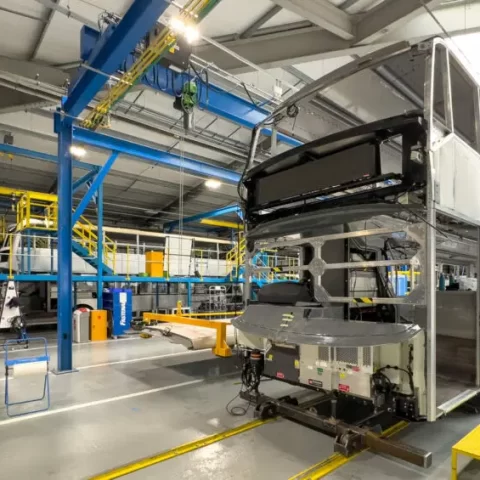
Alexander Dennis announced on March 31st that it has launched a consultation on a revised manufacturing strategy in Scotland that would retain operations at Larbert while closing its Falkirk site.
The proposal outlines the conversion of the Larbert facility into a chassis manufacturing site supporting the company’s low- and zero-emission bus portfolio. The Falkirk facility, described as legacy, would be closed in line with previously stated plans.
Alexander Dennis, revised manufacturing plan for Larbert and Falkirk
The revised approach follows earlier developments in 2025, when the company had announced the potential closure of both Scottish manufacturing sites, placing up to 400 jobs at risk. Subsequent discussions led to a different configuration of operations.
Under the new proposal, approximately 200 jobs previously identified as at risk would be safeguarded, with around 350 roles retained in Scotland. Up to 115 roles remain subject to potential redundancy under the consultation process.
The company also stated that the Larbert site would retain the capability to reintroduce bus body manufacturing in the future.
The revised plan follows the implementation of a 26-week furlough scheme agreed between Alexander Dennis and the Scottish Government in September 2025, designed to maintain manufacturing capacity and employment. The scheme ran from 22 September 2025 to 22 March 2026 and enabled the company to reassess its operational structure.
Over half of zero emission buses are purchased overseas
Alexander Dennis stated that the UK bus manufacturing sector recorded a shift in procurement patterns in 2025, with 51% of zero-emission buses purchased in the country sourced from overseas manufacturers, an increase of 25 percentage points from 2024. In 2025 the country saw over 2,500 e-buses registered, confirming its position as the largest European market for zero emission buses. The company also reported that public funding allocations, including the ScotZEB3 scheme, resulted in a majority of supported vehicles being supplied by non-UK manufacturers.
The proposed restructuring is presented as a response to these market conditions, with the Larbert site positioned to support chassis production across the company’s product range.
Paul Davies, Alexander Dennis President & Managing Director, said: “We are proposing to retain jobs and restart manufacturing at Larbert with a focus on chassis manufacturing. This represents the best possible outcome for our business, employees, customers and supply chain partners in the current climate. This new approach would enable us to better align with the current market whilst improving our efficiency. It also allows us to continue to adapt to rapidly changing and challenging market dynamics. We remain grateful to the Scottish government for the furlough scheme support to secure these jobs, maintaining skills and manufacturing capability in central Scotland. We will continue to work with the Scottish Government, its agencies and the trade unions to support staff during the consultation period. We are absolutely committed to doing the right thing by our team members and our stakeholders to protect jobs, invest in our business and maintain strategically important manufacturing capability in Scotland.”
Mr Davies added: “The output of the UK Bus Manufacturing Expert Panel does not place enough focus on the significant jobs and economic contribution the domestic bus manufacturers make to the UK. In addition, the results of the ScotZEB3 scheme are incredibly disappointing, with the majority of the funding going overseas to support bus and coach manufacturing in China. We continue to repeat the same calls to both governments to level the playing field, recognise the cost of manufacturing in the UK and the fact that these higher costs flow through the supply chain. Manufacturing in this country needs to be better supported if we are to generate the economic benefit that the country so badly needs.”