From buses to truck: Ballard from fuel cell buses to trucks. Interview with Nicolas Pocard (by Sustainable Truck & Van)
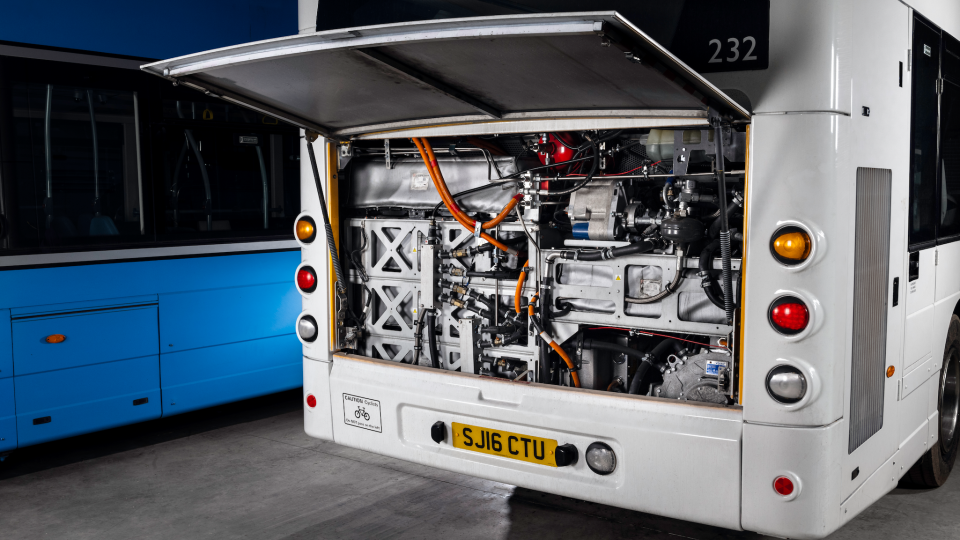
Canada-based company Ballard has been making fuel cell systems for more than 40 years, gaining experience mainly on buses and trains. Now, even the truck sector is getting increasingly familiar with the idea of having fuel cells on vehicles. Our sister media Sustainable Truck & Van talked about this (and much more) with Nicolas Pocard, VP Marketing & Strategic Partnerships at Ballard. Here an excerpt.
Canada-based company Ballard has been making fuel cell systems for more than 40 years, gaining experience mainly on buses and trains. Now, even the truck sector is getting increasingly familiar with the idea of having fuel cells on vehicles, with several new projects and tests being carried out. Also, a few trucks equipped with fuel cells can be currently ordered, including the new Quantron’s QHM FCEV hydrogen truck introduced at IAA. Quite an interesting project, relying on the close cooperation with Ballard, which provides not only the fuel cells.
Our sister media Sustainable Truck & Van talked about this (and much more) with Nicolas Pocard, VP Marketing & Strategic Partnerships at Ballard. Here an excerpt.
How important was the experience Ballard gained in the bus sector to approach the truck one?
“Very important. A bus is a very tough vehicle, as it operates for several hours in the day with a stop-and-go mode. We have buses operating in Europe and North America in different environments. We know the challenges of heavy-duty mobility, also in terms of duty cycle, and this is very useful when it comes to working with truck manufacturers. We’re increasing our range of products to meet the requirements of heavy-duty trucks. Our current production capacity is about 1.6 GW to make fuel cell stacks. In our portfolio, we have smaller stack (50 kW), as well as some products with 120-150 kW power output. We can also provide roof top fuel cell modules to be mounted on buses, or even 12 to 19-ton distribution trucks”.
At IAA, we’ve seen the first hydrogen-powered ICEs mounted on prototype trucks. Do you think hydrogen ICEs and fuel cells can coexist?
“I think so. Hydrogen ICEs can be useful mainly in a transition phase. Internal combustion is limited in efficiency, while fuel cells have a much higher degree of efficiency. At the end of the day, this is going to make a difference.
Hydrogen is not cheap. Fuel is a big part when you talk about truck operation. To summarize, as long as fuel cells are so expensive, hydrogen ICEs can help fill a gap, but when the price of fuel cells goes down, the picture will change a lot. And then, fuel cells are purely zero emissions, while ICEs are not”.