Germany sets €500 million 2026 e-bus budget as 1,887 vehicles are funded in 2025 round
Germany’s Federal Minister for Transport Patrick Schnieder announced today that that a new funding directive for zero-emission buses will be published in spring 2026, with up to €500 million earmarked for that year, while simultaneously awarding €417 million for 1,887 electric buses under the current scheme. The funding certificates, that follows the funding round launched […]
Germany’s Federal Minister for Transport Patrick Schnieder announced today that that a new funding directive for zero-emission buses will be published in spring 2026, with up to €500 million earmarked for that year, while simultaneously awarding €417 million for 1,887 electric buses under the current scheme.
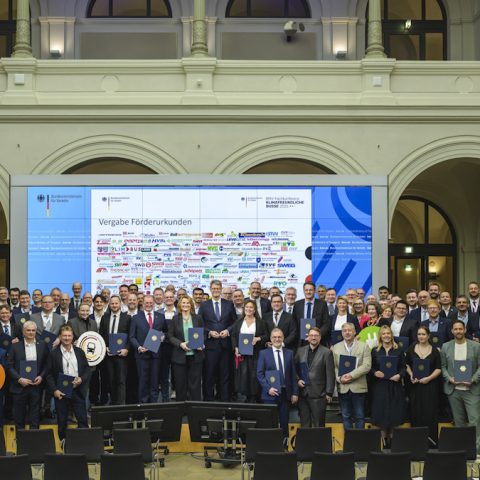
The funding certificates, that follows the funding round launched in mid 2025, were handed over by Federal Minister for Transport Patrick Schnieder at the “Klimafreundliche Busse” (BUSKON 2026) conference held in Berlin.
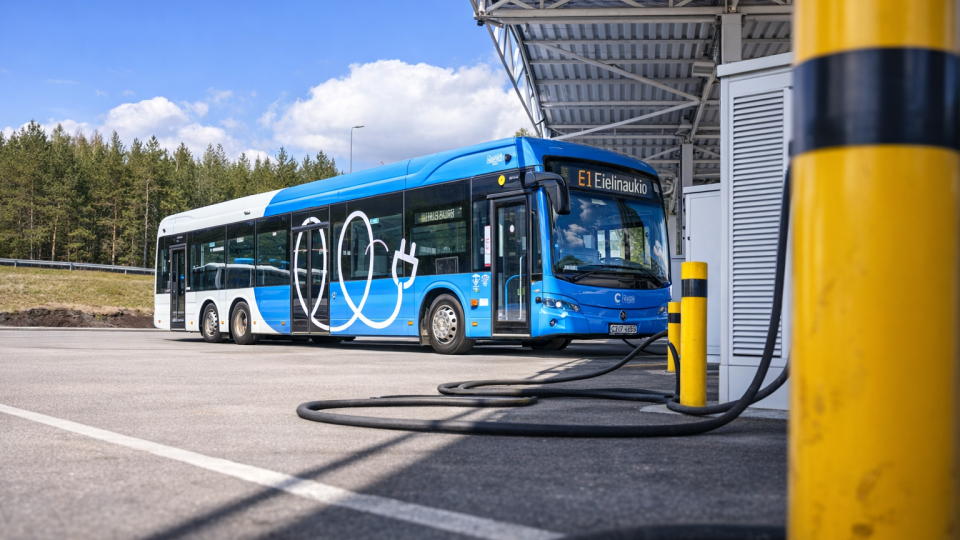
Under the current call of the Directive for the Promotion of Alternative Drives in Passenger Transport Buses, 151 transport companies across Germany will receive support for the acquisition of battery-electric buses.
Electric buses are a key component of climate-friendly local public transport. With our funding, transport companies are investing in clean, quiet and innovative technologies. More than 2,200 electric buses funded by us are already in use. This has already saved a total of more than 130,000 tonnes of CO₂ compared to diesel buses. Another 1,900 or so electric buses are now being added. This shows that the switch is working – and bringing benefits for passengers and residents as well as for the climate and the environment. We have been supporting this transformation with a total of around £1.5 billion since 2021
German Federal Minister for Transport Patrick Schnieder.
€417 million for 1,887 electric buses
The newly funded vehicles add to an existing fleet of more than 2,200 electric buses already supported by the ministry and currently in operation. According to BMV data, these vehicles contribute to savings of more than 130,000 tonnes of CO₂ compared to diesel buses.
Since 2021, the Federal Ministry for Transport has allocated around €1.5 billion to support the market ramp-up of climate-friendly buses through the funding directive.
However, in early 2024, the funding program was halted, with concerns arising on the development of the zero emission bus market in the country. According to the VDV, halting federal subsidies “put conversion of 10,000 buses to zero emission at risk”.
Across six funding calls, 334 different companies have been supported in 400 projects. The measures include vehicle procurement, charging and refuelling infrastructure, maintenance facilities and feasibility studies.
In total, approximately 5,300 vehicles have been supported, including associated charging, refuelling and maintenance infrastructure, as well as nearly 100 feasibility studies.
Eligible technologies under the scheme include battery-electric buses and fuel cell buses. In earlier funding phases, vehicles powered by biomethane were also eligible. Funding also covers the necessary charging and refuelling infrastructure as well as feasibility studies linked to fleet transition projects. Parts of the program are co-financed through the German Recovery and Resilience Plan (DARP) under the European Recovery and Resilience Facility.
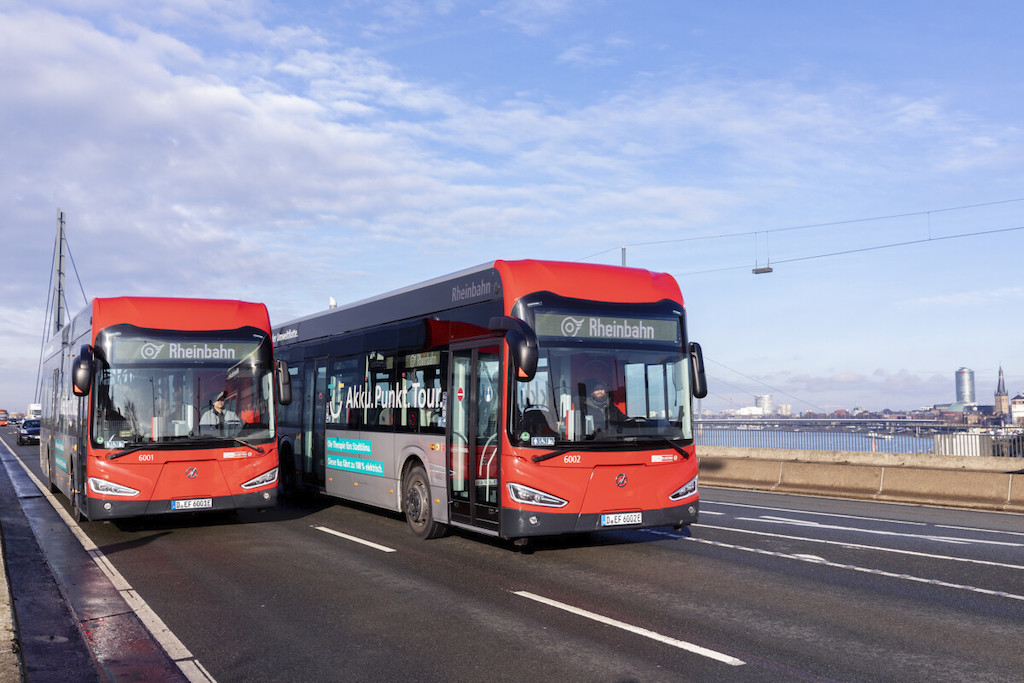
According to the official list of beneficiaries published by the Federal Ministry for Transport, several operators received funding amounts close to the maximum cap of €15 million per applicant. Rheinbahn AG was allocated €14.99 million for 75 buses (without infrastructure), representing the highest number of vehicles among the largest individual grants. Autokraft GmbH was granted €14.83 million for 63 buses, DB Regio Bus Mitte GmbH €14.38 million for 65 vehicles, and Duisburger Verkehrsgesellschaft €14.85 million for 55 buses. LOOK Busreisen GmbH reached the full €15 million ceiling, supporting the procurement of 68 buses.
Across all funding calls under the directive, the three largest beneficiaries in terms of number of supported vehicles are BVG Berlin (320 e-buses), Hamburger Hochbahn (286 buses) and Verkehrsbetriebe Hamburg-Holstein (181 buses). Beyond these top recipients, the programme has also allocated funding to a wide range of regional and private operators.
New funding directive planned for 2026
During the BUSKON 2026 conference, as mentioned, Minister Schnieder also announced plans for a new funding directive to be published in spring 2026, accompanied by a further call for applications. Up to €500 million is earmarked for 2026 under the upcoming scheme.
As reported on trade media electrive, Oliver Braune, Programme Coordinator for Electromobility and Buses at the Federal Ministry of Transport, noted that the number of electric bus manufacturers active in Germany has increased from seven or eight to 14 or 15 over the past five years, while available models have expanded to between 20 and 30. Battery capacity has risen by 60 per cent since 2020, daily mileage has increased from 133 to 182 kilometres, and vehicle efficiency has improved by up to 9.5 per cent. It’s estimated that around 5,700 battery-electric buses are currently in operation nationwide, with about 40 per cent linked to the funding guideline.
“Electric buses are a key component of climate-friendly local public transport. With our funding, transport companies are investing in clean, quiet and innovative technologies. More than 2,200 electric buses funded by us are already in use. This has already saved a total of more than 130,000 tonnes of CO₂ compared to diesel buses. Another 1,900 or so electric buses are now being added. This shows that the switch is working – and bringing benefits for passengers and residents as well as for the climate and the environment. We have been supporting this transformation with a total of around £1.5 billion since 2021″, said Federal Minister for Transport Patrick Schnieder.