RWTH Aachen completes first prototype tests of upBUS hybrid bus – cable car system
RWTH Aachen University announces it has successfully completed the first prototype testing phase of the upBUS concept, a vehicle designed to operate both as an electric road bus and as an urban cable car cabin. The milestone was reached within the upBUS research project, which is developing a multimodal public transport system enabling a seamless […]
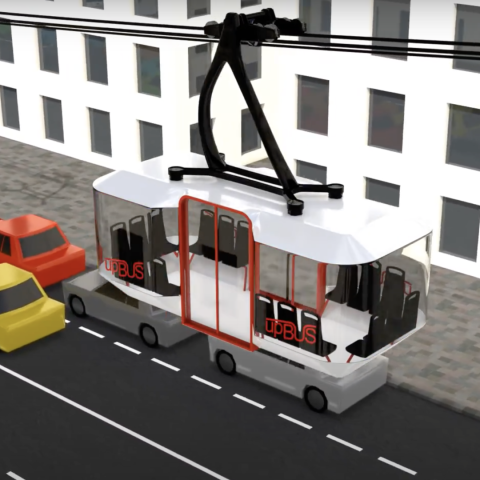
RWTH Aachen University announces it has successfully completed the first prototype testing phase of the upBUS concept, a vehicle designed to operate both as an electric road bus and as an urban cable car cabin.
The milestone was reached within the upBUS research project, which is developing a multimodal public transport system enabling a seamless transition between autonomous electric minibuses and cable car infrastructure. The project is carried out by RWTH Aachen University and funded by the German Federal Ministry of Research, Technology and Space, according to a press release issued by RWTH Aachen. It entered the testing phase in mid-2025.
The upBUS system is being developed by the Institute of Structural Mechanics and Lightweight Design (SLA), the Chair of High Frequency Electronics (HFE), and the Chair of Production Engineering of E-Mobility Components (PEM). It is based on a detachable passenger compartment that can automatically couple either to a road vehicle chassis or to a cable car suspension. The overall concept and its intended role in urban transport have been previously outlined in the upBUS project article published by Sustainable Bus.
Prototype coupling tested on reduced cable car setup
The first test phase focused on the automatic coupling process that allows the passenger compartment to switch between road mode and cable car mode within a few seconds. To carry out the tests, the RWTH Aachen team built a reduced cable car model with a guided sled over a length of 20 metres. Within this setup, the prototype demonstrated the transition from road vehicle operation to cable car suspension and back while in motion.
According to RWTH Aachen, the test campaign provided empirical data on the mechanical and control-related aspects of the coupling procedure, obtained through experiments with a physical system rather than simulations.
Next steps include field trials in 2026
Based on the results of the initial tests, further development of the individual subsystems is ongoing across the participating institutes. RWTH Aachen states that field trials are planned for summer 2026, with the objective of demonstrating reproducible and safe coupling under real-world driving conditions. A potential pilot route is being considered in the municipality of Simmerath near Aachen, where a first feasibility study has already assessed technical, spatial and environmental aspects.
“A key finding from this first phase is that the mechanisms and methods of the start-up ecosystem can be transferred very well to technology development in a research context,” says SLA head and “upBUS” director Professor Kai-Uwe Schröder: “By developing a ‘minimum viable product,’ we encountered significant challenges at an early stage that could not have been foreseen during project planning.”
“In this project, we are combining the robustness and elegance of cable cars with the intelligence and comfort of autonomous driving,” stated Professor Renato Negra, head of the Chair of High Frequency Electronics at RWTH Aachen University.