TSA takes its HD motor platform global with HD.T3+, to be presented at InnoTrans 2026
Traktionssysteme Austria (TSA) has extended its HD permanent-magnet motor platform with the HD.T3+, a 465 kW continuous-output unit developed for intercity coaches and heavy-duty transit bus applications. The new motor builds on the architecture of TSA's existing HD.T3, which is used for electric city buses, while increasing continuous torque from 1,519 to 2,500 Nm and continuous power from 360 to 465 kW. Peak figures for the HD.T3+ are 550 kW and 5,000 Nm.
Sponsored by Traktionssysteme Austria (TSA)
Traktionssysteme Austria (TSA) has extended its HD permanent-magnet motor platform with the HD.T3+, a 465 kW continuous-output unit developed for intercity coaches and heavy-duty transit bus applications.
The new motor builds on the architecture of TSA’s existing HD.T3, which is used for electric city buses, while increasing continuous torque from 1,519 to 2,500 Nm and continuous power from 360 to 465 kW. Peak figures for the HD.T3+ are 550 kW and 5,000 Nm.
The Austrian traction motor manufacturer developed the HD.T3+ for applications characterised by lower axle ratios, higher vehicle weights and sustained operation at higher speeds. TSA identifies European intercity and coach applications and North American transit buses among the target vehicle segments.
The company will present the HD.T3+ at InnoTrans 2026 in Berlin running from 22 to 25 September (Hall 18, Stand 300).
Having two motors on one shared platform (the HD.T3 and the HD.T3+) means our customers benefit from proven serial-production technology, regardless of which application they are targeting. It is the perfect example of how one mature, field-tested platform can be precisely optimized for a completely different application profile – without compromising on quality or reliability
Marius Kohnle, Head of TSA’s ROAD division
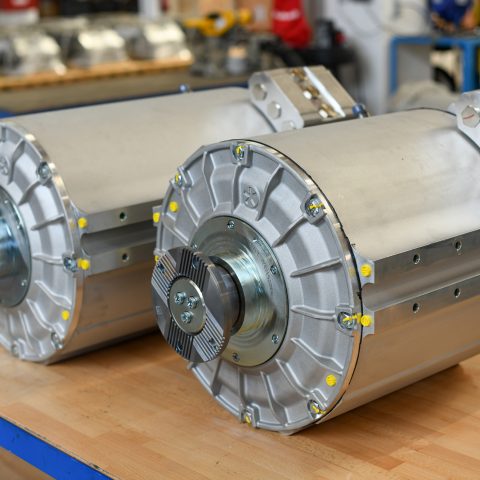
TSA HD.T3+ delivers 465 kW continuous power and 5,000 Nm peak torque
The HD.T3 and HD.T3+ are permanent magnet synchronous motors based on a common Heavy Duty platform, but TSA specifies the two variants for different operating profiles. They “are not simply two sizes of the same motor – they are optimized for two distinct application profiles”, the supplier states.
The HD.T3 was originally developed as a central drive for 12-, 15- and 18-metre electric city buses. According to TSA, the motor is currently used on seven vehicle platforms from more than four OEM customers.
For the HD.T3+, TSA has increased the active section by 50% and introduced a modified winding design and a higher proportion of permanent magnets. The resulting continuous output is 465 kW, compared with 360 kW for the HD.T3, while continuous torque increases from 1,519 to 2,500 Nm.
The HD.T3+ reaches 550 kW of peak power and 5,000 Nm of peak torque. The latter is 65% higher than the peak torque specified for the HD.T3. TSA also reports efficiency above 97% for the HD.T3+.
HD.T3 and HD.T3+ share TSA’s modular motor architecture
A central element of the HD.T3+ development is the retention of components and interfaces from the existing HD platform. TSA says the housing, bearings, sensor systems and interfaces are common across the variants, while the electromagnetic and mechanical configuration can be adapted according to the application.
The future of bus electrification is not about developing a new motor for every application. It is about creating scalable platforms that can adapt quickly to changing market requirements. The HD.T3 and HD.T3+ demonstrate exactly this philosophy: one platform, multiple applications, and maximum flexibility for our customers
Marius Kohnle, Head of TSA’s ROAD division
Different winding configurations, active-section lengths and connection variants are available within the architecture. TSA specifies the platform for commercial vehicles ranging from 18 tonnes to more than 30 tonnes.
According to the company, the shared-component approach is intended to maintain common integration interfaces and production processes across different vehicle programmes.
The HD.T3+ differs from the HD.T3 primarily in applications where lower axle ratios require higher torque directly from the traction motor. TSA identifies this operating profile in European coaches and intercity buses as well as 12- and 18-metre North American transit buses.
TSA targets European intercity and North American transit bus applications
For the North American market, TSA says the HD.T3+ can be supplied in configurations manufactured in Europe or in the United States, depending on the requirements of individual projects. The US-manufactured option can in fact address Buy America requirements for publicly funded transport projects.
The HD.T3+, meanwhile, expands a road-vehicle product portfolio that TSA has developed alongside its activities in rail traction. Traktionssysteme Austria employs more than 400 people in Austria and operates through group companies and partnerships in the United States, Bosnia and Herzegovina, China and India.
In brief
- What is the continuous output of the TSA HD.T3+?
TSA specifies more than 465 kW of continuous power, compared with 360 kW for the HD.T3. - How much torque does the HD.T3+ deliver?
The motor provides 2,500 Nm continuously and up to 5,000 Nm at peak, according to TSA. - Which buses is the HD.T3+ designed for?
TSA targets intercity and coach applications in Europe and heavy-duty transit buses in North America. - What efficiency does TSA claim for the HD.T3+?
The manufacturer reports efficiency above 97%.
An heritage dating back to 1960
TSA’s motor architecture builds on a heritage dating back to 1960 in electromechanical drive development. The lineup expanded from rail traction into road electromobility with the flagship HD.T3 central drive for European electric city buses. Today, that proven design has evolved into a modular, high-torque Heavy Duty platform powering diverse commercial vehicle segments worldwide.
Marius Kohnle, Head of TSA’s ROAD division, said: “The HD.T3 demonstrates the full potential of a well-designed modular platform. It allows us to adapt quickly to different vehicle concepts without developing a completely new drivetrain for every application. Having two motors on one shared platform (the HD.T3 and the HD.T3+) means our customers benefit from proven serial-production technology, regardless of which application they are targeting,” Kohnle said. “It is the perfect example of how one mature, field-tested platform can be precisely optimized for a completely different application profile – without compromising on quality or reliability.”
“Despite significantly higher continuous output and torque compared to the HD.T3, the HD.T3+ achieves efficiency levels above 97 percent,” Kohnle added. “That means more performance per kilowatt-hour – a decisive advantage on long Intercity routes and in high-speed, high-load duty cycles where energy costs directly affect operating economics.”
“The future of bus electrification is not about developing a new motor for every application,” Kohnle concluded. “It is about creating scalable platforms that can adapt quickly to changing market requirements. The HD.T3 and HD.T3+ demonstrate exactly this philosophy – one platform, multiple applications, and maximum flexibility for our customers.”