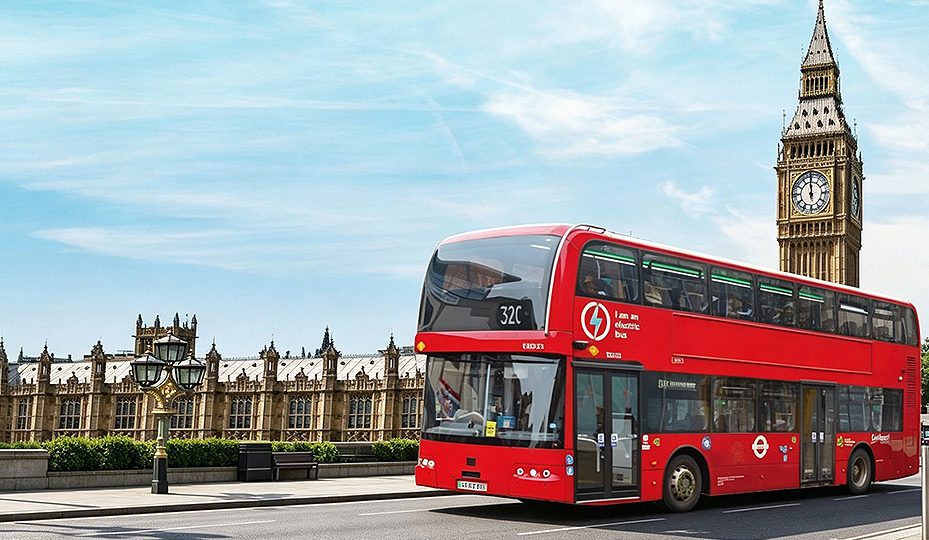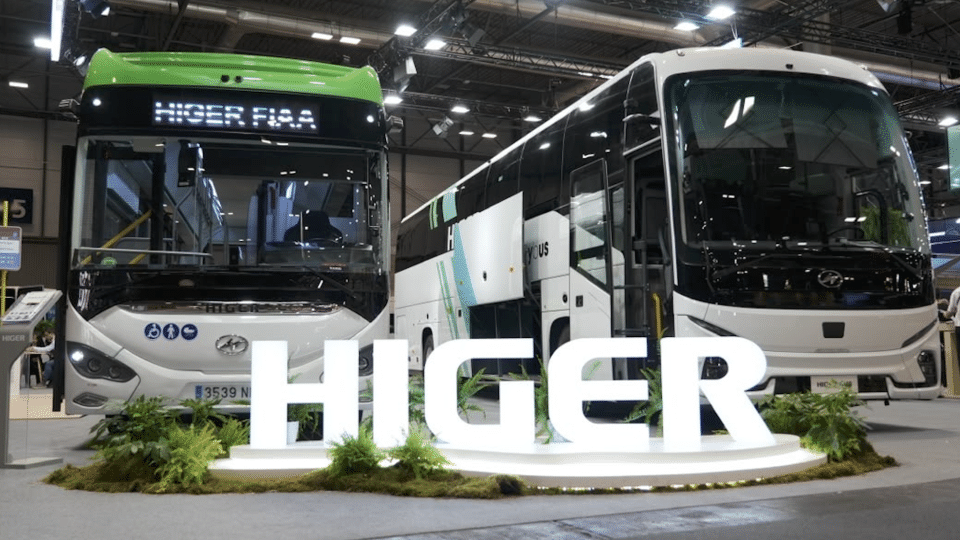
ACEA urges EU action on bus manufacturing as Chinese brands take 32% of electric city bus market and EU trade deficit reaches €2.9 billion
European manufacturers’ association ACEA is calling for urgent EU action on bus manufacturing and public procurement, as Chinese brands reached 32% of the European electric city bus market in 2025 and the EU bus trade deficit increased to €2.9 billion. In a position paper published on 21 October 2026, titled “Bus manufacturing in Europe – […]
European manufacturers’ association ACEA is calling for urgent EU action on bus manufacturing and public procurement, as Chinese brands reached 32% of the European electric city bus market in 2025 and the EU bus trade deficit increased to €2.9 billion.
In a position paper published on 21 October 2026, titled “Bus manufacturing in Europe – Urgent action needed”, the European Automobile Manufacturers’ Association (ACEA) sets out proposals covering public procurement, European industrial value creation, production planning, cybersecurity and international competitiveness. The association calls for changes to the Industrial Accelerator Act and EU procurement rules, with measures to be introduced ahead of major fleet renewal contracts expected before 2030.
According to ACEA, new EU bus registrations increased by 22.7% in the first half of 2026, reaching 22,590 units, while approximately 60% of newly registered city buses are now battery-electric. The association highlights the role of public procurement and public funding in this transition, alongside the Clean Vehicles Directive and European CO2 standards.
The ACEA position paper comes amid growing calls for European preference criteria in public bus procurement. In June 2026, Beulas, HESS, Solaris Bus & Coach and VDL Bus Group urged EU institutions to introduce “Made in Europe” requirements, covering industrial activities beyond final vehicle assembly. At the same time, UITP expressed support for the principle of European preference, while calling for a gradual and targeted approach that would take into account production capacity, procurement costs, competition and public transport decarbonisation targets. The debate also extends to the European Commission’s initiative to revise public procurement legislation, including the question of European preference.
According to the association, European manufacturers have invested in additional capacity, converted production plants, diversified suppliers and expanded workforce training.
European Automobile Manufacturers’ Association (ACEA) position paper “Bus manufacturing in Europe – Urgent action needed”
However, ACEA notes that manufacturers cannot commit production capacity or order long-lead components against tenders they have not yet won. The association also identifies small customised production batches and dependence on external battery and component suppliers as continuing constraints. Its proposals include longer tender-to-delivery periods, framework contracts with committed volumes, aggregated orders, standardised technical specifications and stable long-term funding programmes.
Most of the approximately 680,000 buses operating in the EU provide services commissioned by public authorities through competitive tenders or public service contracts. In the city bus segment, demand depends entirely on public procurement and funding. Private operators providing publicly contracted services are generally subject to the same procurement requirements.
Europe’s bus manufacturing base comprises more than 38 assembly plants across 12 EU Member States, with production activities in Poland, France, Germany, Italy, Spain, Czechia, the Netherlands, Belgium, Portugal, Hungary, Lithuania and Romania. EU bus production increased by 8.9% in 2025. The industrial value chain also includes chassis manufacturing, components, engineering, research and development, software and electrification technologies.
Chinese manufacturers hold 32% of EU electric city bus market
ACEA reports that Chinese brands accounted for approximately 9% of the overall EU bus market in 2025 and 28% of the electric bus segment. In city buses, their market shares reached 20% overall and 32% among electric vehicles. By comparison, Chinese-made passenger cars represented 7% of EU passenger car sales during the same period.
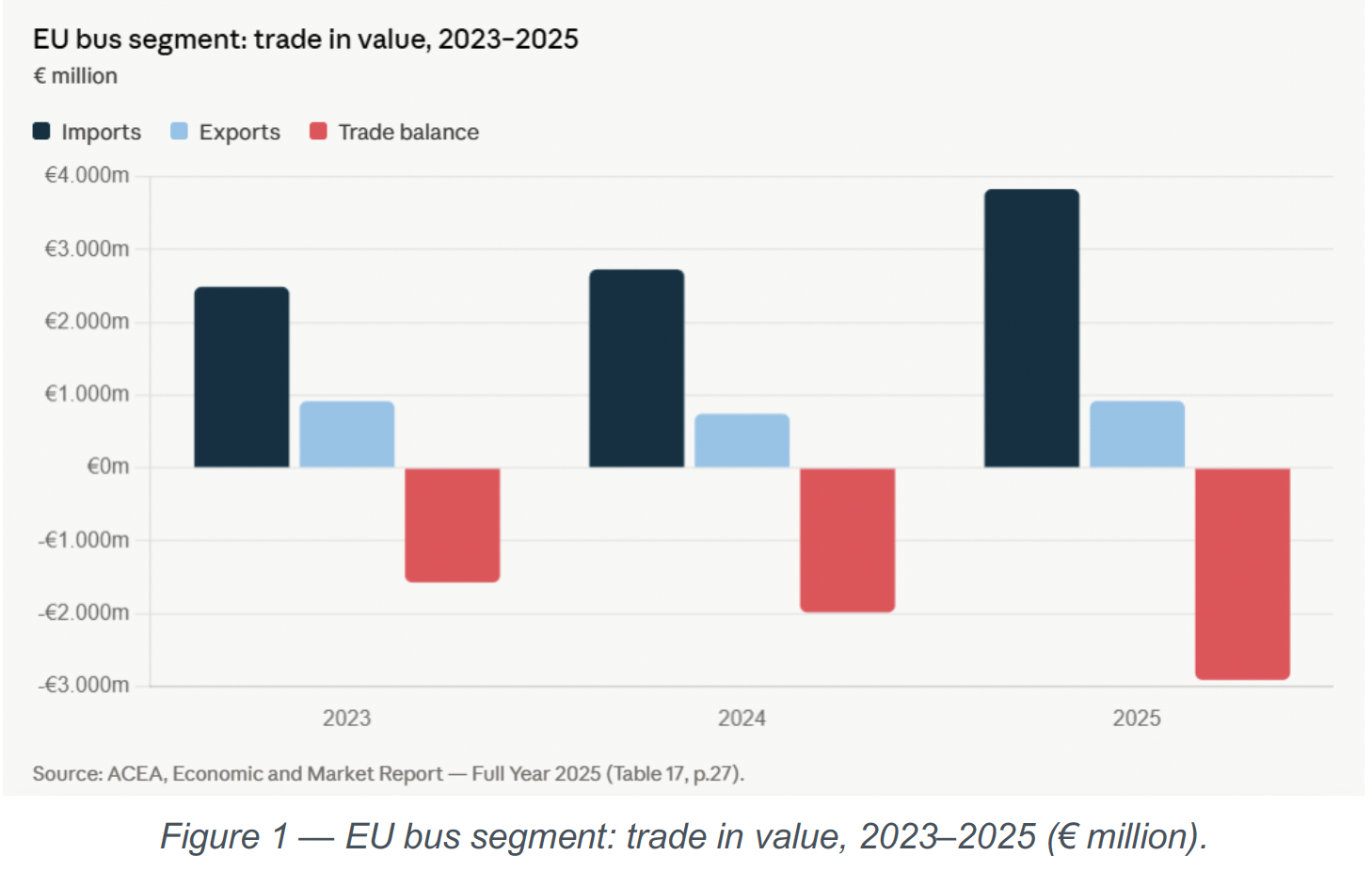
The association also reports a widening EU bus trade deficit, from €1.6 billion in 2023 to €2.9 billion in 2025. The deficit increased by 46.8% in 2025 alone, while bus imports from China exceeded €1 billion for the first time, growing by almost 70% year on year.
The expansion of electric bus registrations continued in early 2026. Electrically chargeable buses represented 21.8% of total EU bus registrations in the first quarter, compared with 20% one year earlier. Registrations in this category increased by 36%, including a 161.2% rise in Italy (according to ICCT, the share is 24%).
According to ACEA, European manufacturers compete with Chinese producers operating under different industrial and cost conditions. The position paper identifies vertical integration, large domestic production volumes, state support, lower engineering costs and integrated battery and electric powertrain supply chains among the factors affecting manufacturing costs.
The association states that the construction of an equivalent factory in China can cost up to 60% less than in Europe. It also identifies differences in access to battery cells, engineering resources and production volumes.
ACEA calls for European industrial value creation to be assessed across the complete vehicle value chain rather than solely through the location of final assembly. The association proposes including research and development, engineering, software, battery pack integration and other manufacturing activities in the calculation of European value added.
ACEA calls for public procurement reform
Public procurement is a central element of ACEA’s proposals. The association notes that existing EU procurement rules already allow contracting authorities to consider criteria beyond vehicle purchase price, but argues that these provisions are not consistently or effectively applied.
According to the position paper, price remains decisive in many bus procurement procedures, while the contribution of manufacturing, engineering, research and development, innovation and long-term services is not sufficiently reflected in tender evaluations.
ACEA proposes making non-price award criteria mandatory in publicly funded bus tenders, with uniform application across Member States and guidance from the European Commission. The association refers to the public procurement rules revision draft published on 9 September 2026, including provisions covering strategic objectives, environmental requirements, circularity, social considerations and product labelling.
The proposed criteria would cover European value added, innovation, resilience, cybersecurity, maintenance, spare parts availability, software development and lifecycle services.
ACEA also requests changes to the Industrial Accelerator Act. In particular, the association calls for removing the Member State opt-out under Article 11(3), which would allow exceptions to the proposed Made in the EU provisions where procurement costs differ by more than 25%.
The position paper further proposes including OEM-generated value in the European content calculation, covering engineering, research and development, software and battery pack integration alongside final vehicle assembly.
On vehicle energy consumption, ACEA calls for VECTO to become the single reference methodology in public bus tenders, potentially through mandatory application. The association notes that some contracting authorities continue to request SORT data despite the VECTO framework established under Regulations (EU) 2017/2400 and (EU) 2024/1610.
Bus delivery times and production planning
The position paper also addresses delivery times and the conditions under which European manufacturers plan production capacity.
ACEA identifies several pressures affecting the industry between 2020 and 2026, including the COVID-19 pandemic, supply chain disruptions following Russia’s invasion of Ukraine, electronic component shortages, implementation of GSR II requirements and concentrated deliveries financed through NextGenerationEU.
According to the association, European manufacturers have invested in additional capacity, converted production plants, diversified suppliers and expanded workforce training.
However, ACEA notes that manufacturers cannot commit production capacity or order long-lead components against tenders they have not yet won. The association also identifies small customised production batches and dependence on external battery and component suppliers as continuing constraints.
Its proposals include longer tender-to-delivery periods, framework contracts with committed volumes, aggregated orders, standardised technical specifications and stable long-term funding programmes.
ACEA also addresses the possibility of an EU-wide platform for aggregating expected bus demand. While recognising the potential contribution of greater market transparency, the association states that non-binding forecasts alone would not provide sufficient certainty for manufacturers to commit additional production capacity.
Cybersecurity and international competitiveness included in position paper
ACEA also calls for a coordinated European approach to cybersecurity and supply chain resilience in connected public transport fleets.
The paper cites developments in Norway, where the share of newly registered buses originating from countries without security-policy cooperation increased from 0% in 2018 to 65% in 2025. Norwegian authorities are consulting on procurement guidance covering supplier diversification, security and supply chain resilience.
ACEA proposes using UN Regulation No. 155 as the primary framework for automotive cybersecurity and supply chain risk management. It also requests that the review of Regulation (EU) 2019/1242, due by 31 December 2027, examine the inclusion of digital and cybersecurity dependencies in security-of-supply criteria.
International competitiveness is another area covered by the position paper. ACEA identifies Latin America, Africa and Asia as markets where European bus manufacturers face competition from Chinese suppliers in electric bus procurement.
The association calls for European content, resilience and technical standards criteria to be incorporated into Global Gateway urban mobility projects. According to ACEA, the initiative had mobilised more than €306 billion by 2025, against a target of €300 billion for 2021–2027.
The document also proposes integrated export financing packages covering vehicles, charging infrastructure, maintenance and financing, alongside closer coordination with European public transport operators managing concessions outside the EU.
ACEA identifies the next 24 months as critical
The timing of regulatory and procurement measures is a central element of ACEA’s position paper.
The association states that procurement decisions taken before 2030 will determine a substantial part of the European public transport supplier landscape for the following decade, including vehicle production, maintenance contracts, spare parts, software services and engineering activities.
ACEA calls for the relevant industrial and procurement provisions to be implemented before 2030, rather than applying only after further rounds of publicly funded fleet renewal have been awarded.
In brief
- What is ACEA requesting for European bus manufacturing? Changes to EU procurement rules, European value-added criteria, predictable tender volumes and industrial measures before 2030.
- What share of the EU electric city bus market did Chinese brands hold in 2025? According to ACEA, Chinese brands held 32% of electric city buses and 28% of the overall electric bus segment.
- What is ACEA proposing for public bus procurement? Mandatory non-price criteria covering European value creation, innovation, resilience, cybersecurity and lifecycle services.
- How large was the EU bus trade deficit in 2025? ACEA reports a deficit of €2.9 billion, compared with €1.6 billion in 2023.
In its concluding section, ACEA states: “Orders placed between now and 2030 will shape the supplier structure of European public transport for the following decade, together with the revenue from services, spare parts and software and the engineering capabilities behind them. Measures that apply only from 2030 risk arriving after those choices have been made. European bus manufacturers are not asking to be shielded from competition. They are asking that public money, spent under public rules to achieve public objectives, is awarded on criteria that reflect the full economic, industrial and strategic value it creates in Europe.”