Alexander Dennis studies 18-metre Enviro Max tram-style electric bus with Volvo for UK BRT market
Alexander Dennis and Volvo Buses have announced a feasibility study for the development of an 18-metre tram-style electric articulated bus for the UK market, combining Volvo’s BZL Electric chassis with a new Alexander Dennis body design named Enviro Max. The initiative, announced on 22 October 2026, targets high-capacity, zero-tailpipe-emission bus rapid transit (BRT) applications. According […]
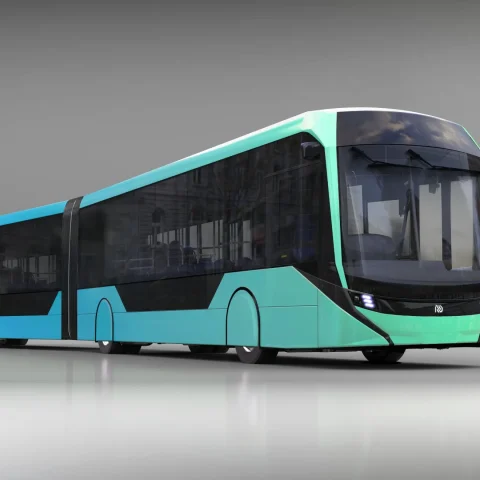
Alexander Dennis and Volvo Buses have announced a feasibility study for the development of an 18-metre tram-style electric articulated bus for the UK market, combining Volvo’s BZL Electric chassis with a new Alexander Dennis body design named Enviro Max.
The initiative, announced on 22 October 2026, targets high-capacity, zero-tailpipe-emission bus rapid transit (BRT) applications. According to Alexander Dennis, a subsidiary of NFI Group, the project will assess potential demand among UK local authorities and transport operators for an articulated electric vehicle designed to operate on existing road infrastructure, without requiring rails, track beds or overhead electrical lines.
Our new Enviro Max would offer combined and local authorities a stunning zero-tailpipe-emission rapid transit solution that supports British manufacturing and benefits the wider economy by keeping investment in the country. We believe there is a role for bus rapid transit schemes alongside our conventional Enviro-family single and double-deck buses, and we look forward to engaging with customers and stakeholders to understand their requirements
Paul Davies, President & Managing Director, Alexander Dennis
Volvo Buses has made its BZL Electric articulated chassis available to Alexander Dennis for the feasibility study. The proposed vehicle would combine Volvo’s electric driveline and chassis technology with Alexander Dennis’ body engineering and UK manufacturing capabilities. The two manufacturers have previously collaborated on the Enviro400XLB high-capacity double-decker, developed using the Volvo B8L chassis.
The Volvo BZL Electric chassis platform was originally launched in September 2021, targeting markets including the UK, Australia and Mexico, with single- and double-deck configurations and compatibility with CCS and OppCharge charging systems. More recently, in June 2026, Volvo Buses introduced the 18-metre BZL Electric Articulated in Australia, featuring a locally manufactured Volgren body.
Alexander Dennis Enviro Max: headed to BRT
The proposed Enviro Max will be based on the articulated version of the Volvo BZL Electric platform, which, as mentioned above, was introduced in Australia earlier in 2026. The chassis is an articulated development of Volvo’s existing BZL Electric rigid platform.
The configuration under evaluation supports a complete vehicle length of approximately 18 metres, with a permitted gross vehicle weight of 30,000 kg.
Within this project,Alexander Dennis will develop a new body design for the vehicle, extending the construction principles already adopted across its Enviro family to an articulated rapid transit application.
According to the manufacturer, the Enviro Max body will incorporate maintenance access arrangements and parts commonality with existing Enviro products. The vehicle’s interior configuration remains under evaluation, with Alexander Dennis and Volvo Buses planning to engage with operators, local authorities and other stakeholders to determine passenger layouts, accessibility provisions and compatibility with existing infrastructure.
The project also involves technical expertise from New Flyer, another NFI Group company, which has experience in the development and manufacturing of articulated buses.
Neither manufacturer has announced a production schedule, vehicle price, passenger capacity or confirmed customer orders for the proposed Enviro Max.
Volvo BZL Electric: up to 530 kWh and 450 kW pantograph charging
The Volvo BZL Electric articulated chassis is equipped with Volvo’s EPT802 dual-motor electric driveline, delivering a maximum combined output of 400 kW and 850 Nm of torque. Power is transmitted through a two-speed automated manual transmission.
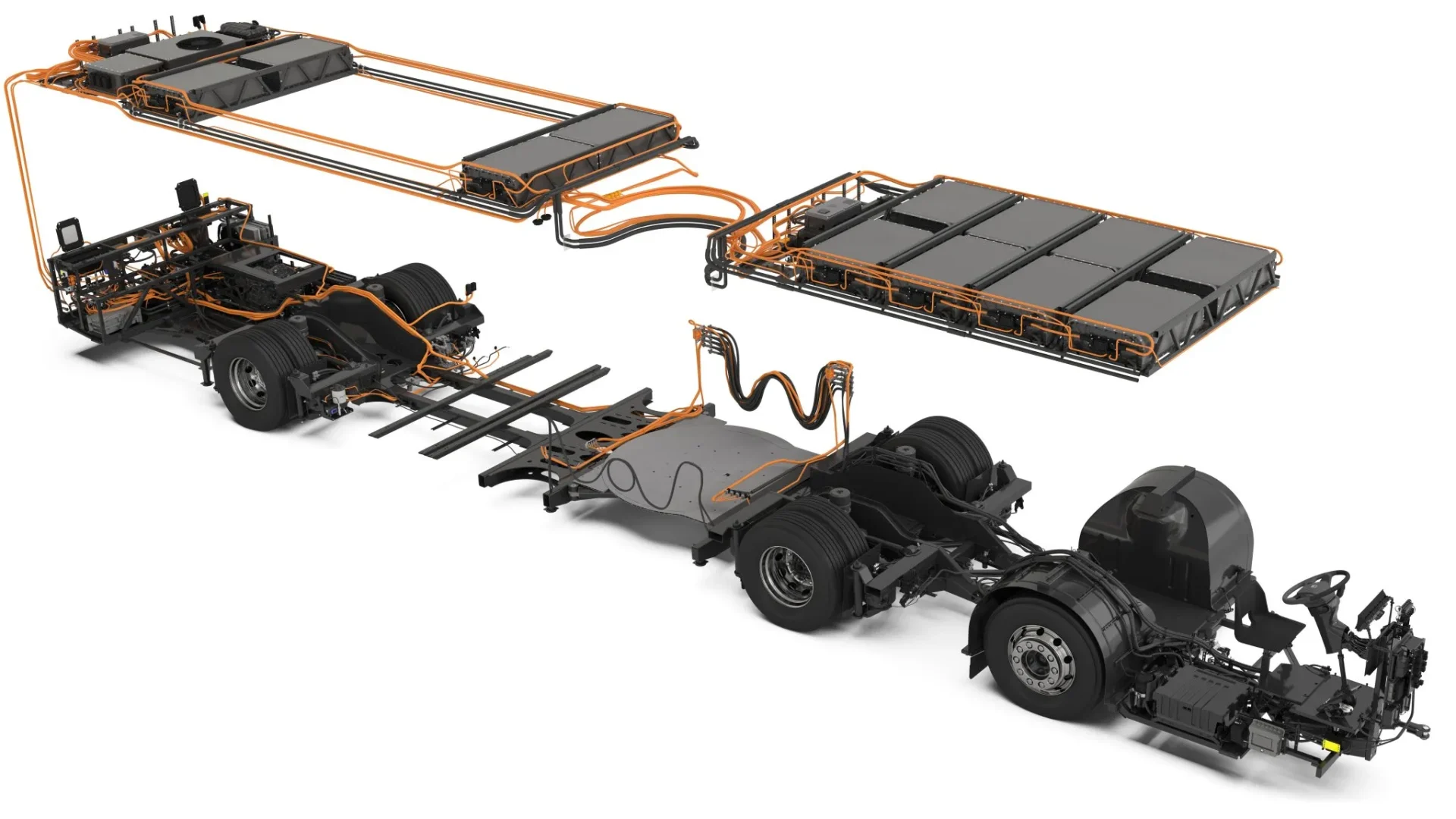
The platform can accommodate up to 12 lithium-iron-phosphate (LFP) battery packs, corresponding to a maximum installed energy capacity of 530 kWh.
Two charging interfaces are available. The chassis supports CCS2 plug-in charging at up to 250 kW and OppCharge pantograph charging at up to 450 kW.
These specifications refer to the Volvo articulated chassis made available for the study. Final battery configuration, vehicle weight, passenger accommodation and charging arrangements for a potential production version of the Enviro Max have not yet been announced.
The manufacturers identify urban and interurban high-capacity services as potential applications for the proposed vehicle, including bus rapid transit corridors.
In brief
- What is the Alexander Dennis Enviro Max? A proposed 18-metre tram-style electric articulated bus for UK rapid transit applications.
- Which electric chassis will it use? Volvo’s BZL Electric articulated chassis, with an EPT802 dual-motor driveline delivering up to 400 kW.
- What battery and charging capacities are available? Up to 530 kWh of installed battery capacity, with CCS2 charging at 250 kW or OppCharge at 450 kW.
- When will the Enviro Max enter production? No production timetable has been announced. The project is currently undergoing a feasibility study.
Alexander Dennis and Volvo Buses on the Enviro Max project
Paul Davies, President & Managing Director at Alexander Dennis, said: “This feasibility work gives us an opportunity to consider how our experience in designing and building buses could be combined with Volvo Buses’ electric chassis technology. As part of this, we will be able to draw on the extensive experience that our NFI Group sister company New Flyer has with articulated buses. Our new Enviro Max would offer combined and local authorities a stunning zero-tailpipe-emission rapid transit solution that supports British manufacturing and benefits the wider economy by keeping investment in the country. We believe there is a role for bus rapid transit schemes alongside our conventional Enviro-family single and double-deck buses, and we look forward to engaging with customers and stakeholders to understand their requirements.”
Richard Mann, Sales Director at Volvo Bus UK & Ireland, said: “We are seeing increasing interest from local authorities in tram-style electric bus systems that can deliver the visibility, capacity and passenger appeal associated with tram-style systems, while offering a more flexible and lower-infrastructure route to delivery. Following the successful introduction of the Volvo BZL Electric articulated chassis in Australia earlier this year, we are now exploring with Alexander Dennis how this proven electric platform could support a tram-inspired product tailored to the UK market.”