Volvo Group and Daimler Truck to jointly develop digitalised vehicle platform. Binding agreement signed
Volvo Group and Daimler Truck intend to create a joint venture to develop a common software-defined vehicle platform and dedicated truck operating system, “providing the basis for future software-defined commercial vehicles”, the OEMs state in a press note that follows the announcement made in May this year (see article from Sustainable Truck & Van below). […]
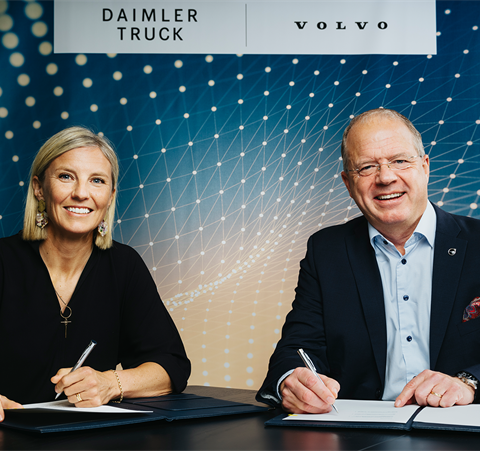
Volvo Group and Daimler Truck intend to create a joint venture to develop a common software-defined vehicle platform and dedicated truck operating system, “providing the basis for future software-defined commercial vehicles”, the OEMs state in a press note that follows the announcement made in May this year (see article from Sustainable Truck & Van below).
The transaction is expected to be completed in the first half of 2025.
The two giants, together with Traton, are also members of the Milence joint venture, announced in 2021 and aiming at installing at least 1,700 charge points all over Europe. Not to mention Cellcentric, the fuel cell joint venture Cellcentric, first announced in april 2020, with goal of accelerating the use of hydrogen-based fuel cells for long-haul trucks and beyond (also long distance coaches will be part of this development. Developing of fuel cell coaches is the intent of recently launched CoacHyfied project).
Volvo Group – Daimler Truck together for software-defined vehicle platform
The two commercial vehicle industry players have now signed a binding agreement to establish the joint venture and are working towards setting up the company that will be headquartered in Gothenburg, Sweden.
The software-defined vehicle platform is set to “enable Volvo Group and Daimler Truck and potential other future customers of the joint venture to provide stand-alone digital vehicle functions for their products”.
The joint venture’s activities, in the words of the JV, “will include the specification and procurement of centralized high-performance control units dedicated for commercial vehicles and capable of handling large amounts of data. The new company will develop an operating system and tools which vehicle manufacturers can use as a basis to develop their own differentiating digital vehicle features. This will decouple software and hardware development cycles in the future and enable customers to purchase and update digital applications wirelessly ‘over the air’, ultimately enhancing customer efficiency and experience”.
In any case, the companies strengthen that Volvo Group and Daimler Truck will remain competitors and continue to differentiate their complete product and services offerings, including their respective digital solutions.
“The signing demonstrates our joint commitment to lead the digital transformation of our industry. The software and hardware from this joint venture will be crucial for achieving unprecedented levels of safety, comfort, and efficiency for our customers,” says Karin Rådström, CEO of Daimler Truck.
Martin Lundstedt, President and CEO of the Volvo Group, adds: “We are joining forces to redefine software architecture and pioneer a new era of self-optimizing trucks. Together we are removing complexity to allow our customers to unlock higher levels of connectivity, safety and efficiency and continually push for a greater performance. It is a revolutionary response to the challenges of our modern world, and we are proud to be setting the industry standard.”