From e-buses to autonomous mobility: Martin Schmitz outlines Mobility Move 2027
Autonomous driving will gain further space at Mobility Move 2027, while electric mobility will remain one of the main pillars of the Berlin event, scheduled for 16-18 March. Following a 2026 edition that attracted more than 1,600 participants and 110 exhibitors, preparations are already under way for next year’s Mobility Move. The programme will introduce new focuses on robotics, passenger information and processes for bringing innovations into operation, alongside an expanded autonomous driving forum and a new area dedicated to start-ups. We spoke with Martin Schmitz, CTO of the Association of German Transport Companies (VDV), about what to expect from Mobility Move 2027

Sponsored by Mobility Move
Autonomous driving will gain further space at Mobility Move 2027, while electric mobility will remain one of the main pillars of the Berlin event, scheduled for 16-18 March.
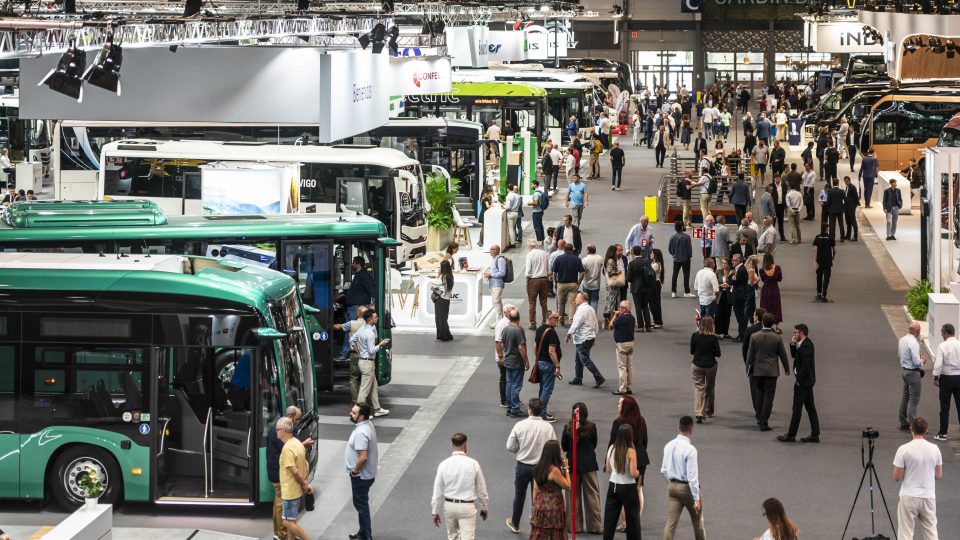
Following a 2026 edition that attracted more than 1,600 participants and 110 exhibitors, preparations are already under way for next year’s Mobility Move. The programme will introduce new focuses on robotics, passenger information and processes for bringing innovations into operation, alongside an expanded autonomous driving forum and a new area dedicated to start-ups.
We spoke with Martin Schmitz, CTO of the Association of German Transport Companies (VDV), about what to expect from Mobility Move 2027, the progress of autonomous public transport projects, the role of AI and common digital standards, and the investment requirements facing operators as fleet electrification and automation develop in parallel.
Schmitz also addresses the event’s expected growth and international participation, as well as Mobility Move’s positioning as a specialist conference and networking platform rather than a conventional bus trade show.
Startups and robotics will take a place at Mobility Move 2027
Preparations for Mobility Move 2027 are already under way. What can you reveal about what will be new next year?
In 2027, participants can once again look forward to a high-quality conference programme featuring a wealth of professional expertise, as well as a broad range of exhibitors at the trade show. One new feature will be a start-up area, giving emerging market players the opportunity to showcase their innovative developments. We will also introduce additional thematic focuses, including robotics, the transformation of processes for introducing innovations, and a stronger focus on passenger information.
The 2026 edition attracted more than 1,600 participants and 110 exhibitors. Do you expect further growth in 2027, and in what areas?
The registration figures so far give us every reason to be very positive. By August, we had already registered as many exhibitors as we had by December last year. We therefore expect a slight increase in both exhibitors and visitor numbers in 2027.
For us, however, the key is to maintain the same high quality and special event atmosphere despite this growth. Mobility Move sees itself as a networking platform where everyone is welcome. At the same time, we offer knowledge transfer for both newcomers and more experienced professionals in the fields of e-mobility, autonomous driving and digitalisation.
E-mobility to remain a key pillar for Mobility Move 2027
Mobility Move began as an electric bus conference, anticipating a transition that has since entered the mainstream. Is autonomous driving now emerging as the event’s next major innovation focus?
The autonomous driving forum attracted a great deal of interest in 2026. We will therefore further expand this thematic focus at Mobility Move 2027.
At the same time, e-mobility remains an important pillar of the event, as there are still many public transport operators that need to invest in this area. In addition, the integration of different systems and new software solutions offer operators further potential to make their processes more efficient.
What progress in autonomous public transport will be showcased in 2027? The shift from pilot projects to larger-scale deployment of autonomous public transport has been anticipated for years. Do you now see concrete signs that it is becoming a reality, and how will Mobility Move 2027 reflect this development?
Autonomous transport systems are an important building block for making mobility services more efficient, flexible and cost-effective in the future. However, it will still take some time before such projects can be scaled up more broadly. The industry is still working on its concepts, and there is still a great deal of groundwork to be done and experience to be shared.
We expect new insights from German projects such as KIRA+, MILA and Ahoi, as well as from international projects. These experiences and developments will therefore also play a role at Mobility Move 2027.
Autonomous mobility also relies on AI, connectivity and data management. How will these technologies feature in the 2027 programme?
In our AI forum, we address topics related to digital connectivity. At the same time, we at the VDV are developing a standardised backend system to ensure that we are well prepared for the new challenges ahead. The MILA project, for example, involving almost 35 participating companies, develops and tests an open, manufacturer-independent digital platform for autonomous vehicles in public transport. It connects vehicles from different manufacturers with control centers, dispatching and booking systems, as well as infrastructure data, enabling autonomous fixed-route and on-demand services to transition more easily and seamlessly into regular operation in the future.
The quest for funding and the challenges of technology
Operators still need to finance the electrification of fleets and infrastructure while preparing for automation. How will Mobility Move address these two investment challenges?
The VDV advocates for appropriate financial and regulatory support at both German and European policy levels. In 2026, the German federal government launched its fifth funding call to support e-mobility. In addition, a funding programme for the procurement of individual autonomous vehicles is also in place.
However, significantly more investment funding is needed to implement both innovations. By showcasing the combined expertise represented both in the exhibition and in the conference programme, we want to demonstrate to policymakers that these funds are well invested in our industry.
Is Mobility Move becoming more international? Do you expect more operators, manufacturers and technology providers from outside Germany (and DACH countries) in 2027?
Once again, numerous international exhibitors will be represented at the trade show in 2027, including manufacturers from the Far East. Our main focus is on Central Europe, as the framework conditions within this region are comparable. Nevertheless, we regularly welcome participants from around 20 countries.
Mobility Move is often described as a “family gathering” for the public transport sector. How will you preserve that character as the event grows?
Mobility Move has grown at a healthy pace over the past few years. The thematic organisation of the exhibitors also means that participants naturally group together according to their areas of interest. This means that while there are more people at the event overall, we can also prevent individuals from feeling lost as the event grows.
In addition, many colleagues work professionally across several different areas and bring varying levels of experience and knowledge. It is therefore helpful to have more participants with different areas of expertise coming together and exchanging ideas.
From an organisational perspective, we have also been able to grow alongside the event. The core of our organising team has remained almost unchanged for many years, with some colleagues having been involved since the very beginning in 2008. The people who prepare Mobility Move throughout the year and stay in contact with exhibitors are also their points of contact on site and maintain that personal exchange. This plays a major role in preserving the event’s family atmosphere.
What will operators find at Mobility Move 2027 that they would not find at a conventional bus trade show?
We do not see ourselves as a conventional trade show, but rather as a specialist conference. This allows us to provide particularly intensive knowledge transfer and directly combine professional insights with personal exchange.
There are also networking opportunities during the breaks and at our two evening events in the exhibition area. This combination of knowledge transfer and networking is what makes Mobility Move special.
What is the strongest reason for industry players and operators to come to Berlin from 16 to 18 March 2027?
Mobility Move is the focal point for the road-based mobility of tomorrow. It brings together public transport operators, industry, policymakers, public transport authorities and service providers. For anyone active in public transport who wants to help shape the developments within the sector, Mobility Move is the central meeting place.
We specifically target industry professionals and decision-makers. In this way, we create direct networking opportunities between those responsible for procurement on the one hand and industry representatives on the other.