Alexander Dennis raises warrantable energy throughput up to 1.6GWh on its in-house built e-bus range
Alexander Dennis announces increase of warrantable energy throughput of its next-generation electric buses (launched in late 2023) to 1.6GWh maximum. “The Enviro100EV “big small bus” and Enviro400EV “crowd-shifter” have a future-proof battery system designed to maximise use before battery replacement becomes necessary. Drawing on the versatility of NMC cell chemistry, Alexander Dennis has increased the […]
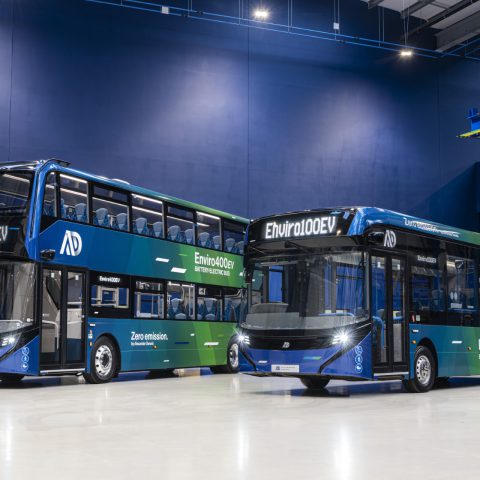
Alexander Dennis announces increase of warrantable energy throughput of its next-generation electric buses (launched in late 2023) to 1.6GWh maximum.
“The Enviro100EV “big small bus” and Enviro400EV “crowd-shifter” have a future-proof battery system designed to maximise use before battery replacement becomes necessary. Drawing on the versatility of NMC cell chemistry, Alexander Dennis has increased the longevity and value offered to operators of its next-generation electric buses”, the OEM states.
The Enviro400EV has recently been certified as capable of energy consumption of a benchmark 0.67kWh/km over the UK Bus Cycle in Zemo Partnership zero-emission bus certification testing.
Our batteries provide the available energy to cover two consecutive seven-year contract terms on typical Transport for London routes without a battery change, or typical provincial routes for up to 20 years with just one mid-life change of batteries
Ben Werth, Alexander Dennis Group Sales & Business Development Director
Alexander Dennis offers warranty energy throughput to 1.6GWh
This improves the warrantable energy throughput to a 1.6GWh over eight years for the Enviro400EV with 472kWh battery, or 1.2GWh with 354kWh battery.
On the Enviro100EV, an energy throughput of 1.2GWh can be warranted when the bus is fitted with the larger 354kWh battery system, or 800,000kWh for the 236kWh battery option.
Alexander Dennis can tailor warranty length and warranted throughput to best suit the operation and duty cycle, including ten and twelve-year warranty options.
Alexander Dennis Group Sales & Business Development Director, Ben Werth, said: “The option to warrant higher-intensity battery use is great news for operators planning to deploy electric buses on heavy-duty or high-mileage services. We’re delighted to be driving value through longevity by giving our customers peace of mind that our next-generation electric buses will offer longer-term operational profitability. We have recognised with our customers that the energy throughput, including regeneration, is critical to calculating the true longevity of their battery capacity choice, and by using our industry-standard multi-physics simulation modelling, we can ensure we deliver the warranted battery performance that meets expectations. Route analysis shows that our batteries provide the available energy to cover two consecutive seven-year contract terms on typical Transport for London routes without a battery change, or typical provincial routes for up to 20 years with just one mid-life change of batteries.”