Hamburg secures over €1.1 billion EIB financing for power grid expansion and 188 electric buses
The European Investment Bank has approved more than €1.1 billion in financing for electricity network upgrades and electric bus deployment in Hamburg. The European Investment Bank (EIB) has signed two financing agreements with Hamburg-based public companies to support infrastructure investments in energy distribution and public transport. The funding includes up to €1 billion for Hamburger […]
The European Investment Bank has approved more than €1.1 billion in financing for electricity network upgrades and electric bus deployment in Hamburg.
The European Investment Bank (EIB) has signed two financing agreements with Hamburg-based public companies to support infrastructure investments in energy distribution and public transport. The funding includes up to €1 billion for Hamburger Energienetze GmbH (HNE) and €125 million for vhh.mobility (Verkehrsbetriebe Hamburg-Holstein GmbH), both under the coordination of the municipal holding HGV.
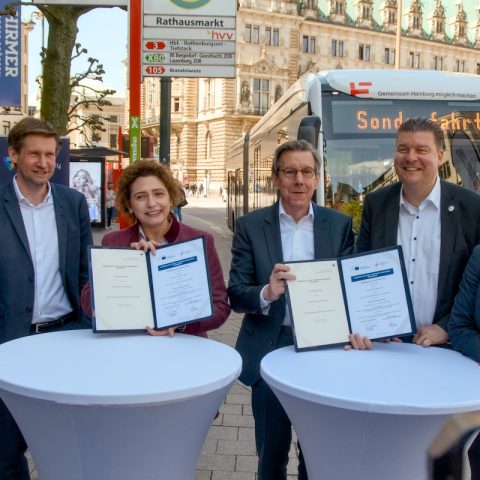
The agreements were formally signed in Hamburg in the presence of EIB Vice-President Nicola Beer, Hamburg Finance Senator Andreas Dressel, representatives of the city’s transport authority, and executives from HGV, HNE and vhh.mobility.
Electricity grid expansion in Hamburg
Hamburger Energienetze GmbH plans to invest approximately €2.9 billion by 2029 in the expansion and modernization of the city’s electricity distribution network. The EIB contribution, structured as a framework loan of up to €1 billion, accounts for about 28 percent of the total investment volume and will be disbursed in multiple tranches, with initial funds already released in October 2025.
The program includes the installation and renewal of around 1,500 kilometers of low-, medium- and high-voltage lines, the construction and refurbishment of substations, and the deployment of 120 new switchgear systems. It also covers the digitalization of network infrastructure to support the integration of renewable energy sources.
The expansion of the grid is designed to accommodate projected increases in electricity demand, including the uptake of heat pumps and the electrification of transport systems. Forecasts indicate that peak load on the network is expected to at least double by 2040.
The project is aligned with the European Union’s REPowerEU framework and broader energy policy objectives focused on security of supply and the integration of renewable energy.
VHH to procure 188 e-buses
vhh.mobility is planning total investments of up to €337 million to expand its electric bus operations. The EIB financing of €125 million represents approximately 37 percent of this program.
The investment includes the procurement of 188 battery-electric buses, comprising 120 standard buses, 52 articulated units and 16 minibuses. The program also covers the conversion and expansion of the Schenefeld depot, including the installation of charging infrastructure.
vhh.mobility currently operates around 800 vehicles, with approximately one-third already electric, as also emerged in our recent interview with Managing Director Britta Oehlrich. Since 2020, all new bus procurements for Hamburg have been zero-emission vehicles
Nicola Beer, Vice President of the European Investment Bank: “Hamburg is demonstrating how European cities are holistically restructuring their infrastructure: with robust power grids and electrified public transport. The EIB supports precisely this integrated approach – with targeted financing for grids and clean bus fleets.”
Gabriele Eggers, Managing Director of HNE: “Modernizing Hamburg’s electricity infrastructure is essential for the success of the energy transition, for emission-free heating and mobility. Our grid will continue to guarantee grid stability and security of supply. To ensure this remains the case, we must invest. And to make this possible, we have a strong and fair partner in the European Investment Bank!”
Britta Oehlrich, Managing Director of vhh.mobility: “This loan gives us the opportunity to make Hamburg a more livable place for all passengers. Every new electric bus on the roads of the Hamburg metropolitan region means less noise, cleaner air, and a visible sign of a city that takes responsibility – for the climate, its people, and mobility. We want to demonstrate that sustainable public transport is not just a goal on paper, but a lived reality that noticeably improves the daily lives of our passengers.”