Germany allocates 2026 funding for additional 1,500 zero-emission buses
Germany’s transport ministry has launched a new funding programme aimed at supporting the deployment of at least 1,500 additional electric buses, following announcement earlier this year. The German Federal Ministry for Transport (BMV) has published a new “Directive for the promotion of alternative drives for buses in passenger transport”, continuing the national support framework for […]
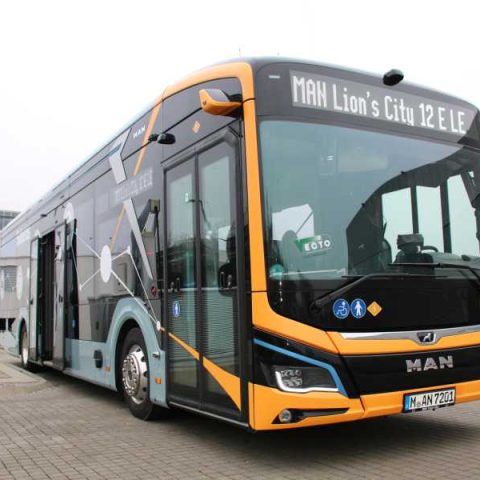
Germany’s transport ministry has launched a new funding programme aimed at supporting the deployment of at least 1,500 additional electric buses, following announcement earlier this year.
The German Federal Ministry for Transport (BMV) has published a new “Directive for the promotion of alternative drives for buses in passenger transport”, continuing the national support framework for battery-electric and fuel cell buses. The new funding call was officially published in the Federal Gazette on 6 May 2026, while applications will open on 26 May.
The BMV states that since the launch of the first funding directive in 2021, more than 5,300 buses have been approved for funding across around 330 public transport operators. More than 2,300 vehicles are already in operation.
In 2025, nearly half of newly registered city buses in Germany were zero-emission vehicles. Germany’s public transport sector added 1,397 emission-free buses in 2025, bringing the total fleet to 4,752 vehicles in operation nationwide, according to PwC’s E-Bus Radar 2026. The data positions electric drivetrains at around 14% of the country’s city bus fleet of approximately 35,000 units. According to the report, German operators have outlined procurement plans for around 6,400 additional zero-emission buses by 2030, bringing the total fleet to over 11,000 vehicles (a substantial increase compared to the 8,500 forecasted in 2023 by the same PwC).
German fundings for 1,500 electric buses
According to the BMV’s press note, the programme is backed by the 2026 federal budget and will support the procurement and conversion of buses with zero-emission drivetrains, together with the related charging and refuelling infrastructure. The scheme applies to battery-electric buses, trolleybuses with batteries, hydrogen fuel cell buses, battery buses equipped with fuel-cell range extenders, and retrofit projects converting conventional buses to battery-electric or hydrogen propulsion.
The new BMV framework introduces two separate funding pillars. Alongside the existing “activation programme”, which follows the structure of previous funding rounds, the ministry is adding a new “scaling programme” targeting operators that already have a significant level of fleet electrification and are planning further expansion of zero-emission operations.
Trade agency electrive notes that “the funding rates will change. Previously, operators could receive funding covering 80 per cent of the additional costs compared to a comparable diesel vehicle. Under the new directive, the government will now cover up to 70 per cent for operators with a low level of electrification and otherwise up to 55 per cent of the additional costs. The federal government continues to provide funding of up to 40 per cent for charging, refuelling and maintenance infrastructure”.
The ministry states that funding allocation will be organised according to technology type, electrification level and operational context. Projects will be selected through a competitive process evaluating environmental contribution, efficiency of public funding utilisation, implementation prospects, operational deployment and energy concepts.
Project sketches may be submitted from 26 May until 21 July 2026, with the sketch phase lasting eight weeks. An online information session linked to the funding call is scheduled for 28 May 2026.
The programme implementation is managed by NOW GmbH and Project Management Jülich (PtJ). Part of the previous funding rounds was co-financed through Germany’s Recovery and Resilience Plan under the European Union Recovery and Resilience Facility.
Federal Transport Minister Patrick Schnieder states: “We have already invested around 1.5 billion euros in more than 5,300 climate-friendly buses. We are consistently continuing along this successful path: with the budget volume available in 2026 alone, we want to bring a further 1,500 electric buses into operation nationwide. This strengthens public transport, the market ramp-up of innovative drive technologies and paves the way for climate-friendly mobility.”
VDV: funding are not sufficient
The VDV, following the announcement of the new funding, released a press note stressing that “in the first phase of implementation, around 400 million euros will be made available in the 2026 federal budget for new grants. This is intended to enable the funding of at least 1,500 buses with alternative drive systems. However, this figure is only possible because the funding rate is falling compared to previous funding rounds“.
The VDV also points out that all previous calls for funding were significantly oversubscribed: “The consistently high demand over the years shows that the sector is both willing and compelled to transform; in doing so, it is not only implementing European climate protection targets but also providing important growth impetus for European industry. However, the federal funding available to date has not been sufficient to drive the fleet transition forward significantly faster and on a nationwide scale. And there are two downsides to the current funding scheme as well: the funding rate is falling and the programme is limited until the end of 2029. We will not achieve the conversion targets set out in the European Clean Vehicles Directive by then,”” said Wortmann. Nevertheless, the VDV welcomes the fact that e-bus funding is now being continued by the federal government”.