Isuzu, Hino, and Toyota join forces in Japan: battery-electric and fuel cell bus ready for launch by 2024
Isuzu, Hino and Toyota Motor Corporation are joining forces in order to «strengthen their efforts to electrify buses toward the achievement of carbon neutrality by 2050» in Japan. In collaboration with Commercial Japan Partnership Technologies Co., Ltd., the companies have set the goal of expanding their lineup to increase customer options and reduce vehicle cost, […]
Isuzu, Hino and Toyota Motor Corporation are joining forces in order to «strengthen their efforts to electrify buses toward the achievement of carbon neutrality by 2050» in Japan. In collaboration with Commercial Japan Partnership Technologies Co., Ltd., the companies have set the goal of expanding their lineup to increase customer options and reduce vehicle cost, in addition to popularizing practical and sustainable electric vehicles.
Isuzu and Hino plan to begin production of battery electric vehicle (BEV) flat-floor route buses in 2024 at Isuzu-Hino joint venture J-Bus Ltd.
The BEV flat-floor route bus planned for production start in FY2024 will be developed by Isuzu, and the adoption of a BEV powertrain, which will provide zero CO2 emissions during vehicle use, is aimed at contributing to the realization of a decarbonized society. Also, toward achieving zero onboard accidents, by taking advantage of the freedom of layout afforded by BEVs, the flat-floor area of the bus’s interior can be greatly expanded compared to conventional non-step buses, significantly improving travel safety.
Isuzu, Hino and Toyota: fuel cell buses in the spotlight
Additionally, Isuzu, Hino, and Toyota have agreed to begin studying the planning and development of next-generation fuel cell electric vehicle (FCEV) route bus based on the BEV flat-floor route bus to be produced from FY2024.
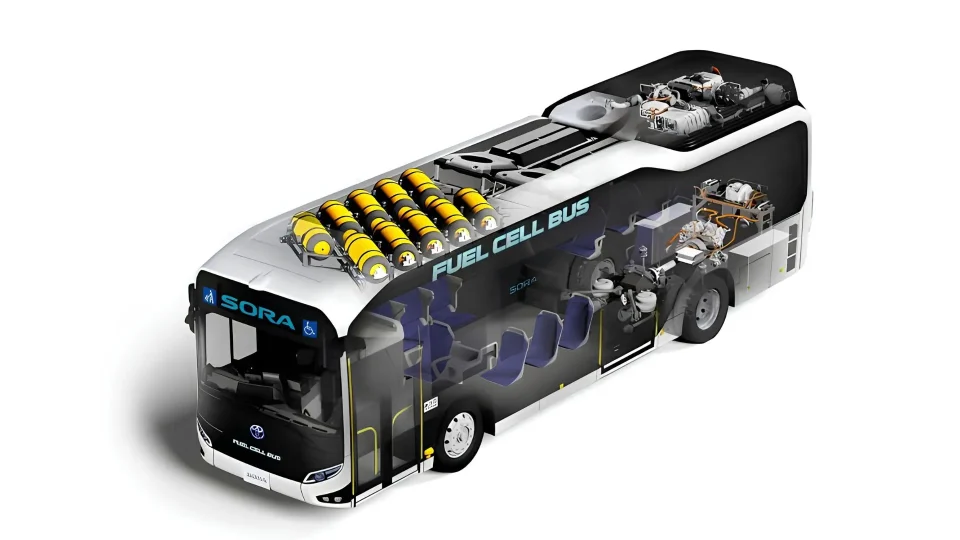
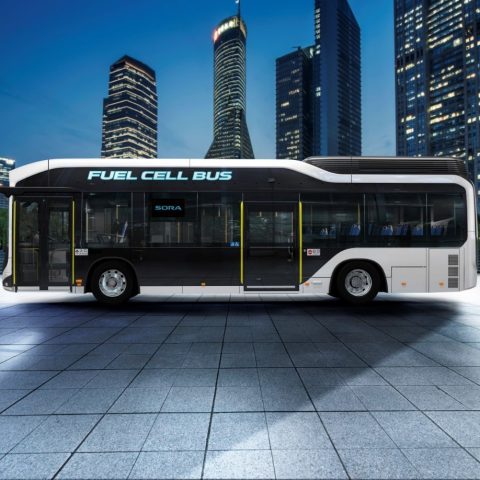
The next-generation FCEV route bus will combine the platform of the BEV flat-floor route bus scheduled for launch in FY 2024, with Toyota’s fully developed fuel cell system found in the Toyota Mirai and the SORA fuel cell bus (and in CaetanoBus – Toyota H2.City Gold as well). By sharing the same components between BEVs and FCEVs, Isuzu, Hino, and Toyota aim to significantly reduce costs, and by adopting new-generation fuel cell stacks and utilizing Toyota and Hino’s FCEV bus development know-how to date, they aim to provide longer-life, higher-added-value electrified vehicles, the partners say.
Through this initiative, Isuzu, Hino, and Toyota intend to contribute to the realization of a hydrogen-based society in Japan, by applying Japan’s strengths in fuel cell technology.