Jacksonville’s autonomous bus project NAVI completes first year; JTA CEO Nat Ford to resign in January 2027
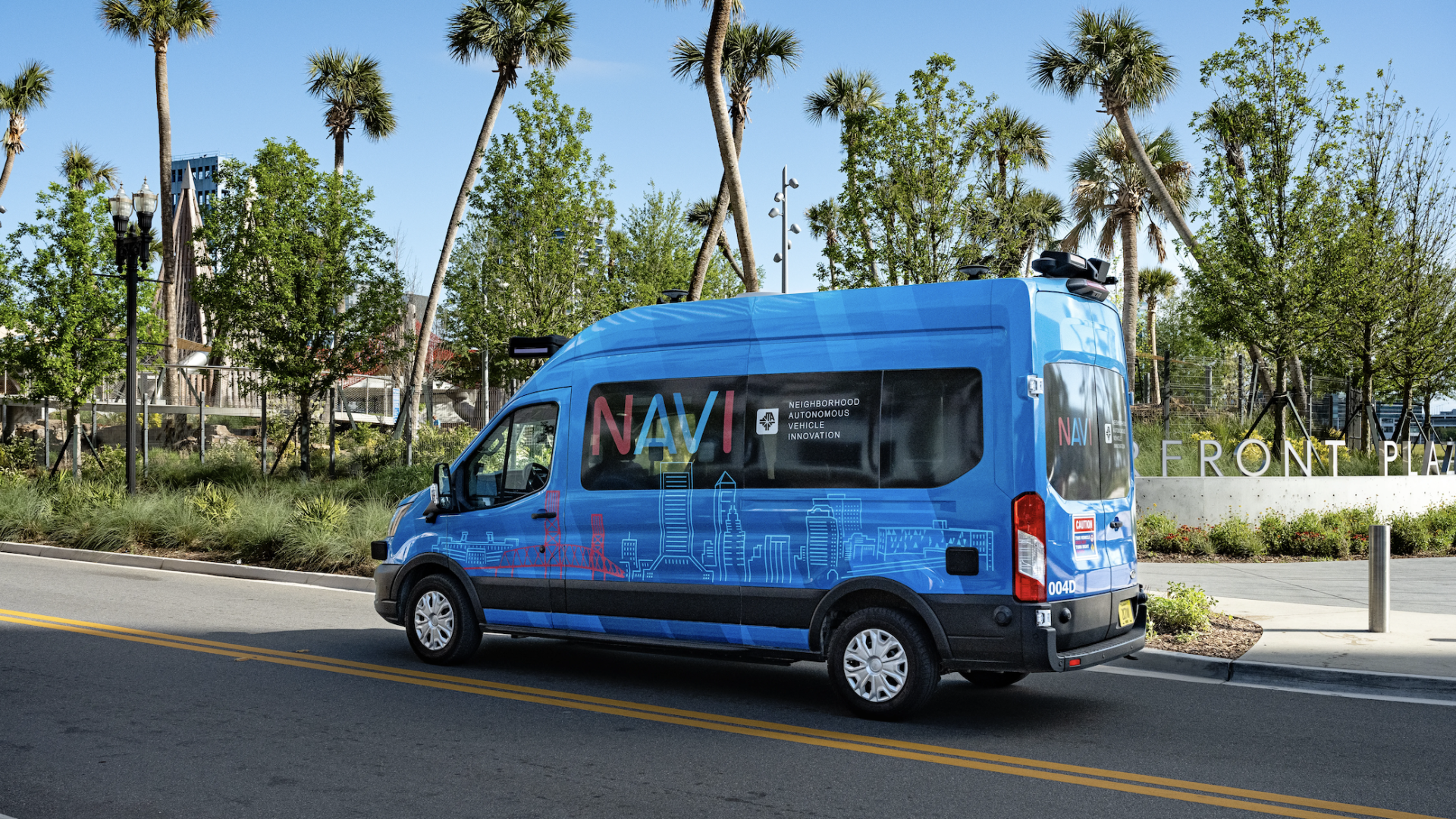
Jacksonville Transportation Authority‘s autonomous public transport service NAVI has completed its first year of revenue operations, carrying more than 15,200 passengers and logging over 61,000 autonomous miles since its launch in June 2025. Introduced on 30 June 2025 as the first phase of the agency’s Ultimate Urban Circulator (U²C) program, NAVI is presented as the […]
By
Editorial staff
Jacksonville Transportation Authority‘s autonomous public transport service NAVI has completed its first year of revenue operations, carrying more than 15,200 passengers and logging over 61,000 autonomous miles since its launch in June 2025.
Introduced on 30 June 2025 as the first phase of the agency’s Ultimate Urban Circulator (U²C) program, NAVI is presented as the first permanent autonomous public transportation service in the United States operating in revenue service.
A few days later, on July 6th, JTA announced that Chief Executive Officer Nathaniel P. Ford Sr. will resign effective 8 January 2027, concluding more than 13 years leading the agency. Ford said he plans to continue working on innovative mobility solutions but did not announce his future role. He will remain in office through January 2027 to support the transition, while the JTA Board of Directors is expected to discuss the succession process at its next scheduled meeting on 29 July.
Autonomous mobility is no longer a concept of the future—it is delivering real-world transportation solutions today. What started as a bold idea has become a national model. The lessons we are learning in Jacksonville are helping define how autonomous technology can be safely integrated into public transportation systems throughout the United States.
Nat Ford, CEO, JTA
During Ford’s tenure, JTA also launched the Ultimate Urban Circulator program and attracted HOLON’s first U.S. autonomous vehicle manufacturing facility, a $200 million investment planned for Jacksonville, as announced in late 2025. Within this deal, reportedly, Holon Urban will be integrated into the JTA’s Ultimate Urban Circulator (U²C) program, with up to 100 shuttles deployed in Downtown Jacksonville in several phases. Additional pilot projects are planned in other U.S. locations from 2026.
NAVI records first year of autonomous public transit operations
According to JTA, NAVI transported more than 15,200 passengers during its first year of operation. The autonomous fleet accumulated over 61,000 miles in autonomous mode, while monthly ridership reached 989 passengers in May 2026.
Throughout the year, the service operated during major special events, roadway construction, changing traffic patterns and more than 80 route detours. JTA also states that NAVI attracted transportation agencies, policymakers, technology companies and international delegations seeking information on large-scale autonomous public transport deployment.
The autonomous service forms the first implementation phase of the Ultimate Urban Circulator (U²C) program and is supported by JTA’s Autonomous Innovation Center together with a network of public and private partners focused on autonomous mobility technologies.
Nat Ford to leave JTA after more than a decade as CEO
Ford’s resignation concludes a tenure during which JTA delivered several major transportation projects. These include the First Coast Flyer bus rapid transit system, described by the authority as the largest BRT network in the southeastern United States, the Jacksonville Regional Transportation Center, the Route Optimization Initiative, and the expansion of JTA’s regional services across Baker, Clay, Nassau and St. Johns counties, including the restoration of the St. Johns River Ferry.
According to JTA, the agency also secured more than $400 million in federal discretionary grants and supported the extension of a local option gas tax generating $1 billion for regional transportation infrastructure.
In brief
When did NAVI enter service? NAVI began revenue operations on 30 June 2025 as the first phase of JTA’s Ultimate Urban Circulator program.
What operational results has NAVI achieved? JTA reports more than 15,200 passengers carried and over 61,000 autonomous miles during the first year of service.
When will Nat Ford leave JTA? His resignation becomes effective on 8 January 2027.
When will the JTA Board discuss the CEO succession? The next scheduled Board meeting is on 29 July.
“As the nation’s first permanent autonomous vehicle public transit service, NAVI represents a major milestone in the evolution of public transportation. One year ago, the JTA transformed a bold vision into reality, launching a service that is helping shape the future of mobility not only in Jacksonville, but across the United States,” said Nat Ford, CEO of the JTA. “Since launch, NAVI has completed over 15,200 passenger trips and traveled more than 61,000 autonomous miles, all while maintaining an exceptional safety record with no safety incidents caused by the autonomous system. These results demonstrate that autonomous mobility is no longer a concept of the future—it is delivering real-world transportation solutions today. As we continue advancing the Ultimate Urban Circulator program, Jacksonville remains at the forefront of innovation, helping shape the next generation of safe, accessible, and scalable public transportation for communities across the country. What started as a bold idea has become a national model. The lessons we are learning in Jacksonville are helping define how autonomous technology can be safely integrated into public transportation systems throughout the United States.”
IVECO BUS Academy supported more than 6,500 participants through classroom training sessions across Europe in 2025, with around two-thirds of its courses now dedicated to electric vehicles. The Academy’s activities cover multi-energy expertise, with a strong focus on electromobility and include, amo...
On 18 March 1895, at 6:25 in the morning, the world’s first motor bus line opened between Siegen, Netphen and Deuz. The vehicle was a Benz Landauer. It had eight seats, a one-cylinder engine of five horsepower, and fifteen kilometres of bad road ahead of it. On the steepest hill, the passengers had ...
Autonomous driving will gain further space at Mobility Move 2027, while electric mobility will remain one of the main pillars of the Berlin event, scheduled for 16-18 March.
Following a 2026 edition that attracted more than 1,600 participants and 110 exhibitors, preparations are already under way f...
Door manufacturer Masats is advancing the development of its AIDA artificial intelligence-based bus door system, with testing on real vehicles targeted within the next 12–18 months. At FIAA 2026 in Madrid, Marc Ball-llosera Massa, Business Development and Product Strategy Manager – Bus & Coach a...
Solaris is preparing to establish bus production in the United States at CAF’s manufacturing facility in Elmira, New York, with vehicle certification and compliance with Buy America requirements among the next steps. The facility currently employs around 300 people, while pilot electric buses ...
LA Metro has broken ground on the 12.4-mile (20-km) Vermont Transit Corridor Bus Rapid Transit (BRT) project in Los Angeles, with 26 upgraded stations, dedicated bus lanes and projected ridership of 66,200 passengers per day. The project, announced by the Los Angeles County Metropolitan Transportati...
It can be done: Autonomous Systems has conducted an initial readiness assessment at Garage West, one of GVB’s three bus depots in Amsterdam, identifying three types of bus movements that could be suitable for automation: the route through the buffer zone to the parking position under the pantograph,...
Mitsubishi Fuso Truck and Bus Corporation (MFTBC) and Foxconn have announced that their new bus manufacturing joint venture, Fuso Bus, is scheduled to begin operations on 2 November 2026, subject to the successful closing of the transaction. The new bus manufacturer will be owned equally by the two ...
This Website uses cookies, small text files placed by the site on the computer or mobile device, which automatically collect some information that the user does not provide directly. Cookie Policy ACCEPTCookie settings
Manage consent
Privacy Overview
This website uses cookies to improve your experience while you navigate through the website. Out of these cookies, the cookies that are categorized as necessary are stored on your browser as they are essential for the working of basic functionalities of the website. We also use third-party cookies that help us analyze and understand how you use this website. These cookies will be stored in your browser only with your consent. You also have the option to opt-out of these cookies. But opting out of some of these cookies may have an effect on your browsing experience.
Necessary cookies are absolutely essential for the website to function properly. These cookies ensure basic functionalities and security features of the website, anonymously.
Cookie
Duration
Description
cookielawinfo-checkbox-advertisement
1 year
Set by the GDPR Cookie Consent plugin, this cookie is used to record the user consent for the cookies in the "Advertisement" category .
cookielawinfo-checkbox-analytics
11 months
This cookie is set by GDPR Cookie Consent plugin. The cookie is used to store the user consent for the cookies in the category "Analytics".
cookielawinfo-checkbox-functional
11 months
The cookie is set by GDPR cookie consent to record the user consent for the cookies in the category "Functional".
cookielawinfo-checkbox-necessary
11 months
This cookie is set by GDPR Cookie Consent plugin. The cookies is used to store the user consent for the cookies in the category "Necessary".
cookielawinfo-checkbox-others
11 months
This cookie is set by GDPR Cookie Consent plugin. The cookie is used to store the user consent for the cookies in the category "Other.
cookielawinfo-checkbox-performance
11 months
This cookie is set by GDPR Cookie Consent plugin. The cookie is used to store the user consent for the cookies in the category "Performance".
JSESSIONID
session
The JSESSIONID cookie is used by New Relic to store a session identifier so that New Relic can monitor session counts for an application.
PHPSESSID
session
This cookie is native to PHP applications. The cookie is used to store and identify a users' unique session ID for the purpose of managing user session on the website. The cookie is a session cookies and is deleted when all the browser windows are closed.
viewed_cookie_policy
11 months
The cookie is set by the GDPR Cookie Consent plugin and is used to store whether or not user has consented to the use of cookies. It does not store any personal data.
Functional cookies help to perform certain functionalities like sharing the content of the website on social media platforms, collect feedbacks, and other third-party features.
Cookie
Duration
Description
bcookie
2 years
LinkedIn sets this cookie from LinkedIn share buttons and ad tags to recognize browser ID.
bscookie
2 years
LinkedIn sets this cookie to store performed actions on the website.
lang
session
LinkedIn sets this cookie to remember a user's language setting.
lidc
1 day
LinkedIn sets the lidc cookie to facilitate data center selection.
UserMatchHistory
1 month
LinkedIn sets this cookie for LinkedIn Ads ID syncing.
__cf_bm
30 minutes
This cookie, set by Cloudflare, is used to support Cloudflare Bot Management.
__sharethis_cookie_test__
session
ShareThis sets this cookie to track which pages are being shared and by whom.
Performance cookies are used to understand and analyze the key performance indexes of the website which helps in delivering a better user experience for the visitors.
Cookie
Duration
Description
_uetsid
never
Bing Ads sets this cookie to engage with a user that has previously visited the website.
_uetvid
never
Bing Ads sets this cookie to engage with a user that has previously visited the website.
Analytical cookies are used to understand how visitors interact with the website. These cookies help provide information on metrics the number of visitors, bounce rate, traffic source, etc.
Cookie
Duration
Description
CONSENT
2 years
YouTube sets this cookie via embedded youtube-videos and registers anonymous statistical data.
vuid
2 years
Vimeo installs this cookie to collect tracking information by setting a unique ID to embed videos to the website.
_ga
session
The _ga cookie, installed by Google Analytics, calculates visitor, session and campaign data and also keeps track of site usage for the site's analytics report. The cookie stores information anonymously and assigns a randomly generated number to recognize unique visitors.
_gat_gtag_UA_161600929_7
2 hours
Set by Google to distinguish users.
_gat_gtag_UA_27868640_1
2 hours
Set by Google to distinguish users.
_gat_UA-120282270-1
session
A variation of the _gat cookie set by Google Analytics and Google Tag Manager to allow website owners to track visitor behaviour and measure site performance. The pattern element in the name contains the unique identity number of the account or website it relates to.
_gid
session
Installed by Google Analytics, _gid cookie stores information on how visitors use a website, while also creating an analytics report of the website's performance. Some of the data that are collected include the number of visitors, their source, and the pages they visit anonymously.
Advertisement cookies are used to provide visitors with relevant ads and marketing campaigns. These cookies track visitors across websites and collect information to provide customized ads.
Cookie
Duration
Description
advanced_ads_browser_width
1 month
This cookie is set by Advanced ads plugin.This cookie is used to measure and store the user browser width for adverts.
fr
3 months
Facebook sets this cookie to show relevant advertisements to users by tracking user behaviour across the web, on sites that have Facebook pixel or Facebook social plugin.
IDE
1 year 24 days
Google DoubleClick IDE cookies are used to store information about how the user uses the website to present them with relevant ads and according to the user profile.
MUID
1 year 24 days
Bing sets this cookie to recognize unique web browsers visiting Microsoft sites. This cookie is used for advertising, site analytics, and other operations.
test_cookie
15 minutes
The test_cookie is set by doubleclick.net and is used to determine if the user's browser supports cookies.
VISITOR_INFO1_LIVE
5 months 27 days
A cookie set by YouTube to measure bandwidth that determines whether the user gets the new or old player interface.
YSC
session
YSC cookie is set by Youtube and is used to track the views of embedded videos on Youtube pages.
yt-remote-connected-devices
never
YouTube sets this cookie to store the video preferences of the user using embedded YouTube video.
yt-remote-device-id
never
YouTube sets this cookie to store the video preferences of the user using embedded YouTube video.