Frankfurt reaches 109 zero-emission buses (26% of fleet), with 49 additional e-buses planned by 2028
Frankfurt am Main has reached 109 zero-emission buses in operation, representing 26% of its 418-vehicle fleet, with the German city targeting complete conversion to battery-electric and hydrogen fuel cell technologies by 2033. According to a statement released by the City of Frankfurt, the fleet currently comprises 77 battery-electric buses and 32 hydrogen fuel cell buses. […]
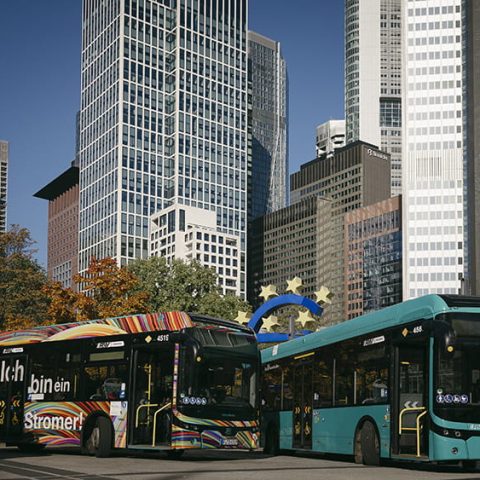
Frankfurt am Main has reached 109 zero-emission buses in operation, representing 26% of its 418-vehicle fleet, with the German city targeting complete conversion to battery-electric and hydrogen fuel cell technologies by 2033.
According to a statement released by the City of Frankfurt, the fleet currently comprises 77 battery-electric buses and 32 hydrogen fuel cell buses. The threshold of 100 zero-emission vehicles was exceeded during the 2026 timetable year following the introduction of nine Ebusco battery-electric buses operated by Transdev Rhein-Main GmbH (TDRM).
The nine vehicles have entered service on route 56, connecting Rödelheim, Sossenheim and Eschborn, and route 71, serving Praunheim and Nordweststadt.
Frankfurt electric bus fleet: 77 battery-electric and 32 H2 buses
Frankfurt’s bus electrification programme started in 2018 with the introduction of five Solaris Urbino 12 electric buses. Subsequent deployments included Irizar articulated electric buses, CaetanoBus vehicles and Ebusco buses for Transdev Rhein-Main. The city has also developed its hydrogen bus fleet through successive Solaris orders. The current target of full fleet conversion by 2033 replaces the original 2030 deadline.
The City of Frankfurt confirms that 109 of the 418 buses currently operating in its public transport network use locally emission-free propulsion systems, corresponding to an electrification rate of approximately 26%.
The municipality intends to retain both technologies in its fleet conversion programme, with hydrogen fuel cell vehicles continuing to operate alongside battery-electric buses.
According to traffiQ managing director Tom Reinhold, the operating costs of an electric bus are now approximately 40% lower than those of a comparable diesel bus. Reinhold also reports that battery-electric buses currently achieve operating ranges of between 250 and 300 kilometres per charge.
Part of Frankfurt’s battery-electric bus fleet is charged at the municipal waste-to-energy plant (Müllheizkraftwerk, MHKW) in Heddernheim. The facility is operated by Frankfurter Entsorgungs- und Service GmbH (FES) and energy provider Mainova. It generates electricity through the incineration of municipal household waste, among other activities.
The site provides charging facilities for electric buses operated by Transdev Rhein-Main. The cooperation between FES and TDRM also covers vehicle servicing and maintenance at the FES workshop in Heddernheim.
Frankfurt plans 49 additional electric buses by 2028 and new charging depots
Further vehicle procurement and infrastructure investments are scheduled as part of Frankfurt’s programme to convert its entire bus fleet to locally emission-free propulsion by 2033.
From 2027, ten additional battery-electric solo buses are scheduled to enter service in the western part of Frankfurt under bus operating package B.
For 2028, the city plans to procure another 39 electric buses for operations in eastern Frankfurt. These vehicles will be supported by the new East electric bus depot, currently being developed by In-der-City-Bus GmbH (ICB) on Flinschstraße in Seckbach. From December 2028, minibus routes 25, 57, 81, 82, 83 and 85 will be grouped under operating package H and converted entirely to electric operation.
A further infrastructure project concerns the planned West electric bus depot on Lorscher Straße in Rödelheim, which will replace the existing Römerhof depot.
According to the municipality, the new facility is planned to provide parking and charging capacity for up to 200 battery-electric and hydrogen buses.
As an interim measure ahead of the opening of the new depot, ICB has recently introduced 52 conventional diesel buses into operation.