Shillong starts deployment of 55 EKA electric buses under PM eBus Sewa scheme
by Usha Sandhya Shillong is not the first city you’d expect to lead India’s electric bus revolution. Perched at 1,500 metres in the Khasi Hills, its narrow winding roads and steep gradients have long made mass transit a logistical headache. And yet, on a recent morning, the city’s Chief Minister Conrad K. Sangma stood before […]
by Usha Sandhya
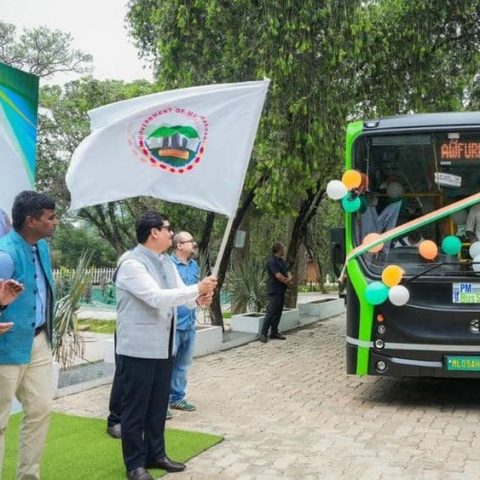
Shillong is not the first city you’d expect to lead India’s electric bus revolution. Perched at 1,500 metres in the Khasi Hills, its narrow winding roads and steep gradients have long made mass transit a logistical headache. And yet, on a recent morning, the city’s Chief Minister Conrad K. Sangma stood before a fleet of sleek EKA electric buses and flagged them into service — setting in motion what could become one of the country’s more interesting urban mobility experiments.
The buses, procured under India’s centrally funded PM eBus Sewa Scheme, are not just a greener replacement for ageing diesel vehicles. They represent a structural rethinking of how public transport is run, and who it’s really meant to serve.
Shillong is the capital of Meghalaya, a state in northeastern India bordering Bangladesh. The wider Shillong urban agglomeration exceeds 350,000 residents. EKA has launched a lineup of e-buses in 2025.
E-buses funded under PM eBus Sewa scheme
For decades, public bus operators across much of the developing world have run on a simple, flawed logic: more passengers mean more revenue. The result is a race to pack buses full, skip stops with few takers, and abandon routes that don’t pay. Schedules become suggestions.
Shillong is trying something different. The city is adopting a Gross Cost Contract (GCC) model, under which private operators are paid based on whether they meet service standards — not on how many fares they collect.
“Whether there is one passenger or twenty, the bus arrives and departs on time,” said Dr. Vijay Kumar D, the state’s Commissioner and Secretary for Urban Affairs, at the launch. “That is the transition we are introducing in Shillong.”
It is, as he noted, a model already proven in cities from London to Singapore. The question is whether it can take root in a mid-sized Indian hill city of roughly 350,000 people — many of whom have long given up on public transport altogether.
The electric bus launch was not Shillong’s first step down this road. A few months ago, the city quietly rolled out 15 diesel buses under the same GCC framework, as a pilot of sorts. The early data is striking. Daily ridership has climbed from around 300 passengers when the service launched to nearly 3,000 per day — a tenfold increase in a matter of months, according to the Directorate of Information & Public Relations (DIPR), Meghalaya. The service has also created jobs for roughly 50 young locals.
It is, by any measure, a promising start for a city where the private car has long dominated and public transport has struggled for relevance.
New EKA e-buses delivered in Shillong
The new EKA buses — manufactured by Pune-based EKA Mobility — come in 9-metre and 7-metre variants, designed with Shillong’s terrain in mind. They are fully electric, with a driving range of 150 to 200 kilometres on a single charge. On board: GPS tracking, e-ticketing, and wheelchair-accessible layouts. A dedicated charging depot is being built at Umsawli in New Shillong to service the fleet.
Over 55 electric buses are being inducted in total, adding to the existing diesel fleet. Within six months, officials expect a combined fleet of around 150 buses running on four identified city routes — targeting 60,000 daily commuters.
Why this matters beyond Meghalaya
India has over 4,000 cities and towns. The vast majority have no meaningful public bus service. The PM eBus Sewa Scheme — which is funding operations in dozens of cities — is an attempt to change that at scale. But procurement is the easy part. The harder challenge has always been operations: keeping buses running on time, maintaining ridership, and making the economics work without reverting to the old fare-chasing model.
Shillong’s experiment, still in its early months, offers a small but real test case. If a hilly, geographically tricky city in India’s northeast can make scheduled, reliable, electric public transport work — and grow ridership tenfold in a season — it is a result worth watching.