Solaris selects Ballard FCmove-SC fuel cell platform for next-generation hydrogen buses
Solaris has selected Ballard Power Systems’ FCmove-SC fuel cell model for integration into its next-generation hydrogen bus platform (model Solaris Urbino hydrogen). Ballard Power Systems announced on 6 May that Solaris Bus & Coach has formally selected the Canadian manufacturer as fuel cell supplier for the Solaris Generation 2 FCEV bus platform. The agreement includes […]
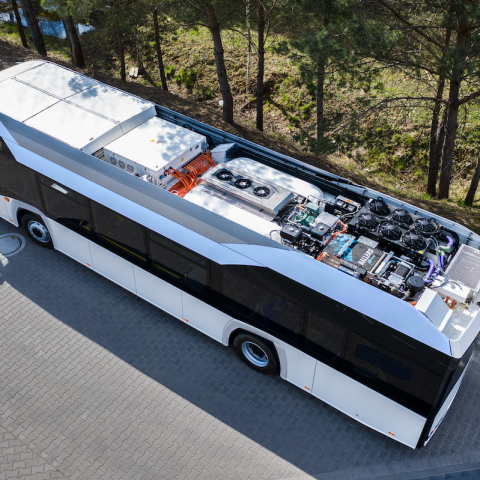
Solaris has selected Ballard Power Systems’ FCmove-SC fuel cell model for integration into its next-generation hydrogen bus platform (model Solaris Urbino hydrogen).
Ballard Power Systems announced on 6 May that Solaris Bus & Coach has formally selected the Canadian manufacturer as fuel cell supplier for the Solaris Generation 2 FCEV bus platform. The agreement includes the integration of Ballard’s FCmove-SC hydrogen fuel cell engine, presented at Busworld last year, and an update to the existing long-term supply agreement between the two companies, extending the framework through 2029.
Beyond the Ballard supply announcement, the development signals the arrival of a new generation of Solaris fuel cell buses, following presentation of the model in 2019 at UITP Summit in Stockholm. The first order for the Solaris Urbino 12 hydrogen was placed from Italy: SASA Bolzano (Bozen’s public transport operator) ordered 12 units, under the JIVE programme financed by the European Union. The contract is worth 12.8 million euros and it includes servicing and maintenance for eight years. The vehicles have been launched in May 2021.
Ballard FCmove-SC selected by Solaris
The announcement marks the continuation of a long-standing cooperation between Ballard and Solaris in the hydrogen bus segment. Solaris is currently the leading fuel cell bus manufacturer in Europe by registrations. Hydrogen fuel-cell buses accounted for 558 registrations in 2025 in Europe, with Solaris representing the major player with 277 units, corresponding to half of the market. Germany accounts for the 60.2% of the European fuel cell bus market.
The FCmove-SC platform was launched in late 2025 as the company’s latest fuel cell engine generation. The system is designed with a simplified architecture and aimed at improving efficiency and durability while reducing total cost of ownership for transit operations, Ballard states.
The updated agreement also aligns commercial terms connected with the supply of fuel cell engines for the new-generation buses. Ballard states that deliveries under the revised LTSA are aligned with Solaris’ next-generation hydrogen bus deployment plans through 2029.
Ballard states that more than 2,200 fuel cell buses powered by its technology are currently operating worldwide. According to the company, these fleets have accumulated more than 300 million kilometres of operation with 98% availability.
The company also highlighted the role of its Ballard Fleet Services activities, including technical support, training, operational monitoring, spare parts supply and stack servicing.
“Solaris’ selection of Ballard for its next‑generation hydrogen bus platform marks a significant milestone for the continued evolution of our FCmove®‑SC engine,” said Marty Neese, Ballard’s CEO and President. “Our long‑standing collaboration with Solaris has been built on trust, technical excellence, and a shared commitment to zero‑emission mobility. With this selection, supported by newly adjusted commercial terms that strengthen long‑term alignment, Solaris reinforces its confidence in Ballard’s ability to deliver performance, reliability, and lifecycle value at scale. The FCmove®‑SC is purpose‑built for Europe’s mature bus market, and OEM nominations like this validate the strength of our value proposition.”