Menarini plans complete e-bus range from 6 to 18m, intercity expansion and use of proprietary batteries, says SERI Industrial CEO Vittorio Civitillo
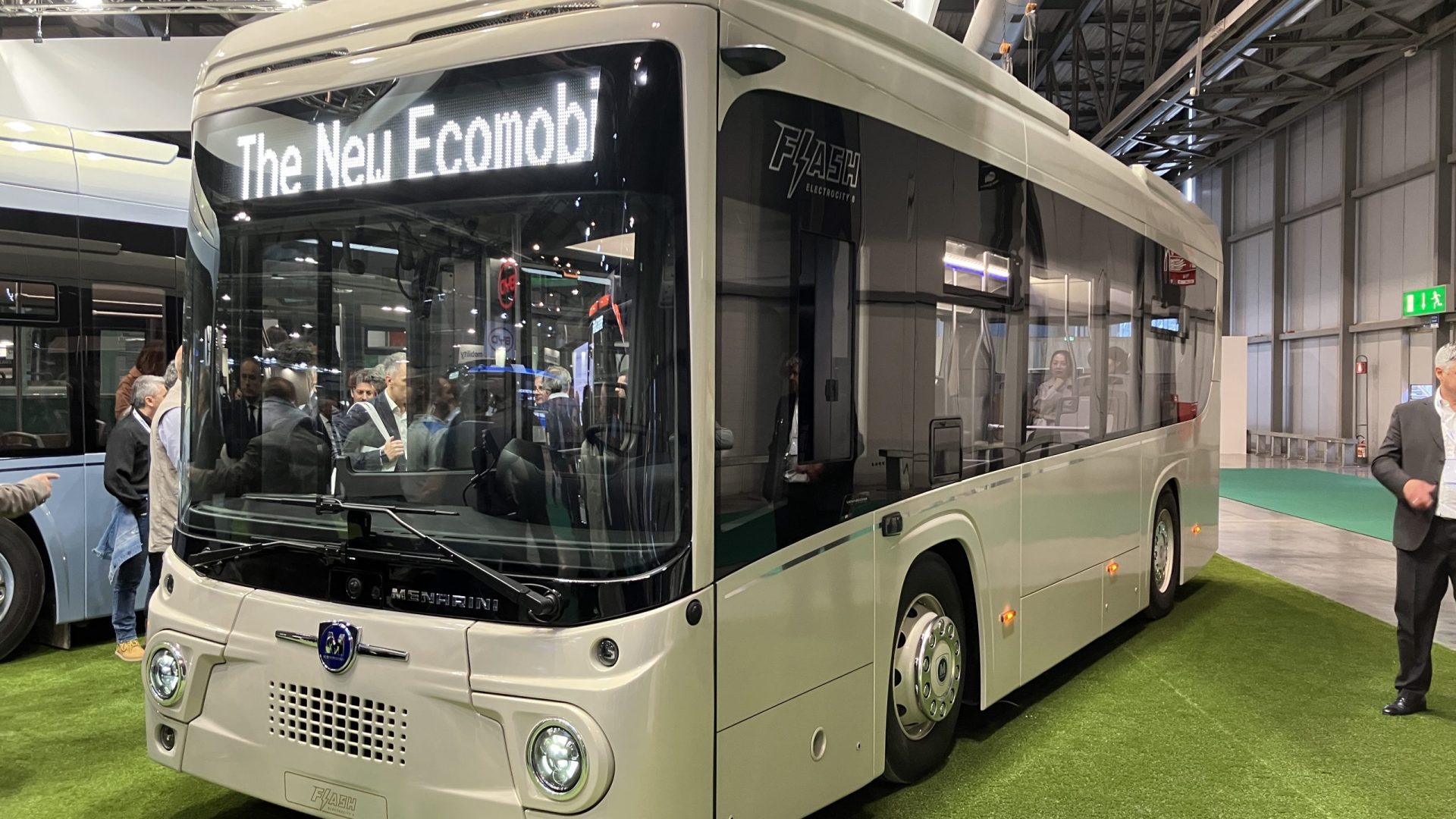
Menarini presented the new Flash and Airon electric buses at Next Mobility Exhibition in Milan, outlining a wider product roadmap that includes articulated and minibus models alongside future in-house battery integration. And that looks actively at foreign markets. The debut of the new models marked the first public step of Menarini’s renewed industrial strategy under […]
Menarini presented the new Flash and Airon electric buses at Next Mobility Exhibition in Milan, outlining a wider product roadmap that includes articulated and minibus models alongside future in-house battery integration. And that looks actively at foreign markets.
The debut of the new models marked the first public step of Menarini’s renewed industrial strategy under SERI Industrial ownership (that took over Industria Italiana Autobus in 2024 and rebranded it as Menarini). The two vehicles, designed by Vernacchia Design and manufactured in Italy, will also be available in 9- and 10-metre variants respectively, while additional models are already under development.
The company confirmed that homologation activities are ongoing for a complete Class I electric range including 6-, 8-, 9-, 10-, 12- and 18-metre vehicles. Menarini is also working on the future introduction of low-entry and Class II products, while battery systems developed within the SERI Industrial group through FAAM are expected to progressively enter production from 2027.
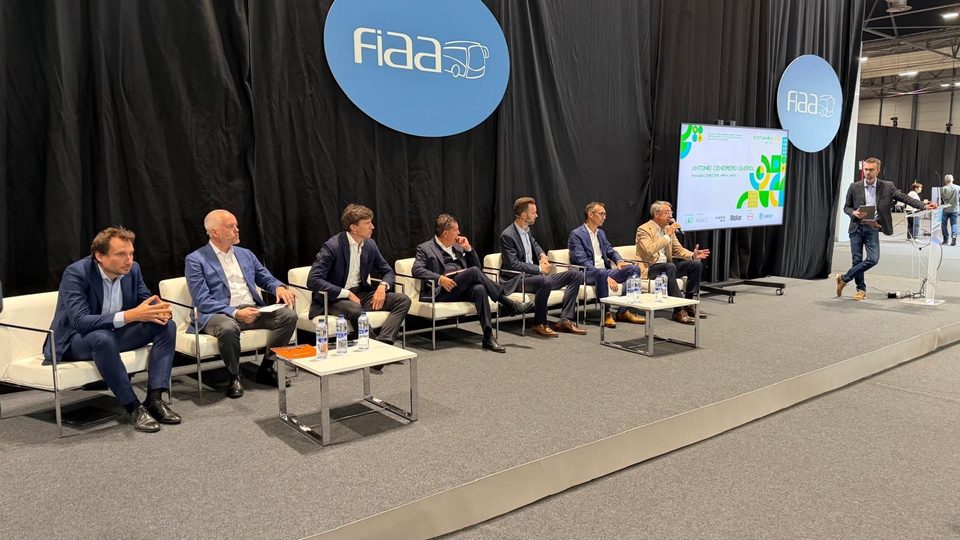
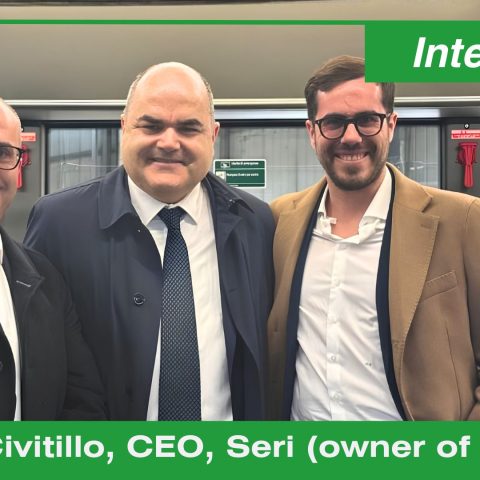
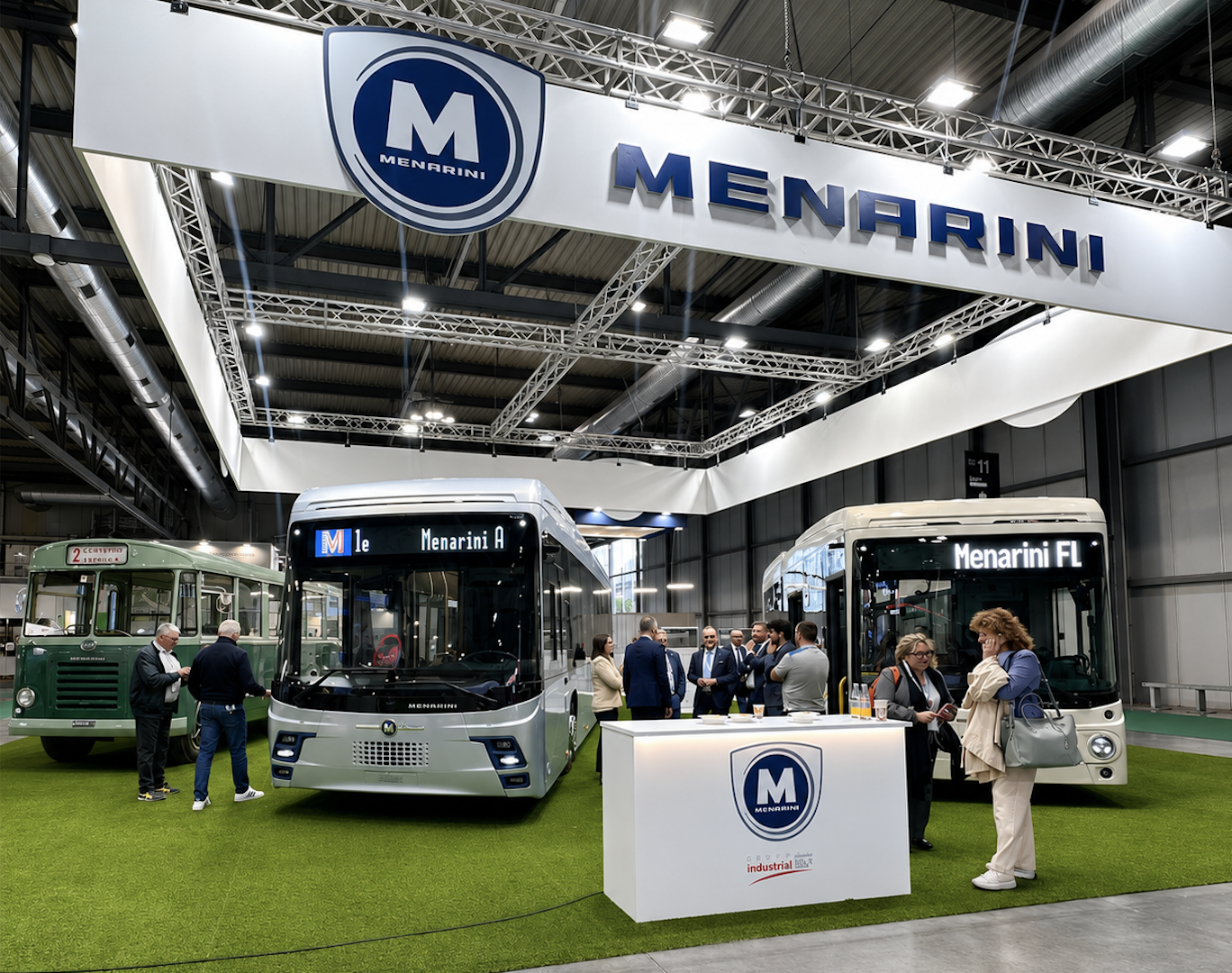
In an interview published by Italian trade media (and our sister company) Autobusweb, SERI Industrial CEO Vittorio Civitillo (at the center in the opening picture) discussed the company’s industrial plans, the current European market environment, battery manufacturing targets and Menarini’s international expansion strategy. Below, the full interview, translated.
Concerning our new product range, everything is in the final stages of preparation for type approval and certification. I believe the 18-metre will go for type approval at the end of the year, followed by the mini. Then it will be the turn of intercity. Concerning the latter, we’re considering whether to proceed with just one model – an evolution from the Class I to the Class II – or to strike a deal with a partner. In that case, it would be a product bearing our brand, built entirely in Flumeri, but using the partner’s components and technology
Vittorio Civitillo, CEO, Seri Industrial (Menarini’s parent company)
Menarini’s Vittorio Civitillo on electric buses, batteries and market conditions
Are Flash and Airon, the latest additions from Menarini, marking the start of a new, broader range?
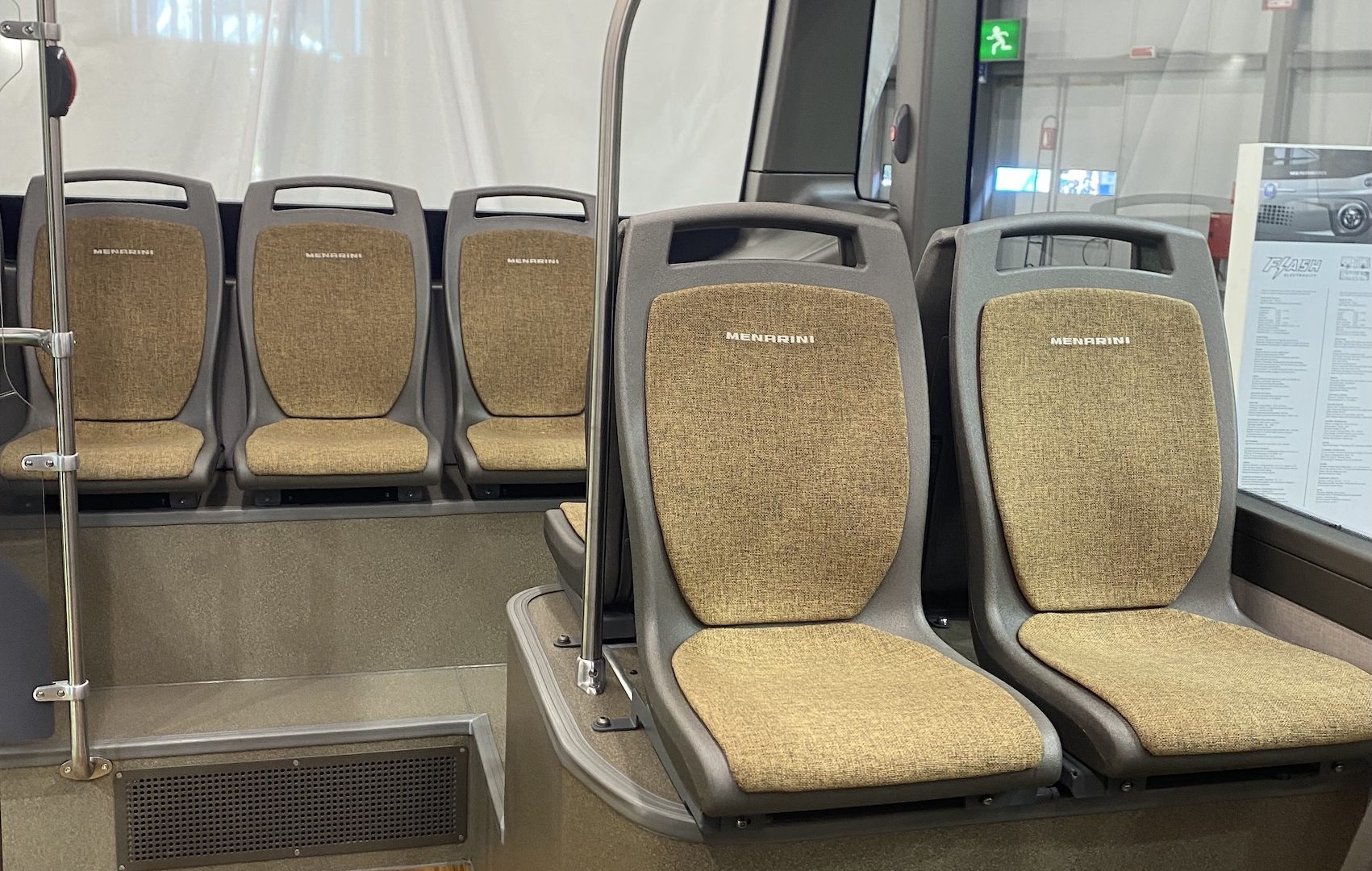
Yes, 6-metre and 18-metre models are also on the way. With the two e-buses unveiled at the Milan trade fair, we are reviving Menarini’s tradition of combining tradition with innovation. These vehicles are not only attractive but also highly innovative from a technological standpoint. We’ve put a lot of work into them. In terms of design, I believe we have created a stunning vehicle, both inside and out. Inside, we have paid close attention to many details; we are working with a new seat supplier, Lazzerini. In my opinion, we are on the right track to bring a good, successful product to market. Unfortunately, the market is currently in a state of stagnation.
Well, staying on the market topic, what trends are you seeing?
Customers aren’t placing orders on a consistent basis. There’s been a complete standstill since the end of Next Generation Europe, and frankly, this is causing us real hardship. We bought the company two years ago and had an extraordinary 2025, because Menarini had never recorded a positive EBITDA before. In addition to the 400 vehicles, we achieved a turnover of 140 million with a positive EBITDA, even in double figures, something that had never happened before. Now, however, there is a standstill linked to a reduced order book. We are making the final deliveries and waiting for new orders to come in. On that note, I’d like to add one thing…
The challenge concerning adopting our own batteries is related to volumes. We need to set up a dedicated production line specifically for buses. The volumes are small compared to a factory producing 16 GWh a year, but we’re going ahead with it. We’ve already set up the module assembly line. Now we’re looking into how to produce customised cells for buses. We’re trying to develop a cell that meets the energy density and range requirements of buses. By the end of the year we’ll have the production line ready. At the Brindisi plant, in a joint venture with Eni, we will have a line dedicated exclusively to heavy commercial transport, but not to cars.
Vittorio Civitillo, CEO, Seri Industrial (Menarini’s parent company)
Asking for incentives for the European supply chain
Please…
In Italy, there is a planning issue: planning is not being done properly. We are making our voices heard on this, together with the sector. I hope that incentives will be introduced for the European supply chain. Somehow we need to put a stop to this, rewarding manufacturers who bring innovation to Italy and Europe, and not rewarding those who win solely on price…
I imagine you are referring to the Industrial Accelerator Act proposed by the European Commission and currently under discussion within the EU institutions…
Exactly. If the Far East floods us with production capacity three times greater than domestic one, it is only natural that we will all face difficulties.
Let’s move on to the topic of batteries: when can we expect to see Menarini buses fitted with battery modules developed in-house within your group?
We need to do this as soon as possible. Not least because, at present, we do not source directly from a manufacturer, but from an assembler that also supplies many of our European competitors. However, we do have the capability to manufacture batteries in-house, through our company FAAM.
The challenge of using in-house batteries
What is the challenge in producing your own industrial-scale batteries for buses?
The volumes, without a doubt. We need to set up a dedicated production line specifically for buses. The volumes are small compared to a factory producing 16 GWh a year, but we’re going ahead with it. We’ve already set up the module assembly line. Now we’re looking into how to produce customised cells for buses.
Could it also be a line that works with third-party manufacturers?
We’re not geared towards that: either we do it ourselves or we don’t do it at all. We’re trying to develop a cell that meets the energy density and range requirements of buses. By the end of the year we’ll have the production line ready, whilst we’re already set up for the modules: if we wanted to buy the cells and produce the battery today, we could do so straight away. We are waiting because we want to assemble the cell in-house as well. In short, in the battery sector we do everything, from the active material to the battery itself, so we have no Asian or third-party suppliers. At the Brindisi plant, in a joint venture with Eni, we will have a line dedicated exclusively to heavy commercial transport, but not to cars.
In 2027, the range will then start to feature in-house modules. Will this require changes to the vehicle’s structure?
We are aiming to maintain the same overall dimensions whilst retaining the same energy density. It will fit into the range layout we have developed.
In terms of European presence, we’ve been scouting the market and are building a network, because there was nothing there before. We’ll be bringing in six people from June onwards and will cover all European regions, with a particular focus on Spain and Portugal, where we’ll have a Menarini office. Our number two for international operations will be moving to Spain, because we believe it’s a very promising market and we want to ensure a stronger presence there.
Vittorio Civitillo, CEO, Seri Industrial (Menarini’s parent company)
Menarini, product roadmap ahead full speed to intercity
Here at NME, you have presented two models, one for each range: Flash and Airon. What is your product roadmap?
We are now ready. For the Class I, our aim is to have everything type-approved by the end of the year.
The four sizes: 8, 9, 10 and 12 metres?
Plus the 18-metre, and the 6-metre is on its way too. Everything is in the final stages of preparation for type approval and certification. I believe the 18-metre will go for type approval at the end of the year, followed by the mini. Then it will be the turn of Class II. We want to build at least one of them in-house. As for the rest, we’re working on partnerships with third parties to speed up the process. We’re doing everything we can to accelerate things. With Class I, we started out thinking of a partnership with a Chinese manufacturer. Then, we managed to complete the whole Class I range on our own and very quickly.
Production is all in Flumeri, right?
The reorganisation project is complete. The offices remain in Bologna: R&D, procurement, sales and administration. All production is in Flumeri.
But is the CNG range staying on offer?
Yes, the Citymood range remains for traditional powertrains. Gas remains, where we still see a market.
Now the foreign markets are in the spotlight
Let’s move on to the foreign market: you recently announced international ambitions…
We’ve been scouting the market and are building a network, because there was nothing there before. We’ll be bringing in six people from June onwards and will cover all European regions, with a particular focus on Spain and Portugal, where we’ll have a Menarini office. Our number two for international operations will be moving to Spain, because we believe it’s a very promising market and we want to ensure a stronger presence there.
And will you be offering the full range abroad?
Yes. With the Class II, we’re considering whether to proceed with just one model – an evolution from the Class I to the Class II – or to strike a deal with a partner. In that case, it would be a product bearing our brand, built entirely in Flumeri, but using the partner’s components and technology. We need to accelerate innovation, because we’ve never had a presence in the Class II segment. There is a structural issue that needs to be completely redesigned.
Between the low-floor urban model and the high-floor Class II, is the low-entry model a product you have in mind?
It’s next. That’s what we’ll be doing in 2027, with a version of the Airon adapted from Class I to Class II low-entry. But these are just the first projects…
For example?
In Italy and Europe, there is a staggering gap in the market for last-mile commercial vehicles. There is a frightening technological lag. We’ll see…