Vilnius Airport electrifies passenger transfers with 12 COBUS buses and new charging infrastructure
Vilnius Airport has replaced its entire diesel passenger bus fleet with 12 new electric COBUS airport buses, following a €7.2 million investment covering vehicle procurement, maintenance and repairs. The vehicles entered service on 16 November 2026, transporting passengers between the airport terminal and aircraft. The fleet renewal was announced on 12 November by Lithuanian Airports […]
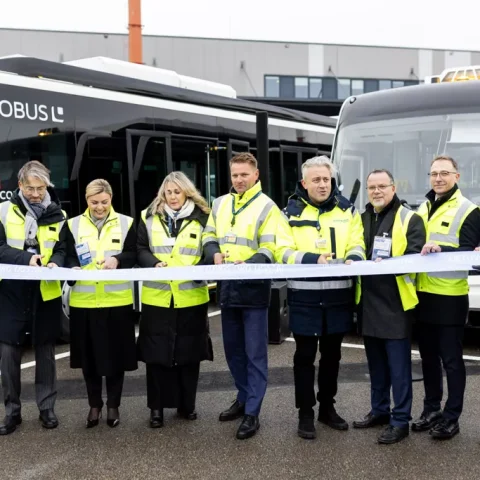
Vilnius Airport has replaced its entire diesel passenger bus fleet with 12 new electric COBUS airport buses, following a €7.2 million investment covering vehicle procurement, maintenance and repairs. The vehicles entered service on 16 November 2026, transporting passengers between the airport terminal and aircraft.
The fleet renewal was announced on 12 November by Lithuanian Airports (LTOU), which operates the country’s airport infrastructure. According to LTOU, the transition to electric passenger transfers is expected to eliminate approximately 58 tonnes of direct CO₂ emissions annually, alongside reductions in local air pollutants and noise on the airport apron.
The project also includes new charging infrastructure and a reorganisation of passenger transfer operations, which are now managed directly by Lithuanian Airports.
The fleet deployment follows the agreement signed by Lithuanian Airports and COBUS in November 2025 for the supply of 12 e.COBUS 2700 electric apron buses, with an option for three additional vehicles. The buses measure nearly 14 metres in length and 2.7 metres in width, and are equipped with 282 kWh batteries. Separately, Vilnius is also renewing its urban public transport fleet: in October 2026, municipal operator VVT secured €110 million in financing from the European Investment Bank and Council of Europe Development Bank to support the acquisition of up to 160 zero-emission buses, including battery-electric and hydrogen vehicles, alongside 145 charging stations and depot upgrades. The urban fleet investment programme is scheduled for completion by the end of 2027.
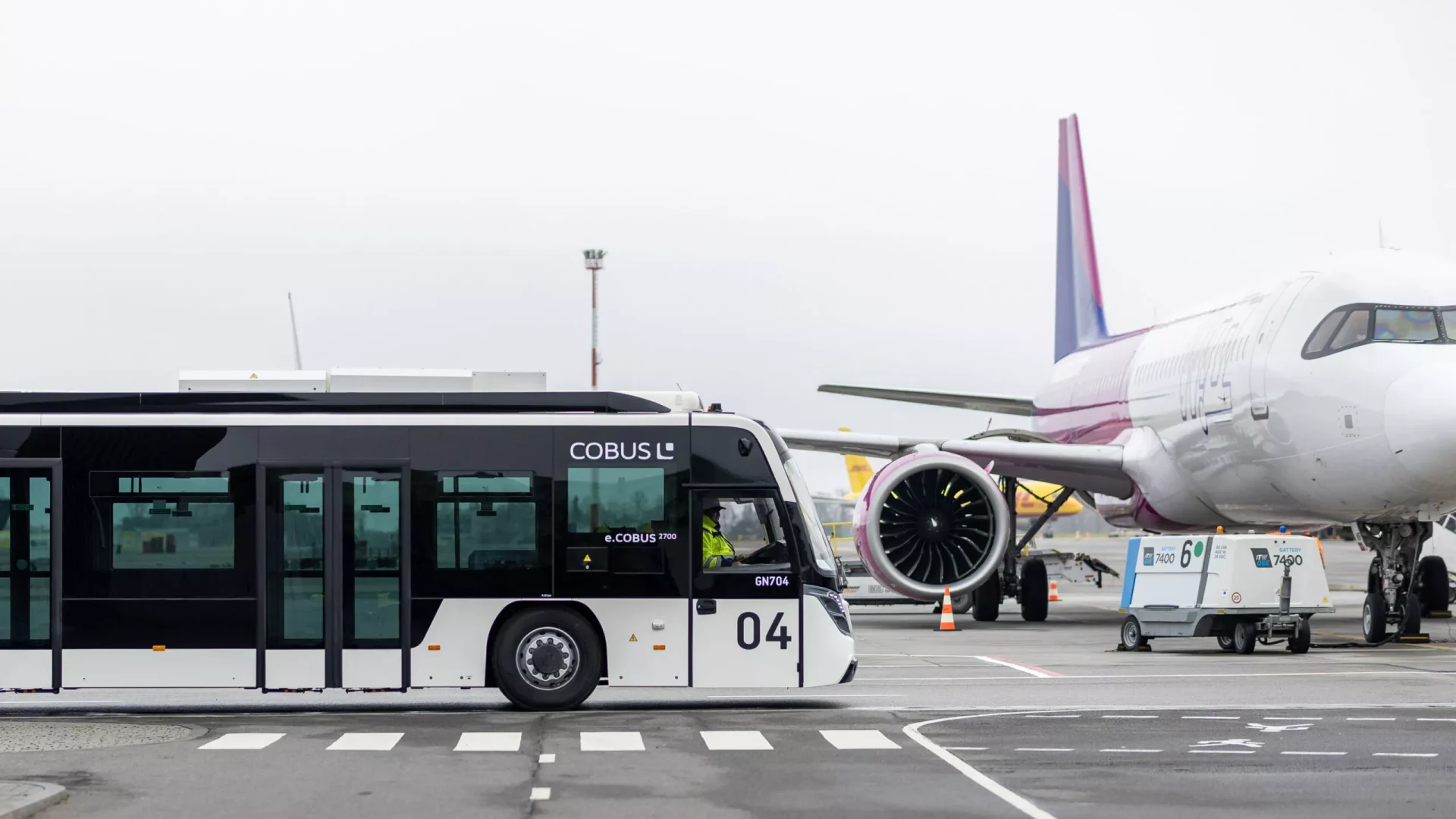
Vilnius Airport deploys 12 electric COBUS buses
The new fleet consists of 12 electric buses manufactured by COBUS and specifically designed for airport apron operations. Each vehicle can accommodate up to 100 passengers, providing a combined fleet capacity of 1,200 passengers.
The buses feature wide doors on both sides, step-free interiors and a kneeling function that allows the vehicle to lower its entrance height at stops. These features are intended to facilitate boarding and alighting for passengers carrying luggage, travelling with pushchairs or requiring reduced-mobility access.
Automatic climate control adjusts interior temperatures according to external conditions, while electric propulsion reduces noise during transfers between the terminal and aircraft.
According to Lithuanian Airports, the electric buses can operate for up to three days on a single charge, depending on operating conditions. The previous diesel buses could operate for approximately 12 hours on a full tank of fuel.
The manufacturer will also provide maintenance services under a five-year agreement, including 24-hour technical support, remote vehicle monitoring, repairs and spare parts supply.
Three dual charging stations installed
Alongside the fleet procurement, Vilnius Airport has installed three dual charging stations capable of charging six buses simultaneously. The infrastructure uses electricity generated from renewable energy sources.
The investment forms part of Lithuanian Airports’ NET ZERO strategy, under which the airport operator has committed to achieving climate neutrality by 2030 and eliminating CO₂ emissions from airport-controlled operations by 2040.
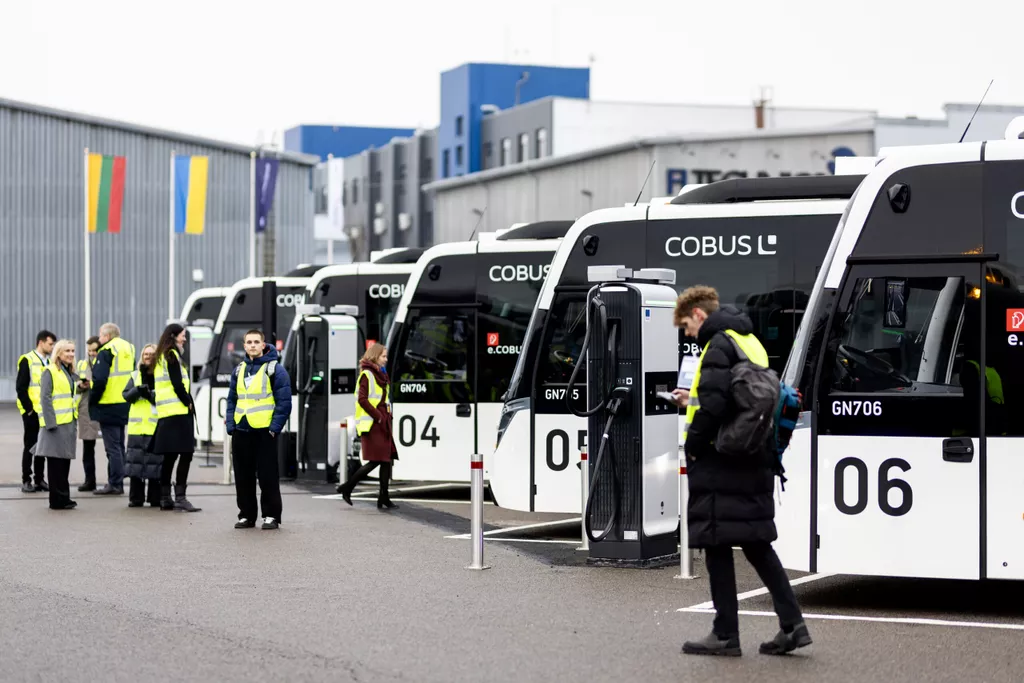
The replacement of diesel passenger buses with electric vehicles is one component of the company’s wider programme to electrify airport vehicles and ground equipment.
The fleet renewal also coincides with a change in the management of passenger transfers. From 16 November, Lithuanian Airports has taken direct responsibility for operating the service, establishing a dedicated organisational unit staffed by 35 experienced drivers.
The new structure brings vehicle scheduling, driver management and coordination with aircraft handling operations under the airport operator’s direct control.
In brief
- How many electric buses has Vilnius Airport introduced? Twelve COBUS electric airport buses, replacing the entire diesel passenger bus fleet.
- How much was invested? €7.2 million, including vehicle procurement, maintenance and repairs.
- What is the passenger capacity? Up to 100 passengers per bus.
- What emissions reduction is expected? Approximately 58 tonnes of direct CO₂ emissions annually.
Živilė Poželienė, Lithuania’s Vice-Minister of Transport and Communications, stated: “When we talk about modernising airports, we usually focus on new terminals and major infrastructure projects. But everyday details matter just as much to passengers, including the few minutes they spend travelling from the terminal to the aircraft. I am pleased that Vilnius Airport will introduce 12 new electric buses designed for all passengers.”
Diana Bankauskienė, Acting CEO of Lithuanian Airports, said: “This is one of our biggest transport infrastructure upgrades in recent years. Our team and partners have spent several years preparing for it, and we are pleased to share the results today. As passenger numbers grow, we want our airports to grow sustainably and become more comfortable to travel through.”
Valdas Stropus, Head of the Operations Department at LTOU, explained the operational changes: “Passenger transfers involve much more than the bus journey itself. We need to plan bus and driver schedules and coordinate transfers with flight handling. Bringing the whole process into one system will help us plan our work better and respond faster when the situation at the airport changes.”