Rio de Janeiro launches $98.2 million PPP for 175 electric buses, backed by $63.5 million BNDES financing
Rio de Janeiro has announced a R$509 million ($98.2 million) project for 175 battery-electric buses and a new charging depot, backed by R$329 million ($63.5 million) in financing from Brazilian development bank BNDES. The financing was announced by the City of Rio de Janeiro on September 25 at Terminal Gentileza and will be provided through […]
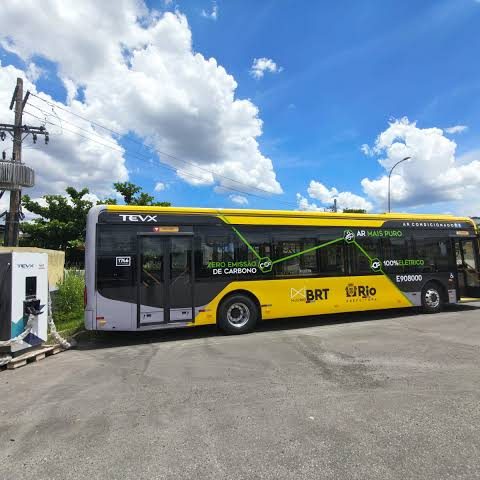
Rio de Janeiro has announced a R$509 million ($98.2 million) project for 175 battery-electric buses and a new charging depot, backed by R$329 million ($63.5 million) in financing from Brazilian development bank BNDES.
The financing was announced by the City of Rio de Janeiro on September 25 at Terminal Gentileza and will be provided through BNDES’s Climate Fund (Fundo Clima). According to the municipality, the project will establish Brazil’s first public-private partnership (PPP) dedicated to electric buses.
The 175 vehicles are scheduled to begin joining the Sistema RIO public transport network in the second half of 2027. The project also includes the construction of a publicly owned depot in Maré, equipped with charging infrastructure.
According to the City of Rio de Janeiro, the new electric buses will electrify the entire bus fleet operating from Terminal Gentileza.
The Rio project comes amid other electric bus investments and industrial developments in Brazil. In 2025, Brazil joined the Global Memorandum of Understanding on Zero-Emission Medium- and Heavy-Duty Vehicles, committing to a target of 100% zero-emission new medium- and heavy-duty vehicle sales by 2040 and an interim target of at least 30% by 2030. Also in 2025, an €80 million financing facility for zero-emission buses in Brazil was launched with the goal of supporting the introduction of more than 1,700 vehicles by 2030. On the manufacturing side, BYD has outlined plans for a new bus factory in Brazil, as the company targets an increase in annual production capacity from around 2,000 to as many as 7,000 units.
Rio’s Sustainable Development Plan sets a target for zero-emission vehicles to account for 20% of the municipal bus fleet by 2030, corresponding to approximately 1,000 buses.
Rio electric bus PPP: R$509 million investment for 175 vehicles
Total investment in the project is estimated at R$509 million, equivalent to approximately $98.2 million. Of this amount, R$329 million ($63.5 million) will be financed by BNDES, R$141.2 million ($27.3 million) will correspond to investment by the concessionaire and R$38.8 million ($7.5 million) will be provided by the municipality.
The BNDES financing will be specifically allocated to the acquisition of the battery-electric buses.
The initiative will be implemented through an administrative PPP with a 16-year contract, comprising one year for implementation and 15 years of operation.
Under the agreement, the concessionaire will be responsible for the partial acquisition of the vehicles, installation of charging infrastructure, construction work at the depot and operation and maintenance of the assets.
According to the ZEBRA-backed E-Bus Radar, Latin America counts 10,628 electric buses, with Brazil accounting for 2,216 vehicles, or around 21% of the regional total. The Brazilian fleet comprises 1,686 standard 12-15 metre e-buses, 333 trolleybuses, 129 battery-electric articulated buses, 46 battery bi-articulated buses and 22 midi e-buses.
New electric bus depot planned in Maré
All 175 buses will be concentrated at a new public depot on Rua Novo Horizonte da Vila do João in Maré, opposite Fundação Oswaldo Cruz on Avenida Brasil.
The site covers approximately 41,000 square metres, of which around 23,000 square metres will be allocated to the electric bus depot.
Plans include areas for vehicle parking and maintenance, administrative facilities and storage, together with the electrical infrastructure required for charging. According to the municipality, charging will take place mainly overnight at the depot.
The project forms part of the Lote Elétrico of Sistema RIO and the municipality’s program to increase the number of zero-emission vehicles in the public transport fleet.
Rio estimates 13,300 tonnes of CO2 savings per year
Over the 16-year period covered by the contract, the municipality estimates cumulative avoided emissions of approximately 199,400 tonnes of CO2 equivalent. The city also expects the deployment to reduce local pollutant emissions and noise from bus operations.
BNDES will provide the R$329 million ($63.5 million) financing through Fundo Clima, a federal financing mechanism supporting projects aimed at reducing greenhouse-gas emissions, including sustainable urban mobility initiatives.
The municipality said operation of the first electric depot is expected to involve approximately 490 drivers, 35 inspectors and 10 dispatchers, in addition to maintenance and administrative personnel.
Around 100 jobs are also estimated during the implementation phase, covering construction, charger installation, electrical adaptations, engineering, vehicle and equipment manufacturing and system testing.
In brief
- How many electric buses will Rio de Janeiro acquire?
The project covers 175 battery-electric buses, scheduled to begin entering service in the second half of 2027. - How much is the project worth?
Total investment is R$509 million, approximately $98.2 million, including R$329 million ($63.5 million) financed by BNDES. - Where will the electric buses be based?
The buses will use a new public depot in Maré, with around 23,000 m² of the site allocated to the electric bus facility. - What is Rio’s zero-emission bus target?
The city targets a 20% zero-emission share of its municipal bus fleet by 2030, corresponding to approximately 1,000 buses.
Rio de Janeiro Mayor Eduardo Cavaliere said: “These 175 buses, which will electrify the entire fleet operating at Terminal Gentileza, are another step in the transformation of the city’s bus transport. The fuel used by buses circulating in the city will also be changed to less polluting biofuels. We will therefore modernize the fleet, combining electrification and biofuels to have greener public transport.”
Luciana Costa, BNDES Director of Infrastructure, Energy Transition and Climate Change, said: “More than talking about resources and new vehicles, we need to look at what this represents in people’s lives: fewer pollutant emissions, quieter and more comfortable journeys and more efficient mobility. Quality public transport means quality of life and more opportunities to study, work and prosper.”
Rio de Janeiro Municipal Transport Secretary Jorge Arraes said: “We are taking another important step towards the decarbonization of Rio’s public transport. The municipality has a long tradition in structuring PPPs and we are now working to enable Brazil’s first electric bus PPP in this format. With technical and financial support from BNDES, through the Climate Fund, we will advance fleet electrification and bring more modern and sustainable transport to the streets. It is the beginning of what we are calling Elétrico Carioca.”