Weser-Ems-Bus launches hydrogen buses with Lhyfe-backed temporary mobile refuelling station in Lower Saxony
A mobile hydrogen refuelling station has enabled Weser-Ems-Bus to place six fuel cell buses into regular passenger service in Lower Saxony while awaiting the completion of a permanent hydrogen refuelling facility. The buses were provided by Portuguese CaetanoBus. The deployment in Jever, in the East Frisia region of Northern Germany, has allowed hydrogen bus operations […]
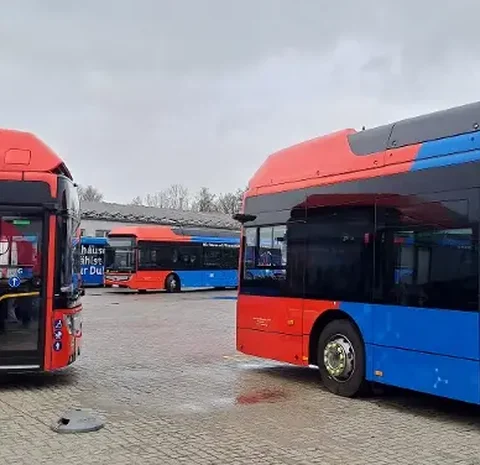
A mobile hydrogen refuelling station has enabled Weser-Ems-Bus to place six fuel cell buses into regular passenger service in Lower Saxony while awaiting the completion of a permanent hydrogen refuelling facility. The buses were provided by Portuguese CaetanoBus.
The deployment in Jever, in the East Frisia region of Northern Germany, has allowed hydrogen bus operations to begin immediately despite the permanent hydrogen station only being scheduled to enter service later in 2026.
The project brings together Weser-Ems-Bus, a subsidiary of DB Regio AG, the Friesland district, research institute ttz Bremerhaven, infrastructure operator MoviaTec and green hydrogen producer Lhyfe. The announcement was made by Lhyfe, which also supplies the renewable hydrogen used by the fleet.
Mobile hydrogen station supports hydrogen bus operations
The mobile hydrogen refuelling station has been operating since December 2025 to supply six fuel cell buses operated by Weser-Ems-Bus. The temporary installation was introduced after the buses had been delivered and a renewable hydrogen supply had been secured, allowing passenger services to start before the permanent infrastructure is completed.
In brief
- How many hydrogen buses are involved in the project? Six fuel cell buses operated by Weser-Ems-Bus have been in service since December 2025.
- Who supplies the hydrogen? Lhyfe provides RFNBO-certified green hydrogen for the fleet.
- Who operates the mobile refuelling station? The station is owned by ttz Bremerhaven and operated by MoviaTec.
- When will the permanent hydrogen station be available? The permanent refuelling station in Schortens is scheduled to enter service during 2026.
The station operates at 350 bar, the pressure commonly adopted for hydrogen-powered buses and commercial vehicles. According to the project partners, several refuelling scenarios were modelled before commissioning based on the expected hydrogen demand of the fleet. Operational experience collected during daily service is now being used to validate those simulations.
The partners report that actual refuelling operations have been completed more quickly than anticipated during the initial modelling phase. The mobile station will remain in operation until the permanent hydrogen refuelling facility in Schortens, within the JadeWeserPark industrial area, enters service later in 2026.
Lhyfe, ttz Bremerhaven and MoviaTec involved
The project combines the expertise of several organisations with distinct responsibilities:
- ttz Bremerhaven supplied the mobile hydrogen refuelling station and is carrying out scientific monitoring of the deployment, collecting operational data on vehicle performance and daily hydrogen bus operation.
- MoviaTec operates the refuelling station in Jever, managing day-to-day operations, safety procedures, explosion protection documentation, inspections, commissioning support and technical assistance during operation.
- Lhyfe supplies RFNBO-certified green hydrogen for the buses. The company operates four RFNBO-certified hydrogen production sites, a fleet of more than 80 Type IV hydrogen transport containers and around fifteen hydrogen storage locations across Europe. According to Lhyfe, the hydrogen supplied to the project complies with the European Union’s sustainability requirements.
The partners present the mobile refuelling concept as a solution that allows vehicle deployment and hydrogen infrastructure development to progress on different schedules while maintaining hydrogen supply throughout the initial operational phase. The information was released by Lhyfe.
Daniel Marx, Managing Director, Weser-Ems-Bus, a subsidiary of DB Regio AG: “We are actively shaping the future of mobility and take our responsibility for climate protection seriously. With the help of funding from the Federal Ministry of Transport, around 10% of DB Regio Bus Nord’s fleet runs emissions-free, mostly on battery-electric. In close cooperation with the Friesland district, we were able to test the use case of hydrogen mobility and gained important experience for the future.”
Günther Schumacher, Project manager, ttz Bremerhaven: “From our previous projects, we are familiar with the challenges involved in introducing hydrogen buses. By analysing the routes and the needs of the bus operator, we were able to develop suitable scenarios for on-demand refuelling of the hydrogen buses introduced in Jever and to implement our hydrogen refuelling system there. Under everyday operating conditions, the refuelling station worked very well and has even exceeded expectations.”
Frank Rößler, Managing Director of MoviaTec GmbH: “This project demonstrates that hydrogen mobility can be implemented quickly and reliably when infrastructure, supply and operation are closely coordinated. As operator of the mobile refuelling station, MoviaTec ensures safe day-to-day operation and supports the project with its practical experience in hydrogen infrastructure, commissioning and technical operations.”
Pascal Louvet, Sales Director Germany at Lhyfe: “Across Europe, we are seeing increasing maturity within hydrogen mobility ecosystems and a strong determination to accelerate deployment. The technologies are available, initial use cases are proving successful, and local stakeholders are progressively organising around operational projects. The challenge today is to enable these projects to move forward quickly through efficient solutions adapted to real-world conditions. Mobile refuelling stations really hit this nail on the head.”