India’s electric bus registrations grow 40% in H1 2026, reaching 2,944 units; Switch Mobility leads market
India registered 2,944 electric buses between January and June 2026. According to data published by the Vahan Dashboard, India’s electric bus market recorded 2,944 vehicle registrations during the first six months of 2026, Switch Mobility, JBM and PMI Electro Mobility Solutions together represented 70% of total registrations. Compared to the same period of 2025, Indian […]
India registered 2,944 electric buses between January and June 2026. According to data published by the Vahan Dashboard, India’s electric bus market recorded 2,944 vehicle registrations during the first six months of 2026, Switch Mobility, JBM and PMI Electro Mobility Solutions together represented 70% of total registrations. Compared to the same period of 2025, Indian e-bus market grew +40%.
In 2025, India registered 3,961 electric buses, with Switch Mobility ending last year as the leading manufacturer with 1,235 registrations (growing 6-fold!), followed by PMI Electro Mobility (744), Olectra Greentech (592) and JBM Auto (564).
Switch Mobility, JBM Auto and PMI lead India’s e-bus market
Switch Mobility ranked first with 830 registrations, corresponding to a 28.2% market share. JBM Auto Limited followed with 635 units (21.6%), while PMI Electro Mobility Solutions registered 574 units (19.5%). Together, these three manufacturers accounted for 2,039 registrations.
| Manufacturer | E-bus registrations H1 2026 | Market share % H1 2026 | Market share % 2025 | Market share % 2024 |
| Switch Mobility | 830 | 28.2 | 21 | 3.6 |
| JBM Auto Limited | 635 | 21.6 | 15.7 | 15 |
| PMI Electro Mobility Solutions | 574 | 19.5 | 23.4 | 14.3 |
| Olectra Greentech | 280 | 9.5 | 22.3 | 17.8 |
| Pinnacle Mobility Solutions | 171 | 5.8 | 7 | 2.7 |
| JBM Electric Vehicles | 169 | 5.7 | data not available | data not available |
| Aero Eagle Automobiles | 113 | 3.8 | 1.6 | 1 |
| Tata Motors | 71 | 2.4 | 5 | 39.2 |
| VE Commercial Vehicles | 53 | 1.8 | data not available | data not available |
| Others | 48 | 1.6 | data not available | data not available |
| Total | 2,944 | 100 |
The JBM Group, combining JBM Auto Limited and JBM Electric Vehicles Pvt Ltd, registered a total of 804 buses during the first half of the year, getting then very close the the leading seller Switch Mobility.
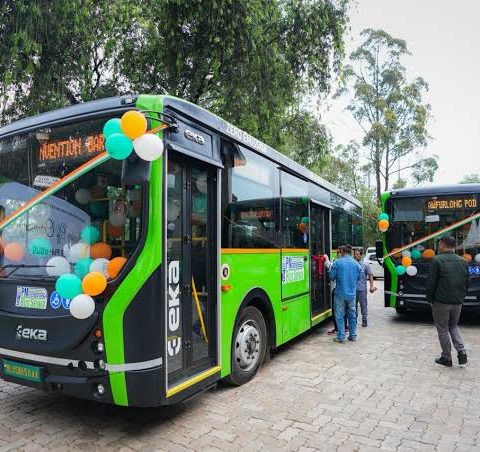
Olectra Greentech Ltd ranked fourth with 280 registrations (9.5%), followed by Pinnacle Mobility Solutions Pvt Ltd (including EKA Mobility brand) with 171 units (5.8%) and JBM Electric Vehicles Pvt Ltd with 169 units (5.7%). Aeroeagle Automobiles Pvt Ltd recorded 113 registrations, while Tata Motors registered 71 units. VE Commercial Vehicles reported 53 registrations, ahead of JSW Mobility (25), AZAD India Mobility Ltd (14), Veera Vidyuth Vahana Pvt Ltd (8) and Neuton Auto Pvt Ltd (1).
In brief
- How many electric buses were registered in India during H1 2026? A total of 2,944 electric buses were registered between January and June 2026.
- Which manufacturer led the market? Switch Mobility Automotive Ltd ranked first with 830 registrations and a 28.2% market share.
- How many OEMs recorded registrations? Thirteen manufacturers registered electric buses during the first half of 2026.
Electric bus market in India, the evolution of market shares
Comparing the first half of this year data with the figures recorded in 2024 and 2025, Switch Mobility Automotive Ltd recorded the strongest market share growth over the three periods. The manufacturer accounted for 3.6% of registrations in 2024, 21.0% in 2025 and 28.2% in H1 2026, ranking first with 830 registered buses.
Tata Motors continued to represent a marginal share of registrations compared with previous years. The manufacturer accounted for 39.2% of registrations in 2024, 5.0% in 2025 and 2.4% in H1 2026, with 71 registered buses during the first six months of the year. Recently, the OEM released a press note announcing it has secured 500 e-bus orders as electric commercial vehicle bookings exceed 3,400 units. The Indian group is in the process of taking over Iveco Group following deal announced in September 2025, with closing of the transaction expected in Q3 2026.
JBM Auto Limited increased its market share from 15.0% in 2024 to 15.7% in 2025 and 21.6% in H1 2026. What is crucial, including JBM Electric Vehicles Pvt Ltd, the JBM Group registered a combined 804 buses during the first half of 2026, corresponding to a 27.3% market share.
PMI Electro Mobility Solutions represented 14.3% of registrations in 2024 and 23.4% in 2025. During H1 2026, the company registered 574 buses, accounting for 19.5% of the market and remaining among the three largest manufacturers by registrations.
With contribution by Usha Sandhya