Verona’s new Hess trolleybuses complete first tests under overhead wires, ahead of planned service launch in early 2027
On the nights of Tuesday 10 November, Wednesday 11 November and Thursday 12 November 2026, operational tests were carried out on Verona’s trolleybus network. Following trials conducted in September, during which the trolleybuses operated in autonomous battery mode, the vehicles ran for the first time with their trolley poles connected to the overhead wires. Verona […]
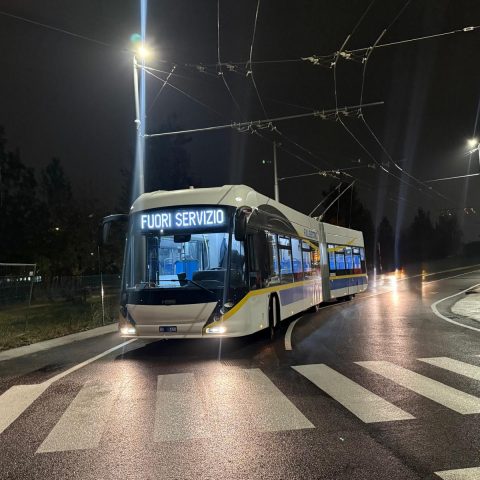
On the nights of Tuesday 10 November, Wednesday 11 November and Thursday 12 November 2026, operational tests were carried out on Verona’s trolleybus network. Following trials conducted in September, during which the trolleybuses operated in autonomous battery mode, the vehicles ran for the first time with their trolley poles connected to the overhead wires. Verona currently has the first six vehicles of a fleet that could eventually reach 39 units.
Trolleybuses are returning to the streets of Verona after 51 years, following the closure of the urban trolleybus network in 1975, after 38 years of operation. At the time, an interurban trolleybus network also connected Verona with San Bonifacio, Domegliara, Grezzana and Soave. The interurban network, discontinued between 1979 and 1981, operated at 1,200 V, while the urban network used a 600 V power supply.
The return of trolleybuses to Verona follows a long and complex development process. As reported on our sister media Autobusweb, the new trolleybus network project, launched in 2007 and approved by the Italian Ministry of Infrastructure and Transport in 2018, initially envisaged the start of operations in 2022. Following years of delays, the first two articulated Hess trolleybuses arrived in the city in June 2026, measuring 18 metres in length, as part of a procurement programme that could eventually reach 39 vehicles. The initial running tests preceded the more recent trials under overhead wire power, a necessary step towards the start of passenger operations.
Trolleybus testing in Verona
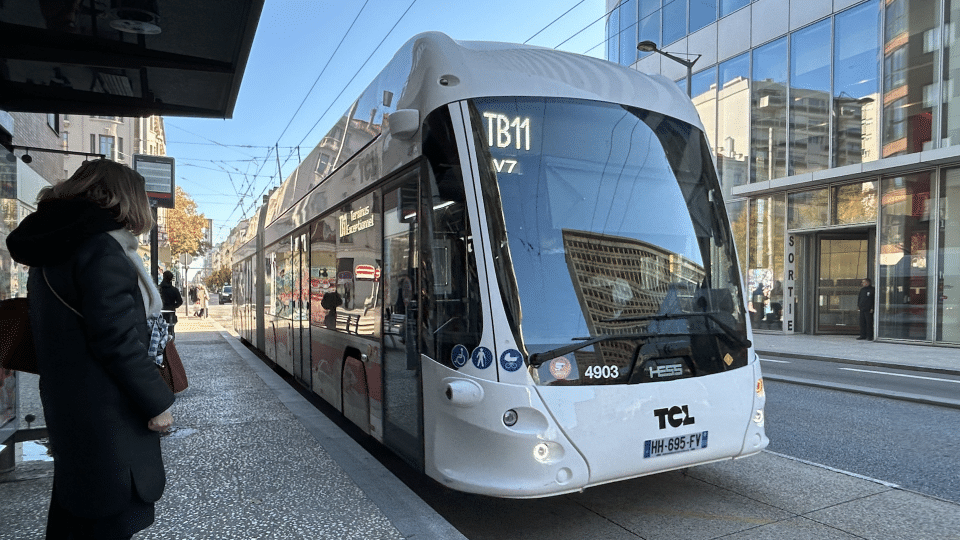
The new network operates at 750 V and the vehicles are Carrosserie Hess lighTram 19 trolleybuses, equipped with the main features of a modern trolleybus: low-floor accessibility, air conditioning for both the driver’s cab and passenger compartment, and video surveillance. The vehicles are also fitted with batteries enabling autonomous operation under normal service conditions, using IMC (In Motion Charging) technology, which allows the batteries to be progressively recharged while the trolleybus is connected to the overhead wires.
This technology, successfully introduced in Cagliari in 2016 and now widely adopted in new-generation trolleybuses, makes it possible to operate on sections of the route without overhead wiring, as is the case in Verona.
The tests took place between the Genovesa depot and the stadium, via the railway station, and also covered the branch running from Viale dell’Agricoltura to the Borgo Roma University Hospital.
The inspections focused primarily on the geometry of the overhead contact wires and switches, supplied by Elektroline, including wire heights, contact points, switches and the operation of the devices used to raise and lower the trolley poles. Acceleration and braking performance were also tested, stops at passenger platforms were simulated, and energy consumption was measured. Particular attention was paid to the batteries, which provide power when the trolleybus operates autonomously, without drawing electricity from the overhead line.
The onboard electrical and traction systems were analysed directly through the trolleybus’s computer systems. By connecting to the onboard software, technicians were able to monitor operating parameters and verify that the vehicle’s response matched the expected performance.
During Thursday’s trials, the vehicle was loaded with ballast to simulate full passenger capacity. The trolleybus covered the same sections of the route as in the previous tests, allowing technicians to assess the impact of a full load on vehicle range and performance.
Thursday’s tests also produced positive results, with performance meeting expectations.
“Taking so many years to see trolleybuses running through the city is a record that Verona needs to leave behind,” said Tommaso Ferrari, Verona’s Councillor for Mobility and Major Infrastructure Projects. “Over the years, we have heard many promises but seen few projects completed. We are working to make up for lost time and respond to residents who have been calling for better public transport for years. The initial tests have produced encouraging results, and we are determined to complete all the necessary checks before the service enters operation. Verona needs to provide more frequent and reliable public transport and begin closing the gap with other cities.”
“I am very pleased with the positive results of the on-road tests carried out over the past few nights,” said Giuseppe Mazza, President of AMT3. “They confirm the quality and professionalism with which this important project has been carried out. I would therefore like to thank all the companies involved and their employees, whose commitment and expertise have contributed to achieving this result.
“Part of the IT system still needs to be completed before the ministerial certification body can be called in. The body is expected to begin functional testing during December.
“If, as I hope, there are no unforeseen setbacks, we can look ahead to the beginning of the new year with confidence: by then, at the latest, our city will finally see its trolleybus system enter service.”