Blue Bird to ramp up electric school bus production: up to 5,000 units/year
Blue Bird has openend a new facility in Fort Valley, Georgia. The new Electric Vehicle (EV) Build-up Center is the outcome of the conversion of a 40,000 sq.ft. facility. This milestone represents Blue Bird’s commitment to expanding its production capacity from 4 to 20 electric vehicles per day. According to the U.S. Environmental Protection Agency […]
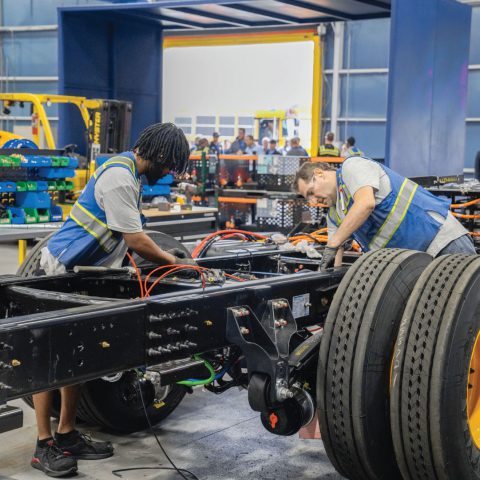
Blue Bird has openend a new facility in Fort Valley, Georgia. The new Electric Vehicle (EV) Build-up Center is the outcome of the conversion of a 40,000 sq.ft. facility. This milestone represents Blue Bird’s commitment to expanding its production capacity from 4 to 20 electric vehicles per day.
According to the U.S. Environmental Protection Agency (EPA), it is projected that 30 percent of all school buses manufactured in 2027 will be electric-powered. This percentage is expected to rise to 45 percent by 2032, based on the EPA’s proposed greenhouse gas emissions standards for heavy-duty vehicles, according to figures presented by Blue Bird.
Blue Bird’s EV Build-up Center will enable the company to increase its long-term production capacity to 5,000 electric school buses annually, Blue Bird states.
North America, funding for zero emission school buses
To support this transition to zero emission school buses, significant public funding sources, totaling over $10 billion, have been allocated, Blue Bird states. The recent Bipartisan Infrastructure Law (BIL) passed by the Biden Administration provides $5 billion over five years specifically for clean school bus transportation.
Blue Bird anticipates receiving thousands of additional electric school bus orders worth approximately $1 billion over the next five years, driven by the funding provided by the Bipartisan Infrastructure Law.
The EV Build-up Center is part of Blue Bird’s multi-million dollar investment in upgrading its Fort Valley manufacturing site. The facility features a dedicated assembly line for electric school buses, where skilled technicians install electric batteries and other components to transform the vehicles into emission-free buses.
Blue Bird has currently nearly 1,000 electric-powered, zero-emission school buses already in operation. The company will assemble its Vision and All American electric school buses at the EV Build-up Center. These buses have the capacity to carry between 77 and 84 students for up to 120 miles on a single charge, the manufacturer states.