Irizar e-mobility receives new order for five ie tram electric buses from Tuvisa in Vitoria-Gasteiz
Tuvisa, the municipal public transport operator of Vitoria-Gasteiz, Spain, has ordered five additional Irizar ie tram battery-electric buses, comprising three 18-metre articulated units and two 12-metre vehicles. The new contract marks the fourth order placed by the operator with Irizar e-mobility since 2019, bringing the total number of vehicles purchased under the collaboration to 33. […]
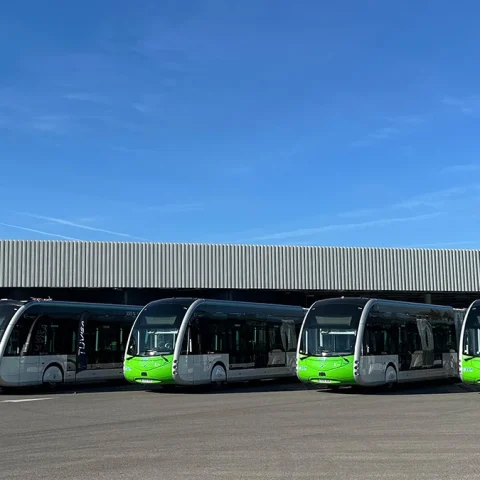
Tuvisa, the municipal public transport operator of Vitoria-Gasteiz, Spain, has ordered five additional Irizar ie tram battery-electric buses, comprising three 18-metre articulated units and two 12-metre vehicles. The new contract marks the fourth order placed by the operator with Irizar e-mobility since 2019, bringing the total number of vehicles purchased under the collaboration to 33.
The agreement was announced by Irizar e-mobility, which manufactures the ie tram range at its plant in Aduna, in the Basque Country.
In summer 2026, Irizar e-mobility introduced the new-generation ie tram Efficient, an updated version of its electric bus range. However, the manufacturer has not specified whether Tuvisa’s latest order covers the new ie tram Efficient or the previous generation of the model.
Tuvisa orders five additional Irizar ie tram electric buses
The latest order includes three articulated 18-metre vehicles and two 12-metre buses, continuing the deployment of the ie tram model in Vitoria-Gasteiz.
The new vehicles will join a fleet that received ten Irizar electric buses in December 2024, comprising six articulated 18-metre vehicles and four 12-metre units. These buses entered service on Line 4 and are housed at the city’s Electromobility Centre. Charging takes place overnight at the depot on Avenida del Zadorra, with pantograph fast charging also available.
According to the previously published fleet information, the 18-metre vehicles can accommodate up to 128 passengers, compared with 80 for the 12-metre models. The buses feature wheelchair spaces, automatic and manual ramps, passenger information displays and driving assistance equipment.
Irizar e-mobility and Tuvisa: four orders since 2019
The collaboration between Irizar e-mobility and Tuvisa began in 2019 with an initial order for 13 ie tram buses in 12-metre and 18-metre configurations. The vehicles were delivered in 2020 for the development of the city’s EIB (Electric Intelligent Bus) system.
The first 12-metre Irizar ie tram was presented in Vitoria-Gasteiz in July 2020. The original project covered Tuvisa’s Line 2 and included ultra-fast charging infrastructure at the Mendizorrotza and Boulevard stops, designed to recharge vehicles in approximately four minutes. The charging equipment was also supplied by the Irizar Group.
A further ten vehicles joined the fleet in 2024, followed by five additional ie tram buses in 2025. The latest acquisition brings the total to 33 vehicles ordered across four procurement rounds.
In brief
- How many electric buses has Tuvisa ordered? Five new Irizar ie tram buses, bringing cumulative orders from Irizar e-mobility to 33.
- Which vehicle lengths are included? Three articulated 18-metre buses and two 12-metre buses.
- When did the collaboration begin? In 2019, with an initial order of 13 buses delivered in 2020.
- Where are the buses manufactured? At Irizar e-mobility’s Aduna plant in Spain.
Iñigo Azcona, commercial director of Irizar e-mobility for Spain and Portugal, stated: “For us, it’s deeply satisfying that Tuvisa and the City of Vitoria-Gasteiz has chosen one of our solutions again. This new addition is the fourth time they’ve put their trust in Irizar e-mobility, which shows the soundness of a collaboration that started in 2019. Moreover, it’s especially gratifying to see our ie trams on the road so close to our Aduna plant, where they’re designed and manufactured. Vitoria-Gasteiz is a European leader in sustainable mobility, and we are extremely proud to be going hand-in-hand with the city in their transition to cleaner and more efficient mobility. We hope to keep moving in the same direction together, and to keep contributing to the development of more sustainable cities for many years to come.”