Battery swapping for buses: SUN Mobility unveils modular solution on Tata Starbus EV
SUN Mobility has unveiled a modular multi-battery swapping solution for electric buses demonstrated on the Tata Starbus EV platform at Prawaas 5.0. The solution was inaugurated by Amrendra Kishore Singh, Director at the Ministry of Heavy Industries, in the presence of representatives from Tata Motors Commercial Vehicles and SUN Mobility. A The platform is designed […]
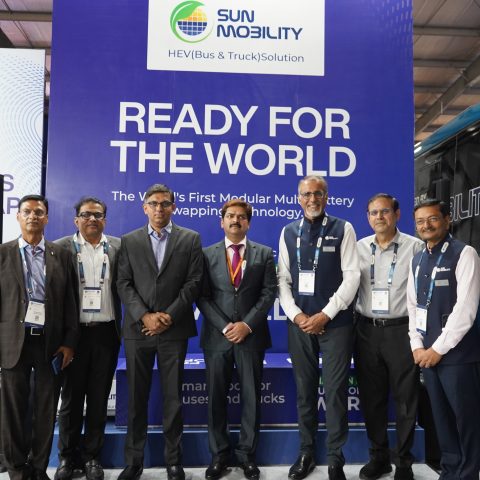
SUN Mobility has unveiled a modular multi-battery swapping solution for electric buses demonstrated on the Tata Starbus EV platform at Prawaas 5.0.
The solution was inaugurated by Amrendra Kishore Singh, Director at the Ministry of Heavy Industries, in the presence of representatives from Tata Motors Commercial Vehicles and SUN Mobility. A
The platform is designed to support commercial bus electrification through battery swapping instead of conventional plug-in charging.
SUN Mobility says it currently operates more than 1,900 Swap Points across over 23 cities. According to the company, the network has completed more than 70 million battery swaps, supporting over 2.1 billion electric kilometres while avoiding more than 100,000 tonnes of CO₂ emissions.
At 2024’s edition of Prawaas, the company presented a battery swapping solution with bus manufacturer Veera Vahana. This year at the show EKA Mobility has launched a new 9-metre electric school bus, Tata has introduced the new Ultra Prime and Starbus Prime bus range, Switch Mobility unveiled a 9-meter e-bus, JBM presented a luxury electric coach from Galaxy family.
Modular battery swapping demonstrated on Tata Starbus EV
At the centre of the presentation is SUN Mobility HEV’s AIS-038-certified Modular Multi-Battery Swappable Solution, integrated into the Tata Starbus EV platform. The system enables two battery modules to be exchanged simultaneously, with the complete swapping process taking less than five minutes.
The modular architecture supports both 50 kWh and 100 kWh battery configurations and is designed for commercial vehicles ranging from 3-tonne to 55-tonne gross vehicle weight (GVW). According to SUN Mobility, the same battery, vehicle and swap station architecture can be deployed across staff transportation, urban transit and intercity bus operations.
The company positions the platform as an alternative energy replenishment solution intended to reduce vehicle downtime and improve fleet utilisation.
Battery-as-a-Service model for commercial fleets
The platform is offered through SUN Mobility HEV’s Battery-as-a-Service (BaaS) model, under which the battery remains separate from the vehicle purchase. Operators pay for energy usage while battery ownership, replacement and lifecycle management remain with the service provider.
According to SUN Mobility, the approach is intended to reduce vehicle acquisition costs while addressing battery replacement and technology obsolescence through the service model.
The company states that the platform is OEM-agnostic and has been developed using more than 275 in-house patents.
Each vehicle using the battery swapping system is connected to SUN Mobility HEV’s digital platform, which monitors battery health, location, energy consumption, driver behaviour and predictive maintenance data. Over-the-air software updates are also supported.
The company adds that its proprietary Digital Twin platform creates a virtual representation of battery packs and swap events to support battery monitoring, fault diagnosis, swap scheduling and carbon accounting.
In brief
- What did SUN Mobility unveil at Prawaas 5.0? A modular multi-battery swapping solution for heavy electric vehicles demonstrated on a Tata Starbus EV.
- How long does a battery swap take? The company states that two battery modules can be swapped simultaneously in under five minutes.
- Which battery sizes are supported? The platform supports both 50 kWh and 100 kWh battery configurations.
- What commercial vehicles can use the platform? According to SUN Mobility, the architecture is designed for vehicles ranging from 3 to 55 tonnes GVW, including buses and trucks.
Chetan Maini, Co-Founder and Chairman, SUN Mobility, said, “When we founded SUN Mobility, our vision was to make electric mobility as convenient, scalable, and economically viable as conventional transport by reimagining energy infrastructure. The unveiling of the world’s first Modular Multi-Battery Swappable Solution demonstrated with Tata Starbus EV at Prawaas 5.0 marks a defining milestone in that journey. We believe the modular multi-battery swapping solution has the potential to unlock large-scale electrification across the commercial vehicle ecosystem by delivering a cost-effective and operationally efficient energy solution for diverse applications. As India accelerates its transition to clean mobility, technologies designed and built here can not only transform commercial transportation at home but also position India as a global leader in next-generation electric mobility solutions.”
Ashok Agarwal, CEO, SUN Mobility HEV, said, “The next phase of electrification will not be defined solely by vehicles, but by the energy ecosystems that power them. Our showcase of the World’s first Modular Multi-Battery Swappable Solution on the Tata Starbus EV platform demonstrates how one battery swapping platform can serve staff, intra-city transit, and intercity fleets alike, without compromising on affordability or operational reliability. We see this as a real step towards the mass adoption of EVs in commercial transportation.”