What we saw at APTA EXPO 2026: Solaris makes U.S. debut, new COR Transit brand, ZAVIR shuttle concept (and more)
APTA TRANSform & EXPO 2026 in Chicago brought new market entries and vehicle concepts in a context that showed a clear focus on conventional and hybrid propulsion technologies, as U.S. federal funding priorities have shifted toward a broader mix of bus powertrains. The exhibition at McCormick Place included the North American premiere of the Solaris […]
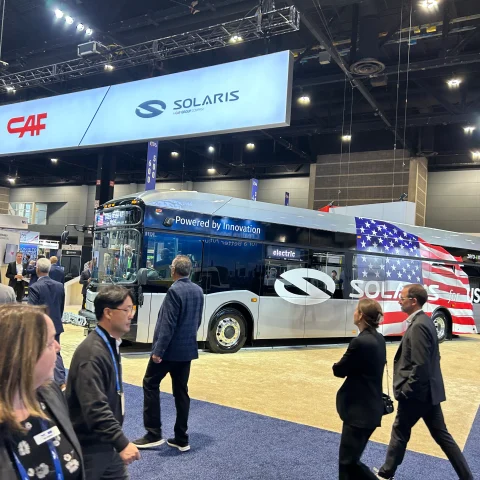
APTA TRANSform & EXPO 2026 in Chicago brought new market entries and vehicle concepts in a context that showed a clear focus on conventional and hybrid propulsion technologies, as U.S. federal funding priorities have shifted toward a broader mix of bus powertrains.
The exhibition at McCormick Place included the North American premiere of the Solaris Urbino 40 electric, the launch of ABC Companies’ COR Transit brand, the first presentation of ENC’s ZAVIR shuttle platform and the announcement of VinFast’s planned entry into the U.S. electric bus market through NexMove. The vehicle displays also included three GILLIG buses covering diesel, hybrid and battery-electric propulsion, three vehicles from NFI Group and the battery-electric Nova Bus LFSe+.
APTA TRANSform & EXPO is being held in Chicago from 4 to 7 October. The event combines the American Public Transportation Association’s conference programme with an exhibition for public transport agencies, vehicle manufacturers and suppliers.
Here is a manufacturer-by-manufacturer overview of what we saw at the show.
APTA EXPO 2026, manufacturer by manufacturer
ABC Companies
ABC Companies used APTA EXPO to introduce COR Transit, a new brand established for the North American heavy-duty transit bus market. The first vehicle under development is a 40-foot diesel transit bus, with prototype activity targeted for 2027 and initial deliveries planned for 2028. Production is planned in the United States.
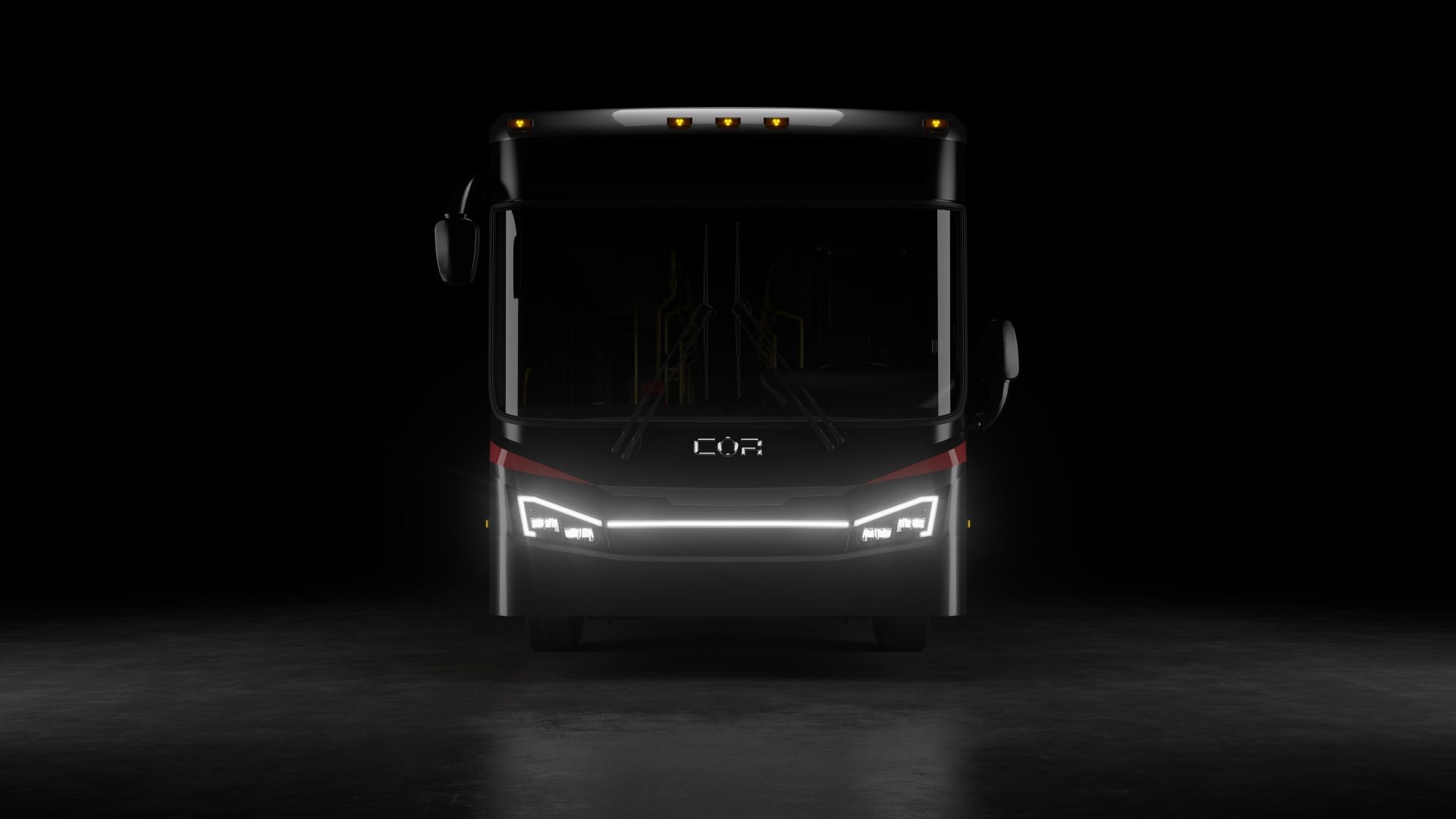
The launch adds a dedicated transit vehicle manufacturing activity to ABC Companies’ existing operations in vehicle distribution, parts, service, refurbishment, training and technical support. According to the company, its current network comprises ten facilities, more than 142 service bays and over 730,000 square feet of parts and service infrastructure. The company supplies parts to more than 700 transit agencies.
The COR Transit project announced at APTA EXPO was the main news from ABC Companies at the exhibition, where the company also displayed several vehicles for specialized applications.
ENC
ENC brought a conventional clean-diesel transit bus to its stand while also using the Chicago exhibition for the first public presentation of ZAVIR, its new medium-duty vehicle brand.
Two versions of the ZAVIR shuttle concept were presented, with low-floor and high-floor configurations. Both are 22 feet long and 8 feet wide and have been designed for up to 18 seated passengers plus standees. Wheelchair access can be provided through either a lift or ramp.
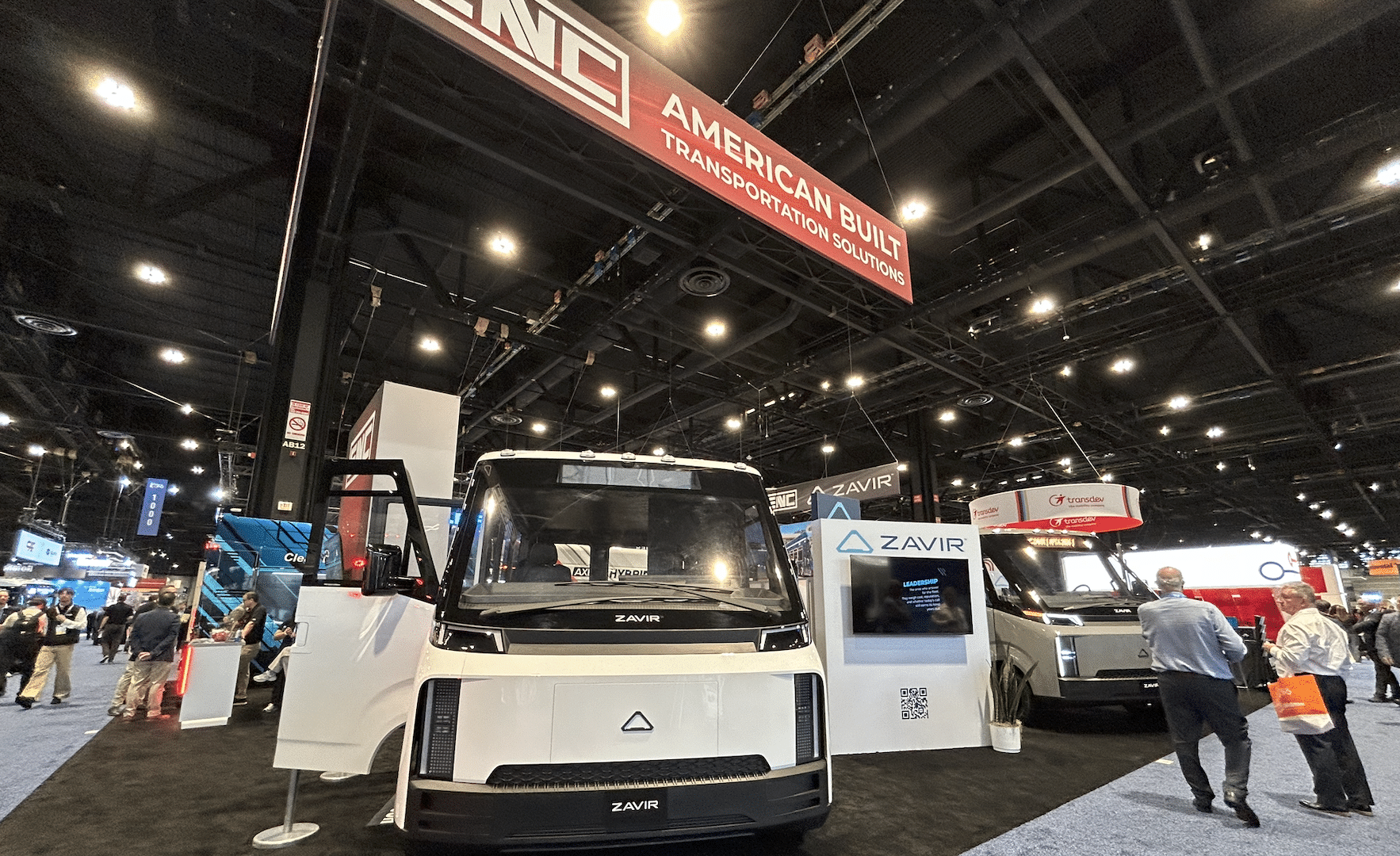
The Class 3 platform has been developed specifically as a shuttle rather than using a conventional van or cutaway architecture. Planned applications include paratransit, airport, campus and corporate transport.
Two propulsion configurations are under development. The battery-electric version has a targeted range of 150 miles and DC fast charging capability of up to 200 kW. ENC is also developing a range-extended electric version using an electric drivetrain combined with a gasoline generator, with a targeted total range exceeding 450 miles.
ENC plans FTA Altoona testing for 2027, followed by reservations from late 2027. Commercial availability and production at the Jurupa Valley, California facility are currently estimated for 2028.
GILLIG
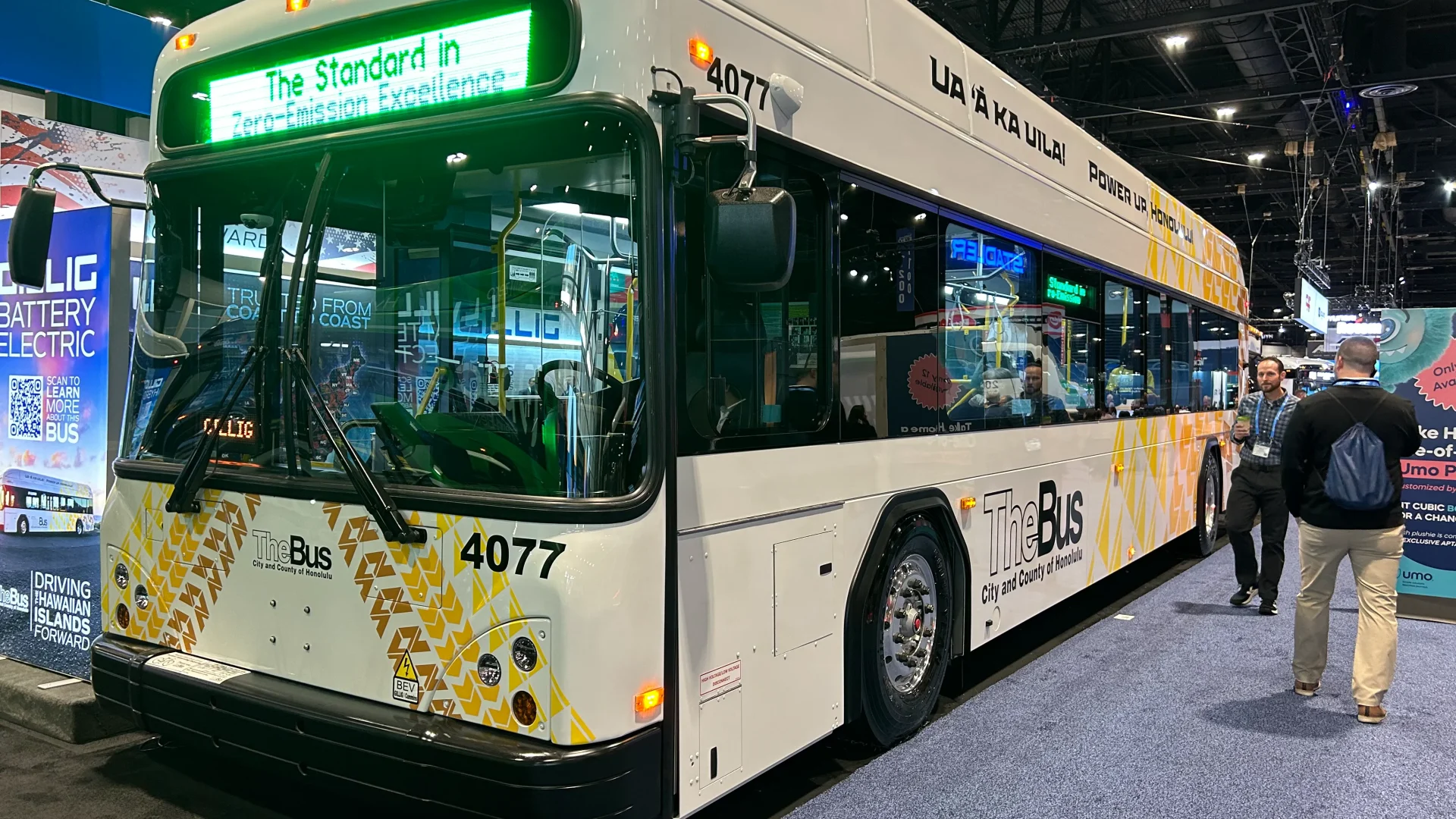
GILLIG presented three different propulsion configurations at APTA EXPO: a 40-foot Low Floor Plus diesel bus for Metro Transit in St. Paul, Minnesota; a 35-foot Low Floor Plus hybrid for Pace in Arlington Heights, Illinois; and a 40-foot Low Floor Plus battery-electric bus for TheBus in Honolulu, Hawaii.
The St. Paul diesel vehicle is powered by a Cummins L9 engine rated at 280 hp, paired with a ZF EcoLife 2 transmission. Its structure combines a bolted extruded-aluminium body with a 3CR12 stainless-steel chassis incorporating integrated side-impact barriers. The customer configuration shown by GILLIG includes a 120-gallon stainless-steel fuel tank, Meritor axles and disc brakes, Michelin tires and a Thermo King HVAC system.
The 35-foot Pace hybrid uses a Cummins B6.7 engine together with an Allison eGen Flex 40 Max transmission. The electrical equipment includes two Vanner Hybrid Beltless Alternators. The vehicle is fitted with a Thermo King TE14 all-electric HVAC unit and Rosco Mobileye Shield+ V4.0 driver-assistance equipment. According to the technical sheet displayed by GILLIG, passenger equipment includes American Seating InSight-Prime+ seats, Q’Straint wheelchair restraint equipment and a Lift-U LU18 ramp.
The battery-electric vehicle displayed in TheBus configuration uses a Cummins TM4 traction motor. Charging is available through two CCS Type 1 connectors, while on-route charging can be carried out using a Schunk Transit Systems pantograph. The vehicle is equipped with electronic cooling, an electrically driven air compressor and Thermo King TE18 all-electric HVAC.
The Honolulu bus also features Meritor axles, disc brakes, ZF ReAX electric-assist steering and two wheelchair areas with Q’Straint equipment. According to the GILLIG technical sheet, the passenger information and electronics package includes Luminator Spectrum full-color destination signs, a seven-camera Safety Vision surveillance system and a Genfare Fast Fare fare collection system.
NFI Group
NFI Group displayed vehicles from New Flyer, Alexander Dennis and Motor Coach Industries (MCI), covering transit bus, double-deck and commuter coach applications.
New Flyer presented an Xcelsior 40-foot hybrid-electric transit bus, representing the hybrid configuration within the Xcelsior heavy-duty transit platform.
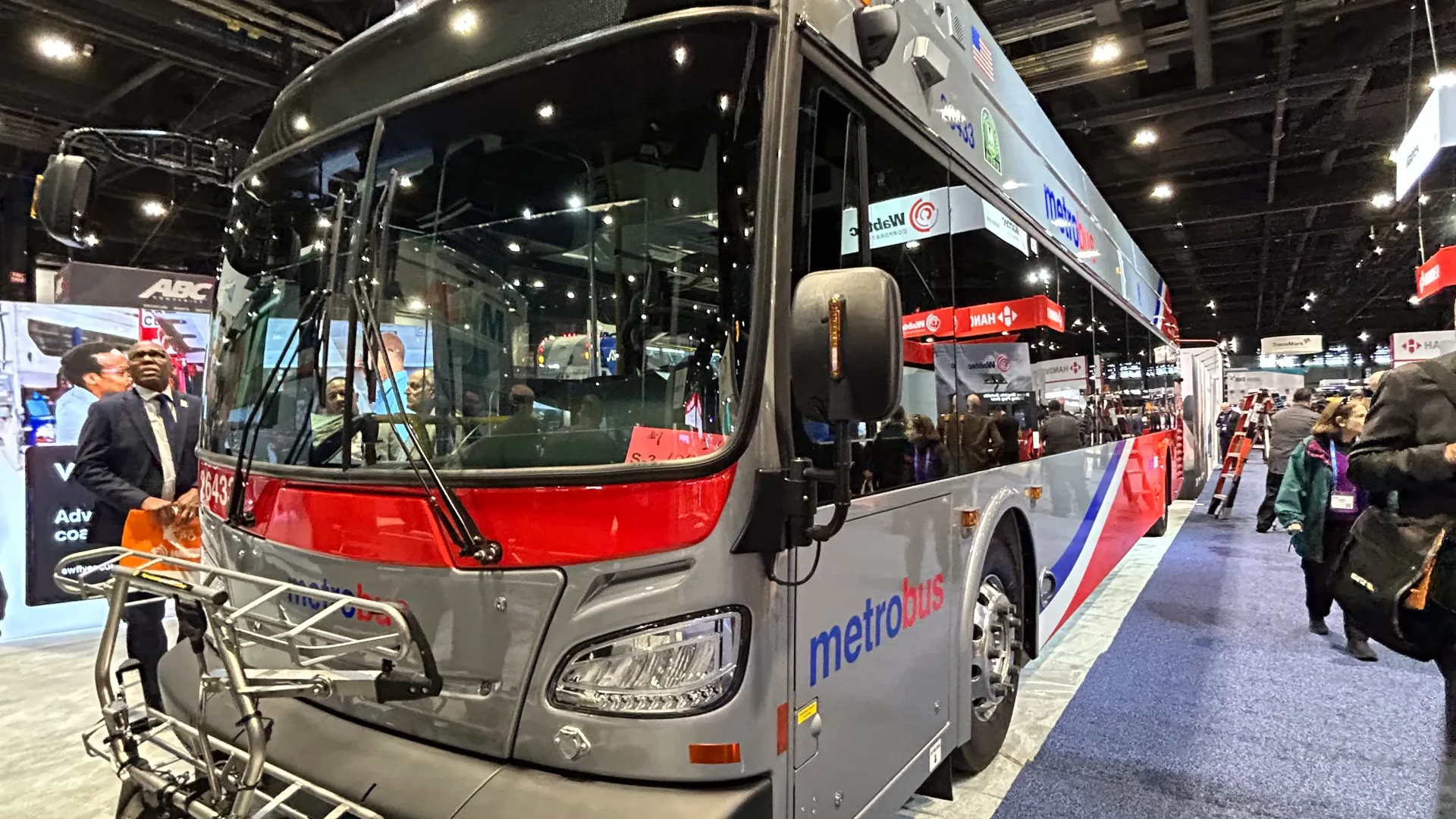
Alexander Dennis was represented by the Enviro500 double-deck bus, a three-axle model for high-capacity transit applications.
MCI displayed the D45 CRT LE, a 45-foot clean-diesel commuter transit coach with a low-entry vestibule developed around passenger accessibility. The vehicle shown at APTA measures 45.82 feet (13.97 metres) long and has a gross vehicle weight of 54,000 lb (24,494 kg).
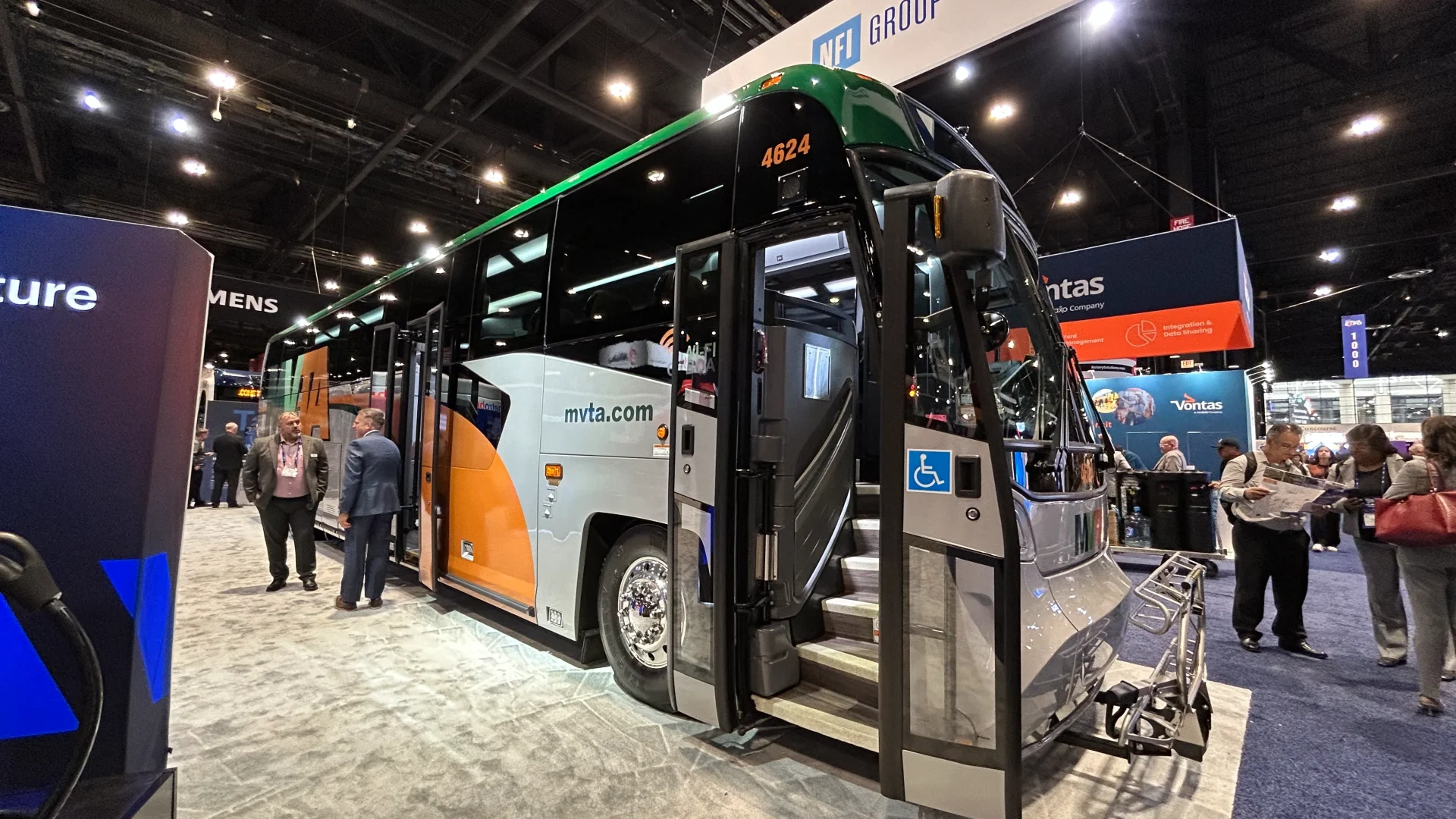
The D45 CRT LE is powered by a Cummins X12 11.8-litre engine, rated at 410 hp and 1,450 lb-ft of torque, paired with an Allison B500 Gen VI automatic transmission with retarder. Passenger capacity is 54 seats.
Accessibility equipment includes a bi-part entrance door and a low-entry vestibule with a 78-inch wheelchair ramp for boarding from ground level. The coach is fitted with Amaya-Astron Sigma passenger seats with three-point belts, a Bitzer air-conditioning compressor and Hanover Displays LED destination signage.
Nova Bus
Nova Bus displayed the LFSe+ battery-electric transit bus at APTA EXPO. The 40-foot (12.19-metre) is 2.59 metres wide and 3.31 metres high, with a 244-inch wheelbase and stainless-steel structure. Passenger capacity reaches up to 41 seated passengers, while total loading capacity is up to 59 passengers with the six-battery configuration and 68 with four batteries.
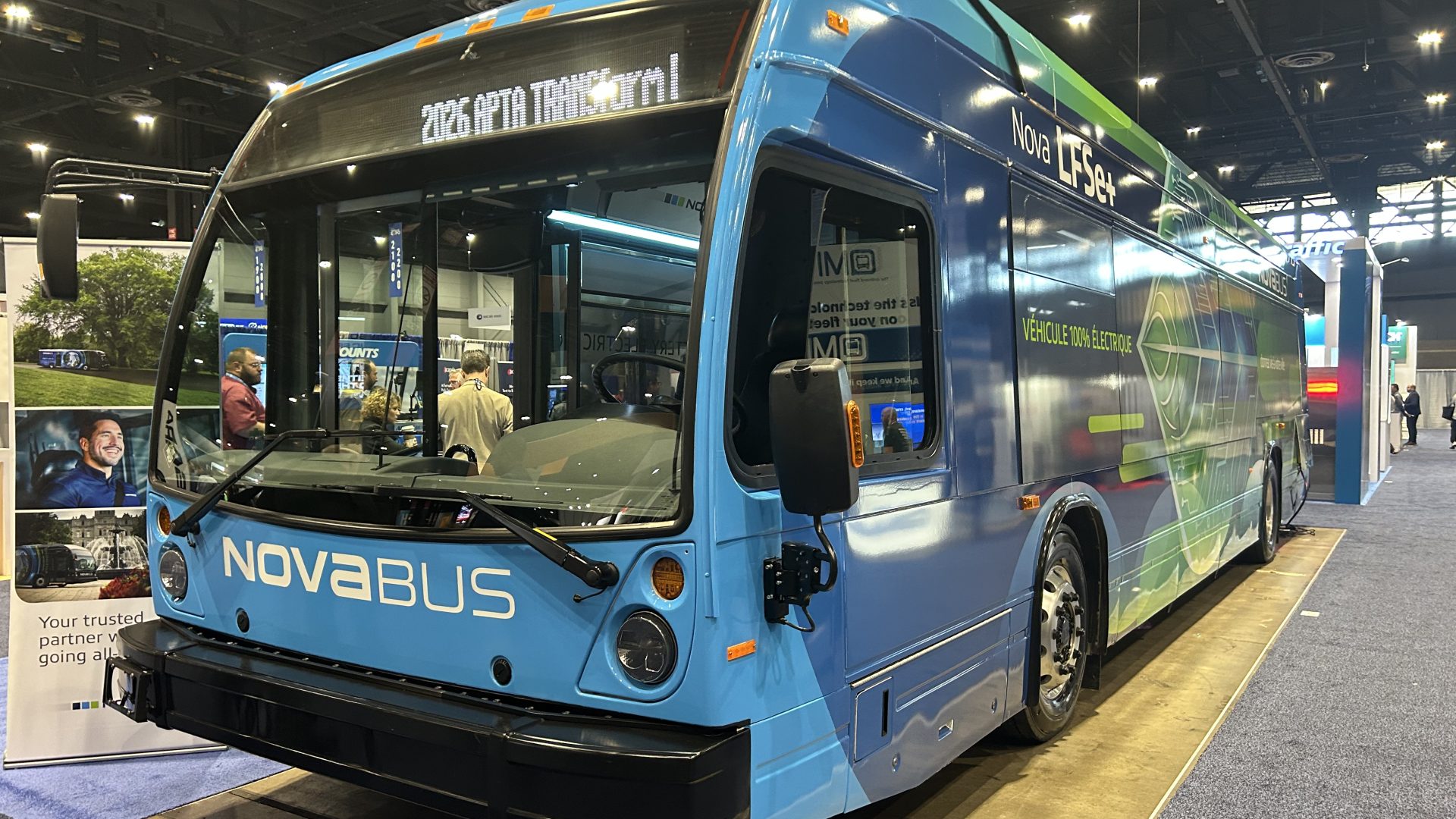
The LFSe+ features modular battery configurations providing up to 564 kWh of onboard energy and supports both depot and opportunity charging. Overhead charging uses the SAE J3105 standard at up to 450 kW, while plug-in charging through CCS Type 1/J1772 reaches 150 kW. According to Nova Bus specifications, overhead charging can provide a 35 kWh energy boost in six minutes, while a full depot recharge can take as little as 3.25 hours depending on operating conditions. The driveline is complemented by regenerative braking with ABS all-wheel disc brakes, ZF front and rear axles and the Nova eCooling system.
The model on display in Chicago comes amid a series of Canadian LFSe+ contracts for Nova Bus, which ended production at its Plattsburgh facility and concentrated its North American manufacturing activities at Saint-Eustache and Saint-François-du-Lac in Québec. In 2023, the manufacturer secured a base order for 339 LFSe+ buses for Québec transit agencies, with a further 890 units included as options, while in 2025 it was awarded a contract for 80 LFSe+ buses for York Region, with deliveries starting in 2026. In June 2026, Montréal operator STM also received the first LFSe+ from its 147-unit order, with the remaining vehicles scheduled for delivery through 2028.
Solaris
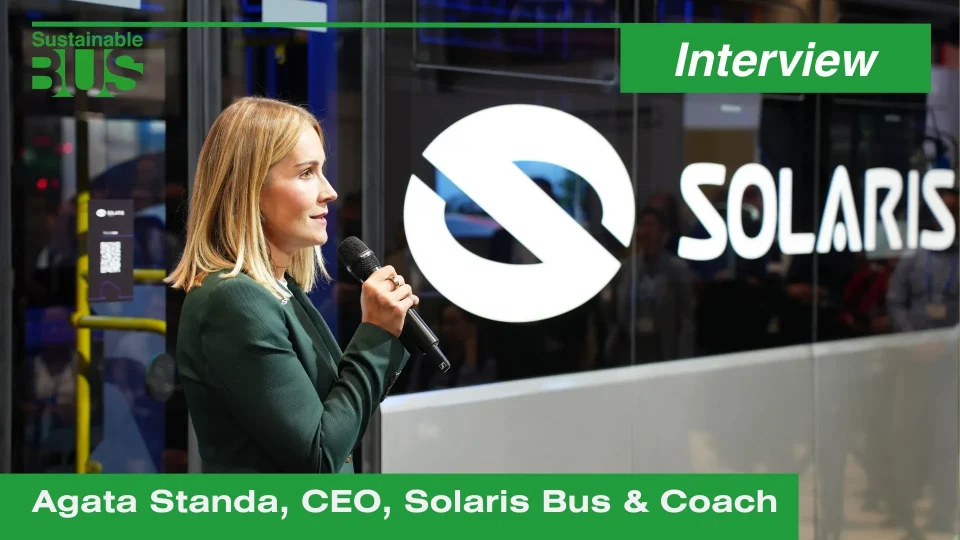
Solaris made its U.S. exhibition debut with the world premiere of the Urbino 40 electric, a 40-foot battery-electric bus developed specifically for the North American market.
The North American Solaris Urbino 40 electric measures 12.19 metres and adopts a Low Entry interior configuration, with the low-floor passenger area at the front followed by a raised rear section. Its roof-mounted batteries provide more than 500 kWh of capacity, while Solaris states a range exceeding 150 miles.
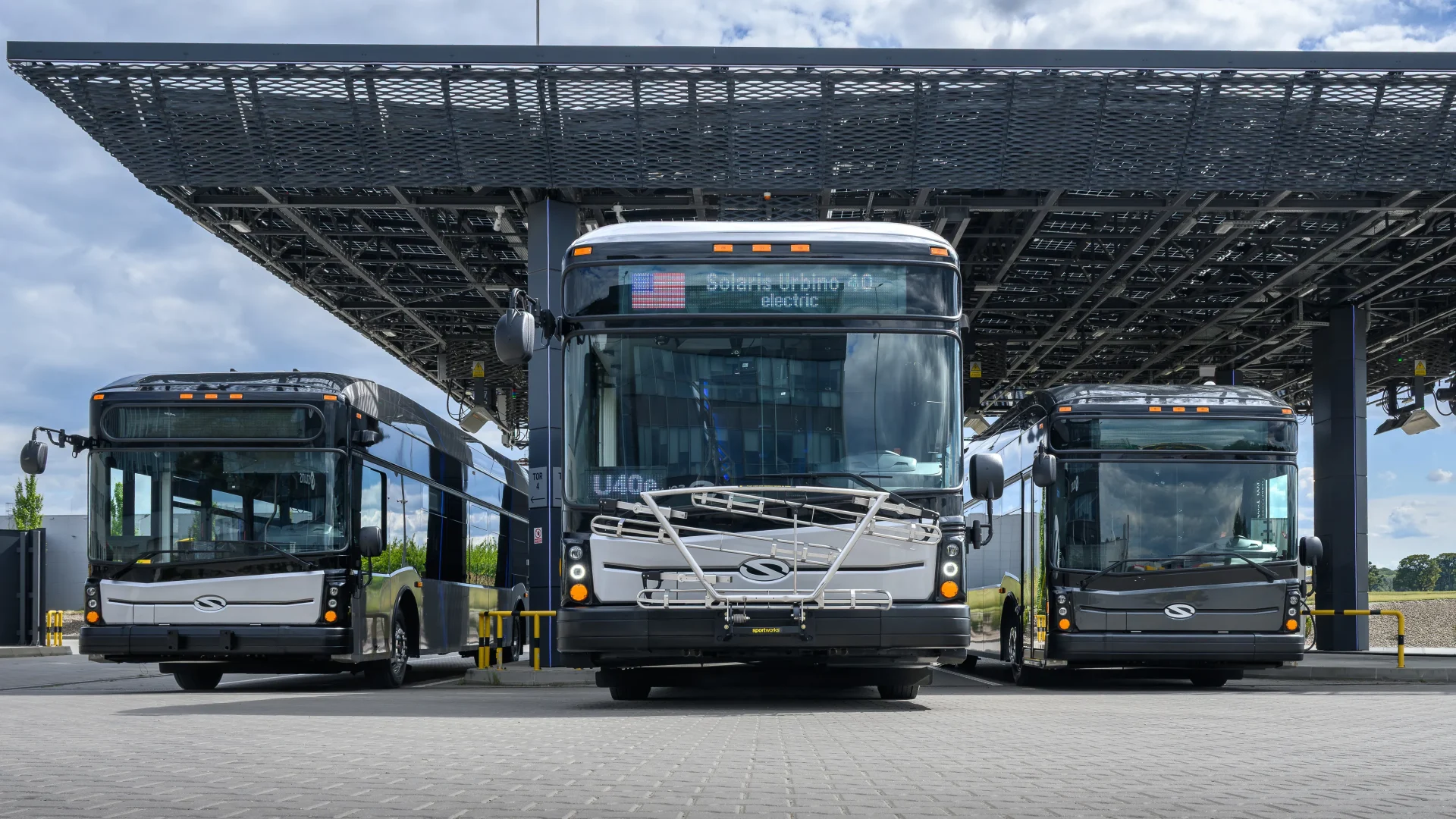
The bus uses a central electric motor, with Solaris stating that the drivetrain can negotiate gradients above 20%. Passenger accommodation reaches 41 seats, including 22 accessible from the low-floor section, together with two ADA-compliant wheelchair spaces. The vehicle has a 2-2 door configuration.
The North American vehicle differs structurally from the European Urbino, including a wider body, longer wheelbase and the Low Entry layout. The operator area includes a fully enclosed compartment, exterior rear-view cameras and cornering lights.
Solaris currently has orders for ten battery-electric buses in the United States. King County Metro ordered two 40-foot and two 60-foot vehicles, with options for additional buses, while San Francisco ordered three standard and three articulated vehicles. The first units are being manufactured in Poland. Solaris has stated that its longer-term U.S. plans include production capacity based on CAF’s existing rail manufacturing footprint in Elmira, New York.
VinFast
VinFast announced at APTA EXPO its planned entry into the U.S. electric bus market through a partnership with NexMove, a joint venture between Transportation Management Services and Zeem Solutions.
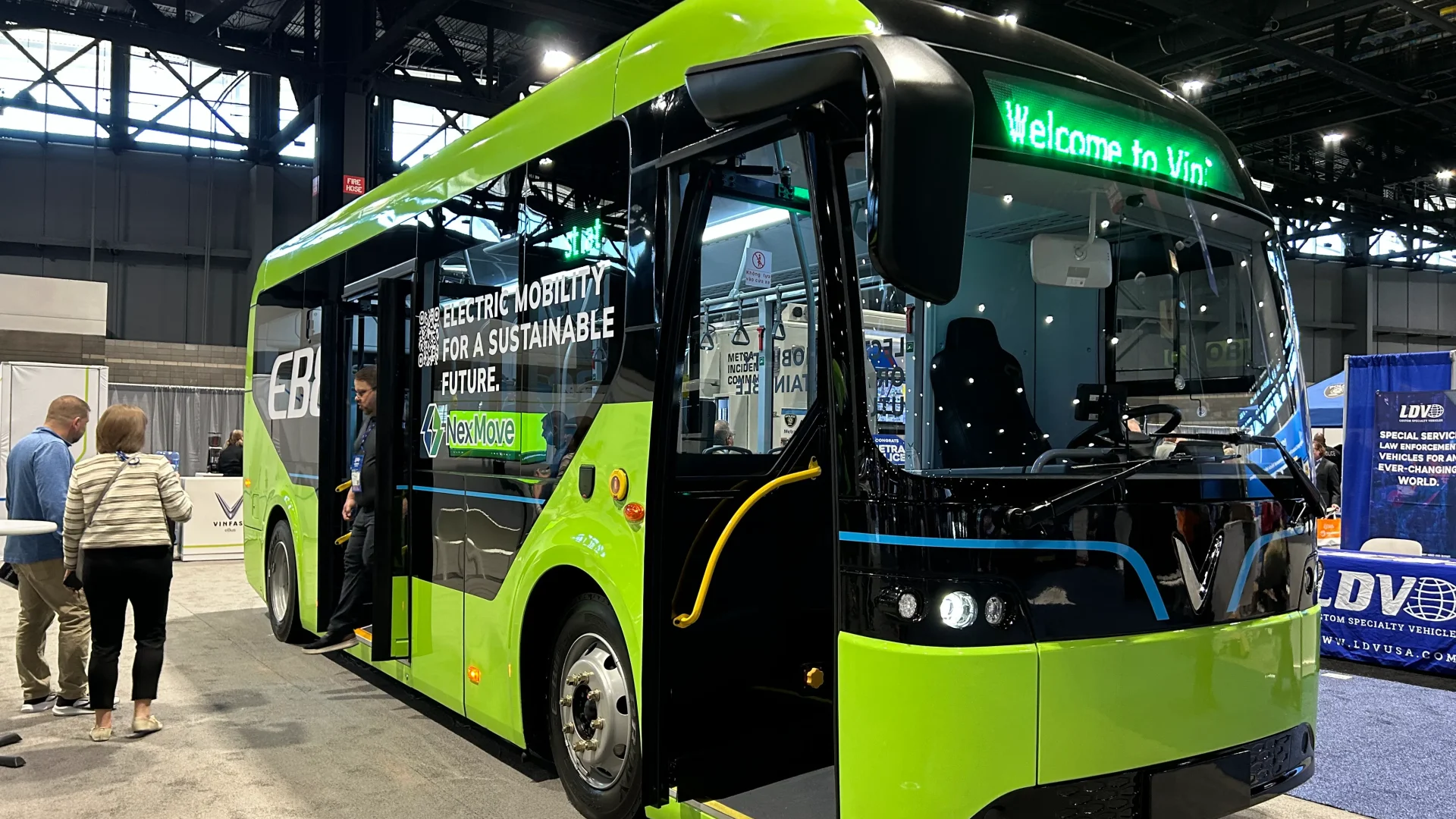
Under the agreement, VinFast electric buses will be offered in the United States through NexMove using an as-a-service model covering vehicles, charging, maintenance and operations. Certified vehicles are expected to begin deliveries in the first quarter of 2028. Sustainable Bus
The announcement in Chicago concerns the future commercialization of VinFast buses in the United States rather than the launch of a vehicle already available to U.S. transit agencies.
Beyond the vehicles on display, APTA EXPO also included manufacturers and technology suppliers active across different parts of the North American public transport sector.
The Europe-to-U.S. route is also being followed by ITS and digital mobility providers. German mobility software company ioki is entering the U.S. market with a newly established local subsidiary and Georgetown University in Washington, D.C., as its first American customer. The university is introducing an on-demand shuttle service using the ioki platform in October. The company’s U.S. activities cover mobility simulation and software for on-demand and fixed-route public transport.
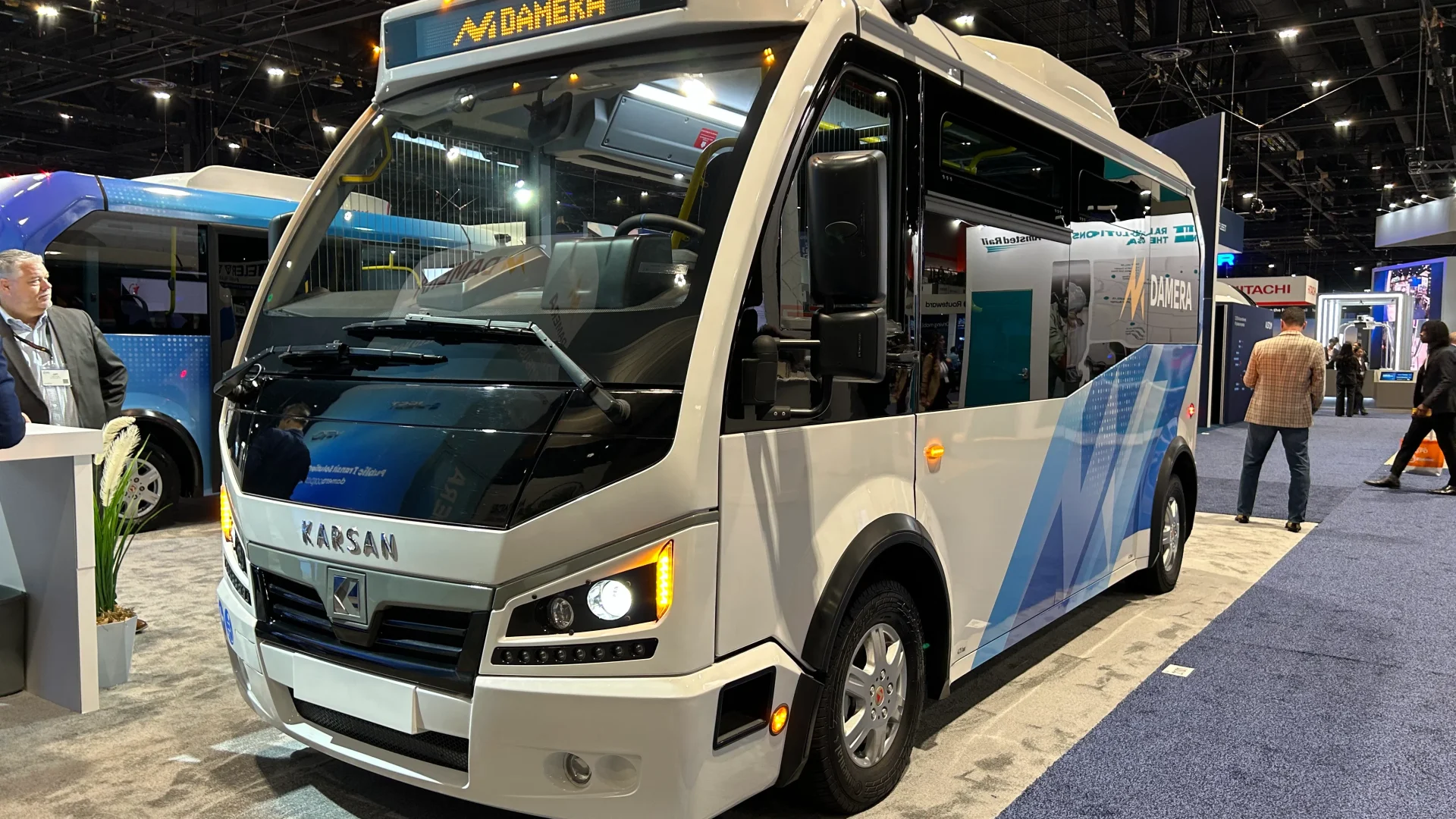
Karsan, represented in North America by dealer Damera, exhibited the battery-electric e-JEST; nearly 200 units have been sold in the market to date, with around 180 already delivered.
Door provider Ventura Systems joined the expo displaying at the booth a Ebusco 3.0 bus with Dutch registration plate.
Ballard presented its fuel-cell systems portfolio, although no hydrogen buses were displayed at the exhibition. The company is the fuel-cell supplier for the U.S. transit bus market, with around 350 fuel-cell buses currently operating and another 150 due for delivery, all manufactured by New Flyer.
BAE Systems showcased its integrated powertrain systems for hybrid-electric and battery-electric buses, with a focus on its plug-in hybrid solution and field-serviceable accessory power management technology. The company is also developing a 7.2-litre hybrid system with Cummins, scheduled for commercial release in January 2028.
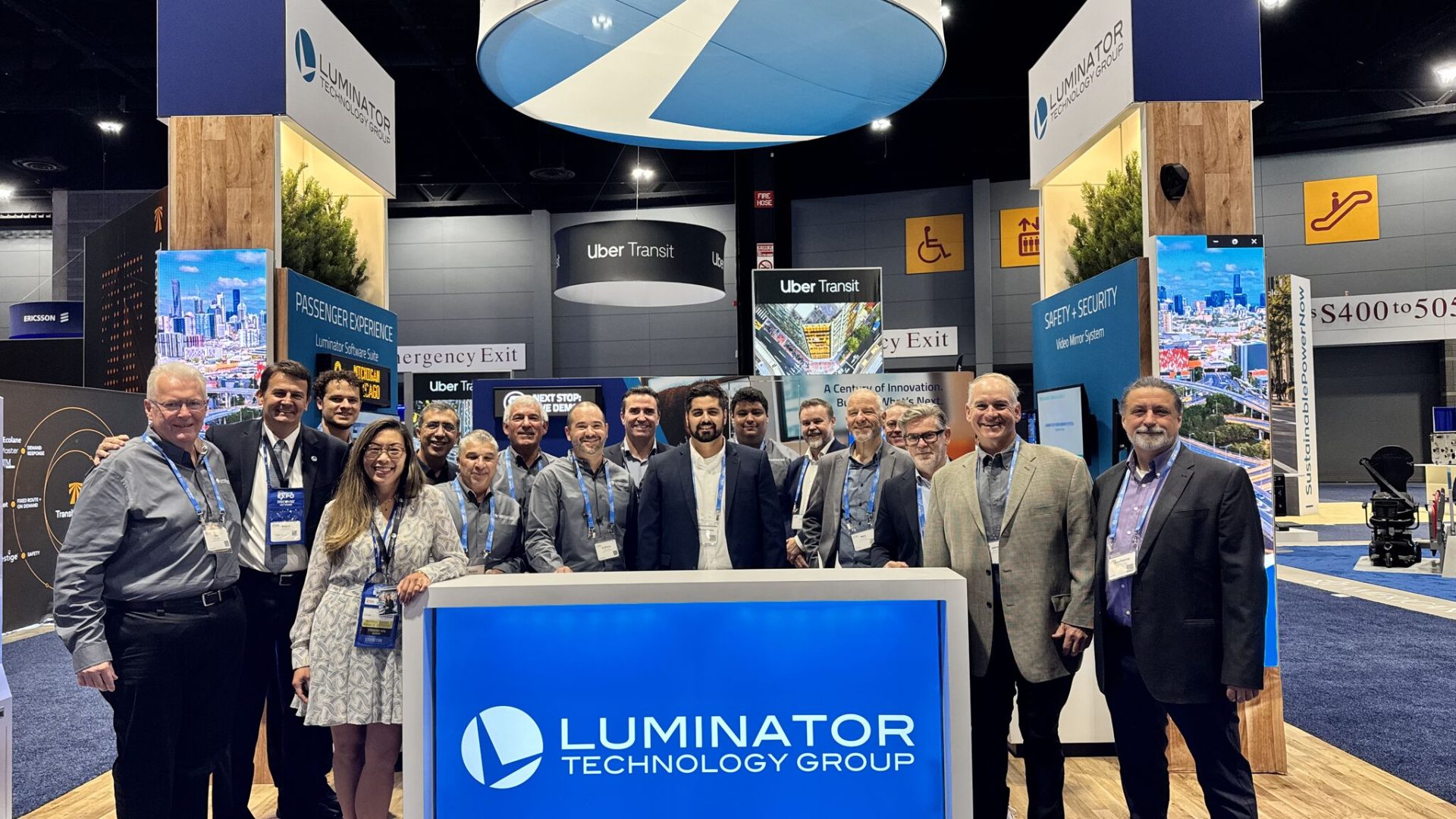
On the ITS side, Luminator presented its latest developments in passenger information, video security and lighting systems, while Optibus showcased its Real-Time Suite for transit operations and control and the newly launched Optibus Agent, an AI-based system designed to automate operational tasks through natural-language interaction.