From bus procurement to batteries and services: Sustainable Bus Tour debate at FIAA puts partnerships in focus [REPLAY]
The transition to zero-emission buses is expanding procurement and industrial decisions beyond the vehicle itself, bringing batteries, infrastructure, services, financing and partnerships into the discussion between manufacturers, suppliers and operators. The topic was at the centre of the Sustainable Bus Tour conference “Building zero emission buses through partnerships. Platforms, investments, industrial strategies”, held on 23 […]
The transition to zero-emission buses is expanding procurement and industrial decisions beyond the vehicle itself, bringing batteries, infrastructure, services, financing and partnerships into the discussion between manufacturers, suppliers and operators.
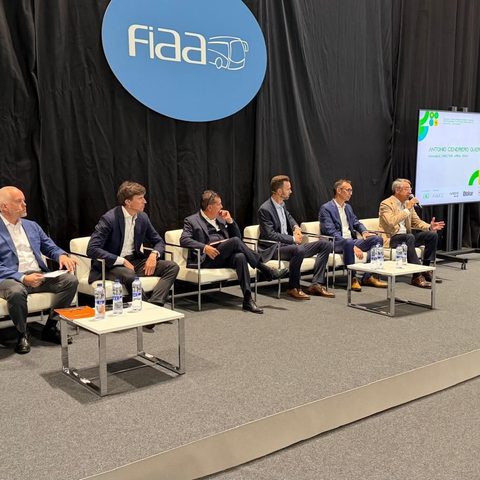
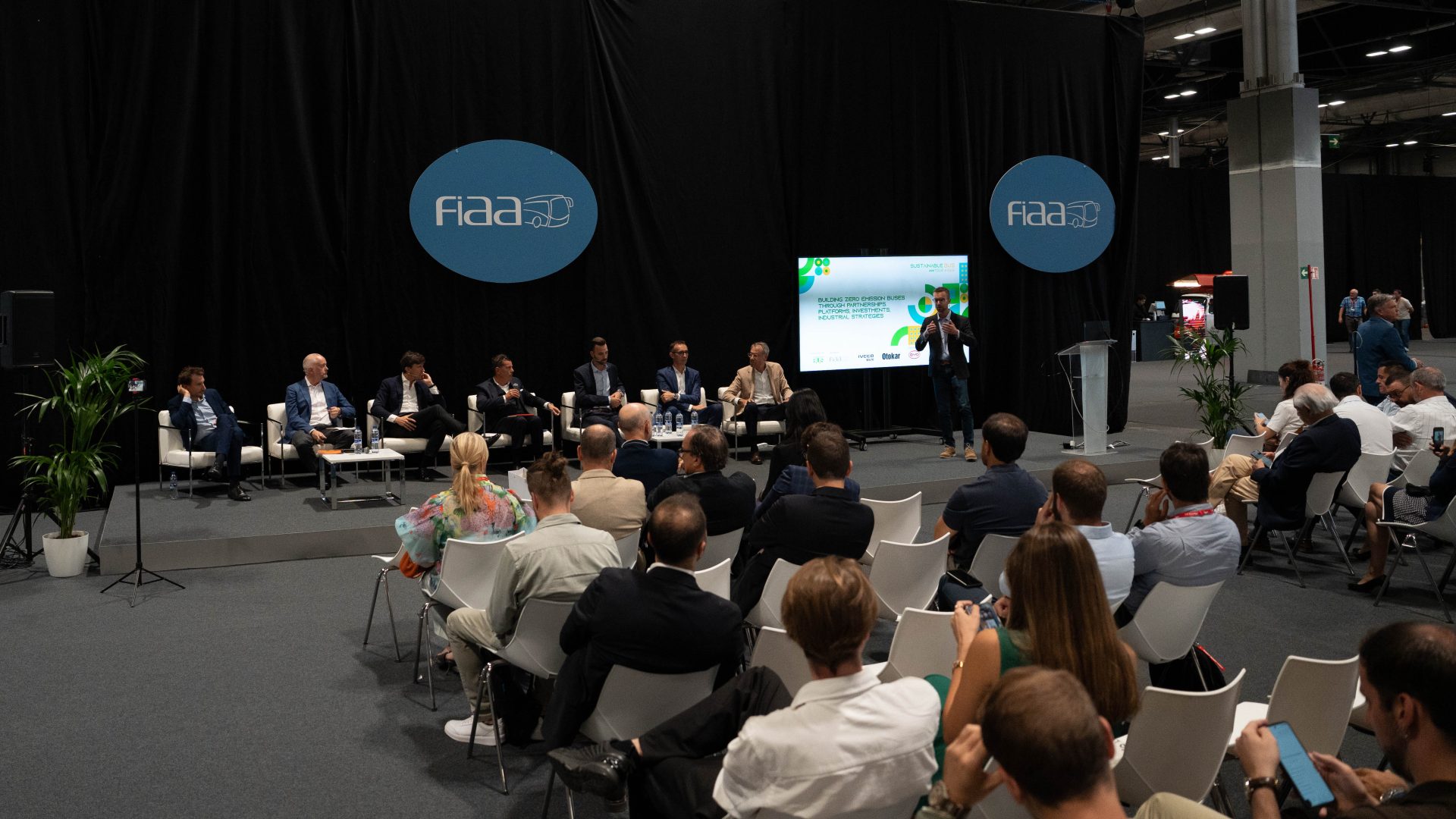
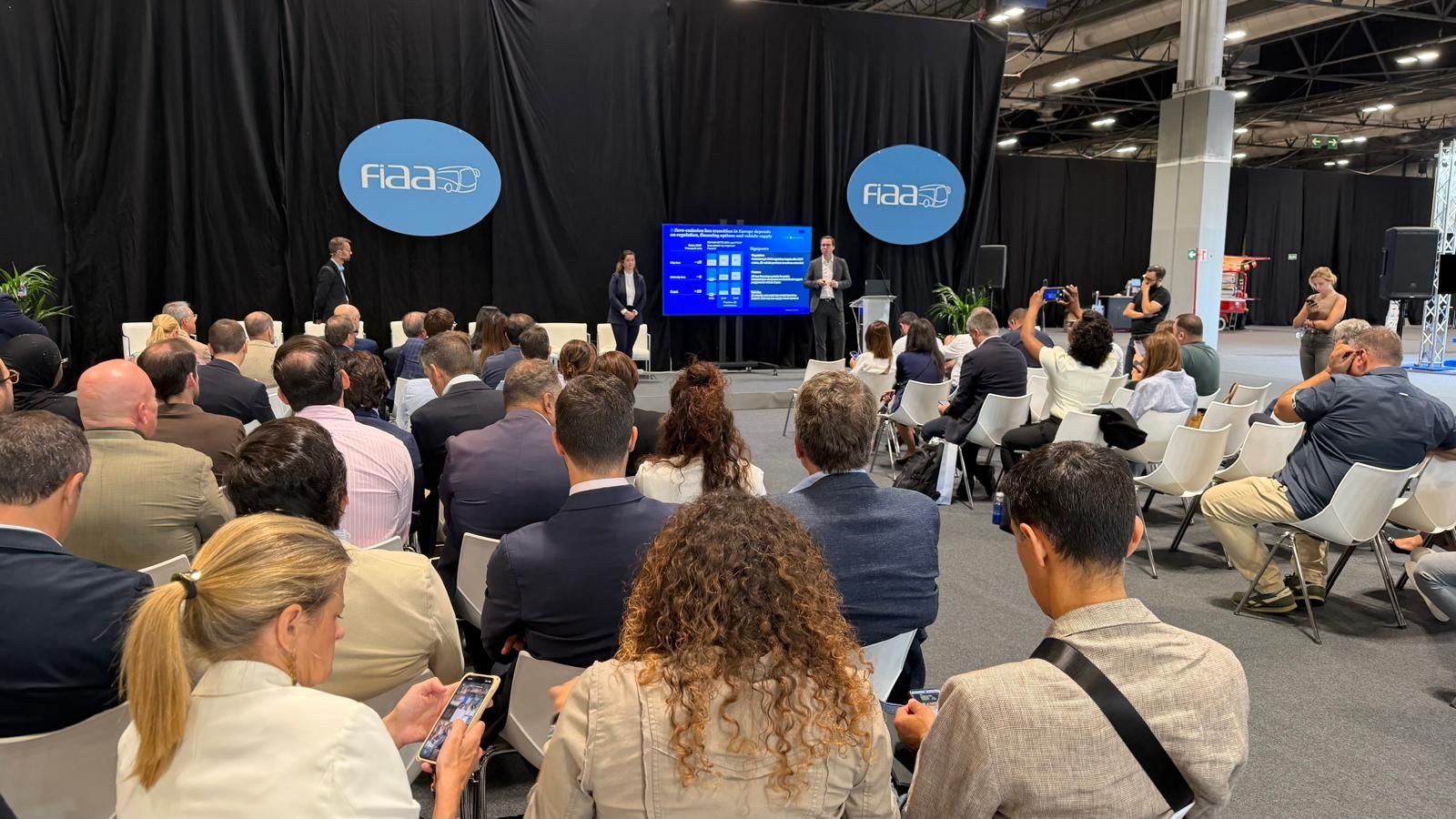
The topic was at the centre of the Sustainable Bus Tour conference “Building zero emission buses through partnerships. Platforms, investments, industrial strategies”, held on 23 September during FIAA 2026 in Madrid. The session brought together representatives of Arriva Spain, Moventis, ANAV, Iveco Bus, BYD Europe, Otokar Europe and ZF, following a keynote presentation by McKinsey & Company.
The Sustainable Bus Tour session at FIAA was supported by Iveco Bus, ZF, BYD and Otokar as tour partners.
McKinsey: zero-emission city buses at 51%, while lifecycle criteria gain weight in tenders
McKinsey opened the conference with figures on electrification, competition, autonomous driving and bus manufacturing costs. According to the data presented by Tobias Schneiderbauer and Lena Bell, zero-emission vehicles have reached a 51% share of the European city bus segment, while Chinese manufacturers accounted for around 28% of the zero-emission bus market in 2025.
Zero-emission bus sales increased from around 2,000 vehicles in 2019 to 13,000 six years later, according to figures shown during the keynote.
The presentation also addressed changes in purchasing criteria. McKinsey’s analysis of German public tenders between 2020 and 2025 showed the weighting of initial purchasing price falling from around 60% to 40%, while lifecycle-related criteria reached around 40% in 2025. These criteria include infrastructure support, vehicle uptime, trial vehicles and training for drivers and maintenance staff.
On manufacturing costs, McKinsey presented an analysis indicating potential cost reductions of up to 50% for an electric city bus by 2030. The areas covered included battery technology, vehicle architecture, chassis integration, homologation, manufacturing footprint, procurement, sales and general and administrative costs.
Partnerships formed the third area identified in the presentation. McKinsey included vehicle platforms, infrastructure, autonomous-driving systems, fleet operations, mobility platforms and consulting among the activities in which different companies can occupy positions across the bus value chain.
Autonomous transport was also addressed. McKinsey said more than 100 robot shuttles were operating in 2025 and presented a scenario reaching around 60% autonomous share for city buses by 2045. The company said its survey found that around one third of interviewed fleets were already interested in introducing autonomous buses within five years.
Operators put batteries, infrastructure and aftersales into bus procurement
Arriva Spain Managing Director Antonio Cendrero Querol said the end of European funding does not change the company’s decarbonisation programme. As outlined by Cendrero, Spanish subsidies covered at most 50% of the price difference between electric and diesel vehicles, excluding infrastructure, and therefore were not the sole basis for electrification decisions.
The procurement process itself has expanded, he said. Operators now need information on battery technologies, safety, state of health, vehicle autonomy, grid capacity and the investments required to electrify depots. Discussions with manufacturers consequently cover both conventional vehicle specifications and energy-related elements.
Ian Livesey, Director of B2B & B2C at Moventis, also identified training, aftersales, spare-parts availability and specialised technical assistance among the requirements associated with new fleets. He added that operators need vehicle data and digital technologies both for fleet monitoring and passenger services.
The funding question was also addressed by Francesco Romagnoli, Head of Technical Affairs at Italian operators’ association ANAV. He said Italy’s National Recovery and Resilience Plan helped reduce the average age of the Italian bus fleet from around 12 to approximately nine years between 2021-22 and 2026.
Romagnoli also reported cases in which zero-emission buses were delivered before sufficient grid capacity or charging infrastructure was available at depots. He called for future investment programmes to provide both funding and greater technological flexibility according to operating conditions.
Intercity electric buses bring range, charging and TCO into the discussion
The transition of Class II intercity buses formed a separate part of the FIAA discussion. Romagnoli distinguished services returning to a depot every night from operations in which buses remain away from their home depot for several days.
For these applications, he said current battery-electric vehicles cannot yet cover every operating profile, particularly where charging is unavailable away from the depot. He also referred to European heavy-duty CO2 requirements and the resulting targets facing manufacturers from 2030.
BYD Europe Bus Senior Commercial and Tender Lead Stéphane Espinasse, who joined BYD this year, described the intercity segment as a combination of different missions, ranging from school services to regional routes requiring 450, 500 or 600 kilometres of range.
He identified three elements in BYD’s approach: local teams able to define individual operating missions with customers, total-cost-of-ownership parity for the selected application, and sufficient sales and service network coverage.
Arriva’s Cendrero also pointed to closer manufacturer-operator integration in the definition of electric services. He cited Arriva’s fleet of almost 100 vehicles introduced in Limburg in the Netherlands around ten years ago, where operations initially relied on opportunity charging and subsequently migrated towards overnight charging.
Iveco Bus, BYD and Otokar set out different partnership models
Vehicle manufacturers used the roundtable to describe different approaches to partnerships, vertical integration and external sourcing.
Iveco Bus Head of Product Management Marco Zanchetta presented the minibus segment as an area where cooperation with bodybuilders has a significant role. He referred to the new eFlexy electric minibus presented by the manufacturer at FIAA, developed with a selected European bodybuilder such as the Italian Olmedo.
According to Zanchetta, bodybuilders provide access to specific customer applications and configurations, while the combination of bodybuilders and dealer networks extends the range of applications available without requiring every configuration to be incorporated directly into the OEM’s industrial processes.
BYD described a different industrial structure. Espinasse referred to the company’s vertical integration across batteries, battery-management systems, electric motors and vehicles, alongside external bodybuilder partnerships in selected markets.
He cited BYD’s bus manufacturing operation in Hungary, whose capacity is being expanded, as well as cooperation with Castrosua and previous work with UNVI in Spain and Superpolo in Colombia. The company presented these models as different go-to-market configurations used alongside its internally developed technologies.
Otokar Europe Commercial Director for Italy and Spain Umberto Mauri said the manufacturer works with external battery and driveline suppliers while retaining other strategic activities internally. He cited autonomous-driving software as one area developed within Otokar, also referring to competencies available elsewhere in the company.
Mauri said Otokar was close to completing electrification of its product portfolio but was also preparing to deliver almost 250 diesel buses over the following three months. He linked the deliveries to current customer demand and funding conditions.
ZF points to modular platforms and scale across commercial vehicles
From the supplier side, ZF Key Account Manager Bus Fabian Schumacher addressed the relationship between technology standardisation, vehicle diversity and total cost of ownership.
Schumacher noted that the bus sector covers several vehicle lengths and propulsion systems, including 12-, 18- and 24-metre platforms as well as battery-electric and hydrogen applications. He also referred to regulatory requirements for systems such as cameras and ADAS, where supplying the component is accompanied by integration, maintenance and driver-training requirements.
ZF is now using a modular platform approach shared across truck and bus activities, he said, allowing components, products and development knowledge to be used across a larger commercial-vehicle base.
Schumacher also said a new ZF axle provides a 20% energy saving compared with the outgoing solution, while the common commercial-vehicle platform provides a larger scale for development and market feedback.
Local content enters European bus manufacturing strategies
Local manufacturing and sourcing with European push for the ‘made in Europe’ were also discussed by Iveco Bus, BYD and Otokar.
Zanchetta described Iveco Bus as a European manufacturer built around industrial operations in Italy, France and the Czech Republic. He cited investments in electric-bus production lines in the Czech Republic and France, alongside a European supplier base and cooperation with local start-ups, engineering companies and major technology suppliers.
BYD pointed to its Hungarian manufacturing operation and bodybuilder partnerships as components of its European strategy.
Mauri raised the question of how manufacturers headquartered outside the European Union will address local-content requirements in tenders, referring specifically to proposals or requirements for a 50% European-content threshold.