In Denmark, Luxembourg and Netherlands over 2/3 of bus registrations are ZE
Denmark, Luxembourg, Netherlands lead the way on emissions-free buses. Transport & Environment has realized a chart, based on data from Chatrou – CME Solutions, that shows the share of zero emission buses registered in 2019 in the European countries (a year with over 1,600 e-bus registrations, more than three times the year before). Results? «Denmark […]
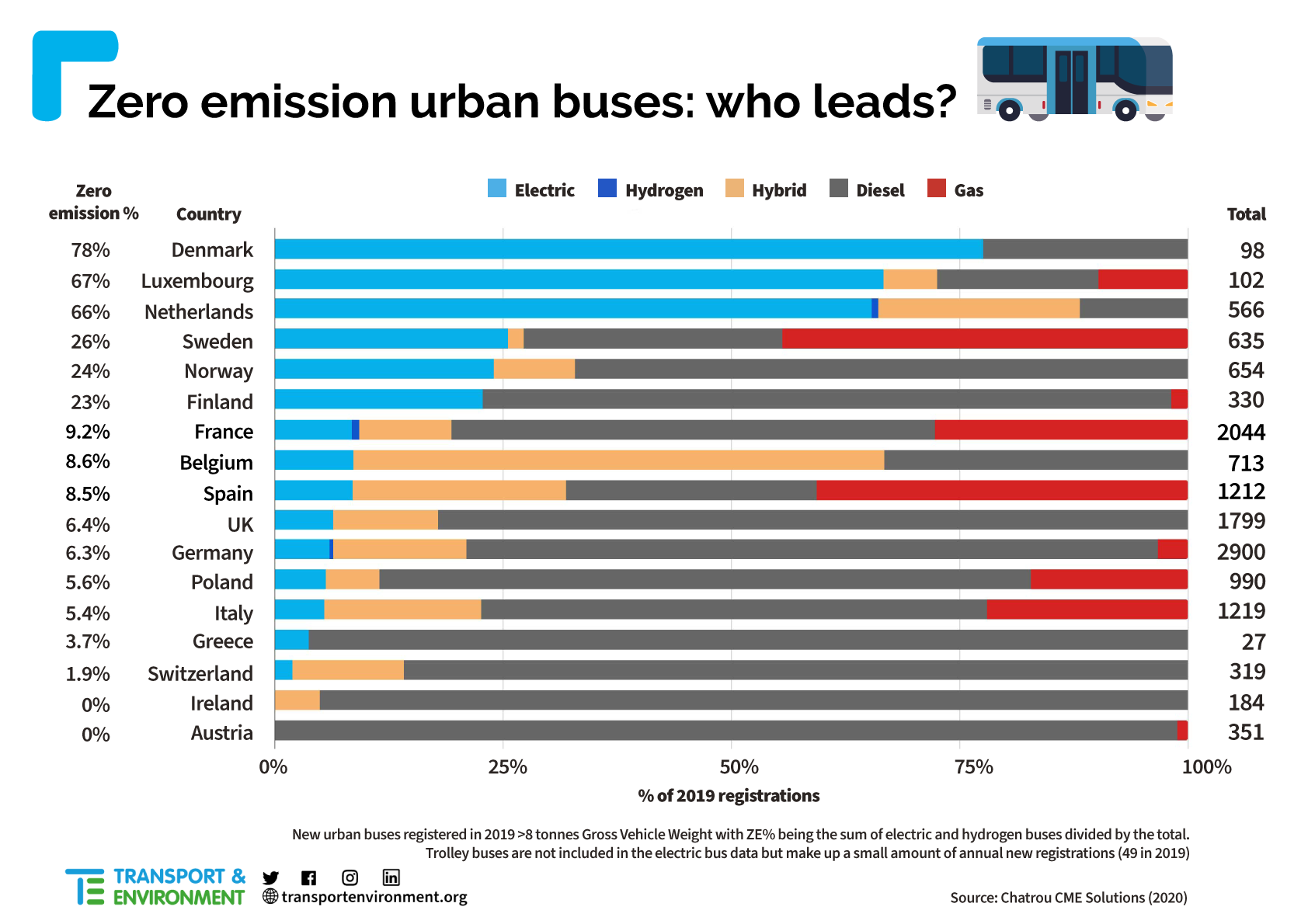
Denmark, Luxembourg, Netherlands lead the way on emissions-free buses. Transport & Environment has realized a chart, based on data from Chatrou – CME Solutions, that shows the share of zero emission buses registered in 2019 in the European countries (a year with over 1,600 e-bus registrations, more than three times the year before). Results? «Denmark leads the way when it comes to putting zero-emission urban buses on the streets in Europe, with 78% of new vehicles being electric. In Luxembourg and the Netherlands about two-thirds of new buses were zero-emissions».
T&E said other EU countries now have a chance to catch up by including emissions-free buses in the Covid recovery plans they must submit to the European Commission by the end of April.
Transport & Environment, the share of ZE buses
In Sweden, Norway and Finland, respectively 26%, 24%, and 23% of urban buses registered in 2019 were zero-emission (electric or hydrogen). Italy, Poland, Germany, the UK, Spain and France, which buy 70% of the urban buses sold in Europe, lag behind. In 2019, less than 10% of their newly-registered urban buses were electric or hydrogen.
T&E notices that Germany took a significant step forward in 2020 though and is now financing 80% of the higher purchase cost of e-buses. And Poland announced that in cities with populations of 100,000 or more, all public transport will be fully electric by 2030, and allocated €290m to support this objective.
Transport & Environment, the opportunity of Recovery Fund for ZE buses
But more member states need to step up, and T&E said the EU’s €750 billion Covid recovery fund is a clear way to finance e-bus deployment. This will be essential for the countries at the bottom of the table: Austria and Ireland registered no zero-emission urban buses in 2019, while in Switzerland and Greece less than 4% of new buses were emissions free.
James Nix, freight manager at Transport & Environment, said: “Urban bus fleets drive millions of kilometers every year. If we want to decarbonise our cities, these vehicles must become emissions free as soon as possible. Nordic states, Luxembourg and the Netherlands are showing how to put e-buses on the road. Other countries, especially those buying a lot of buses, like Italy, Spain and France, and those at the very start of the transition, such as Austria, need to step it up. Zero-emission urban buses help us combat air pollution, tackle climate change, reduce noise and cheaper total costs than diesel buses over their lifetime. EU member states must ensure the Covid recovery plans they are currently writing fund the replacement of fossil buses with zero-emission ones.”