WiTricity expands wireless EV charging activities with new R&D facility in Florida
WiTricity has completed a new research and development laboratory in Stuart, Florida, for wireless EV charging systems covering passenger, autonomous and heavy-duty vehicle applications. The facility follows WiTricity’s relocation to Stuart and expands its capacity for design engineering, prototyping, simulation, testing, validation and vehicle-integration activities. According to WiTricity, its medium-power wireless charging systems currently cover […]
WiTricity has completed a new research and development laboratory in Stuart, Florida, for wireless EV charging systems covering passenger, autonomous and heavy-duty vehicle applications.
The facility follows WiTricity’s relocation to Stuart and expands its capacity for design engineering, prototyping, simulation, testing, validation and vehicle-integration activities. According to WiTricity, its medium-power wireless charging systems currently cover power levels from 7.2 to 50 kW, while the company also has capabilities at 75 kW and above for heavy-duty vehicles and equipment.
“Autonomy cannot stop at the charger. If a robotaxi, delivery vehicle or self-driving passenger vehicle still needs a person to connect a cable, then one of the most basic parts of its operation remains non-autonomous. Our wireless charging technology is proven, backed by research and field testing, and available today. The new Stuart lab gives us an unmatched environment to assist partners with integrating wireless charging into current and next-generation vehicle platforms and accelerate real-world deployments.
Joe Benz, CEO of WiTricity
The company identifies passenger electric vehicles, autonomous vehicles, robotaxis, last-mile fleets and OEM and Tier 1 integration programmes among the applications for its medium-power technology.
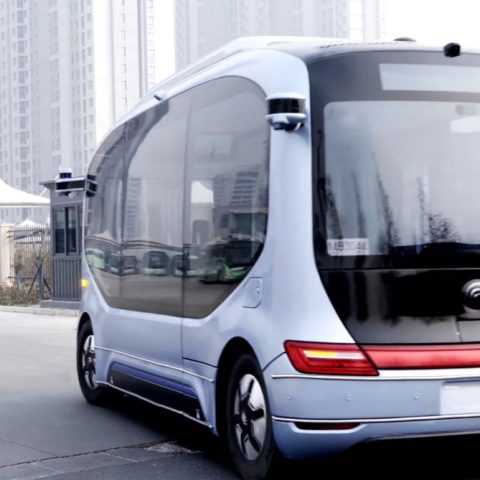
WiTricity has already applied its wireless charging technology to public transport: in 2023, the company announced a collaboration with Yutong for wireless charging of the Chinese manufacturer’s autonomous Xiaoyu 2.0 electric minibus in Zhengzhou. However, WiTricity’s activities have since focused strongly on other vehicle segments, with golf cars now representing one of the company’s main target markets alongside passenger and autonomous vehicle applications.
WiTricity wireless charging systems range from 7.2 to 50 kW
WiTricity’s medium-power systems use a receiver installed on the vehicle undercarriage and a charging pad positioned on the ground. When the vehicle is positioned over the pad, power is transferred through highly resonant magnetic coupling to the vehicle battery without the use of a manually connected plug or cable.
According to WiTricity, the systems operate at charging speeds comparable with conventional plug-in solutions in the same power class.
The company states that its medium-power wireless charging technology is already available for OEM, Tier 1 and fleet integration programmes. The new Florida laboratory will be used to customise and validate the existing systems for individual vehicle platforms and operating environments.
Applications identified by WiTricity include battery-electric passenger cars, automated valet parking, robotaxis, self-driving fleet vehicles and last-mile delivery fleets.
For autonomous vehicle operations, the charging process can take place when a vehicle is positioned over a designated charging pad, without a person connecting or disconnecting charging equipment.
WiTricity also states that its wireless architecture eliminates exposed charging cords and connectors at the vehicle interface. The charging interface has no moving parts and can be used for repeated charging sessions when a vehicle is parked over a charging pad.
New Stuart laboratory to support testing and vehicle integration
The completed Stuart facility expands WiTricity’s capacity for design engineering, application-specific prototyping, electromagnetic and system simulation, testing and validation.
Vehicle-integration support will also be carried out at the laboratory. WiTricity says it can work from the facility with vehicle manufacturers, suppliers, fleet operators, licensees and technology partners on integrating its wireless charging systems into specific vehicles and operating environments.
The laboratory represents an expansion of work on technology already developed and demonstrated by the company rather than the introduction of a new wireless charging architecture, according to WiTricity.
WiTricity targets 75 kW and higher wireless charging
Alongside its 7.2-to-50-kW medium-power portfolio, WiTricity says its wireless charging capabilities extend to 75 kW and above for heavy-duty vehicles and equipment.
Applications identified by the company include buses, transit operations, drayage and yard vehicles, forklifts and ground support equipment, as well as vehicles operating at airports and marine ports.
These higher-power systems also use automatic charging, with the vehicle positioned in relation to the charging infrastructure without requiring manual handling of a charging cable.
In brief
- Where is WiTricity’s new R&D laboratory?
The facility is located in Stuart, Florida, following the company’s relocation there. - What power levels does WiTricity offer for medium-power wireless charging?
The company specifies a range from 7.2 to 50 kW. - Does WiTricity offer wireless charging for buses and heavy-duty vehicles?
Yes. WiTricity states that its capabilities extend to 75 kW and above for heavy-duty vehicles and equipment, including buses. - How does the wireless charging system work?
A receiver underneath the vehicle aligns with a ground-based pad, with energy transferred through highly resonant magnetic coupling.
“Autonomy cannot stop at the charger,” said Joe Benz, CEO of WiTricity. “If a robotaxi, delivery vehicle or self-driving passenger vehicle still needs a person to connect a cable, then one of the most basic parts of its operation remains non-autonomous. Our wireless charging technology is proven, backed by research and field testing, and available today. The new Stuart lab gives us an unmatched environment to assist partners with integrating wireless charging into current and next-generation vehicle platforms and accelerate real-world deployments.”
“The future of electric mobility will not be defined by a single vehicle class or power level,” Benz added. “From passenger cars and robotaxis to the heavy-duty fleets that keep commerce moving, charging must become an automatic part of the vehicle’s normal routine. Our Stuart lab is built to help make that future practical.”