Luminator launches AI-based Transit Environment Intelligence for bus stop and shelter monitoring
Luminator announces the introduction of Transit Environment Intelligence, an AI-assisted capability that uses images collected by buses in normal service to monitor conditions at bus stops and shelters. The technology combines images captured by transit vehicles with location data, Luminator’s mSET software and AI-assisted analysis. According to Luminator, Transit Environment Intelligence (TEI) is available now […]
Luminator announces the introduction of Transit Environment Intelligence, an AI-assisted capability that uses images collected by buses in normal service to monitor conditions at bus stops and shelters.
The technology combines images captured by transit vehicles with location data, Luminator’s mSET software and AI-assisted analysis. According to Luminator, Transit Environment Intelligence (TEI) is available now for pilot deployments with transit agencies.
The launch comes as Luminator prepares to present its wider digital technology portfolio at APTA EXPO 2026 in Chicago, where the company is focusing on the integration of its established onboard hardware with software, data and AI-based technologies. The portfolio includes passenger information, mobile video surveillance, safety systems and fleet management software within a common digital architecture.
The use of AI for analyzing existing transit data was also addressed by CEO Magnus Friberg in a July 2026 interview with Sustainable Bus. Friberg identified real-time passenger information, maintenance and asset management, and analysis of video and sensor data among Luminator’s AI applications, including the use of video to identify issues affecting passengers inside and outside vehicles.
Focus on Luminator Transit Environment Intelligence
Transit Environment Intelligence uses buses operating their regular routes as mobile observation points. The system collects current images of stops and shelters without requiring changes to normal vehicle operation, according to information released by Luminator.
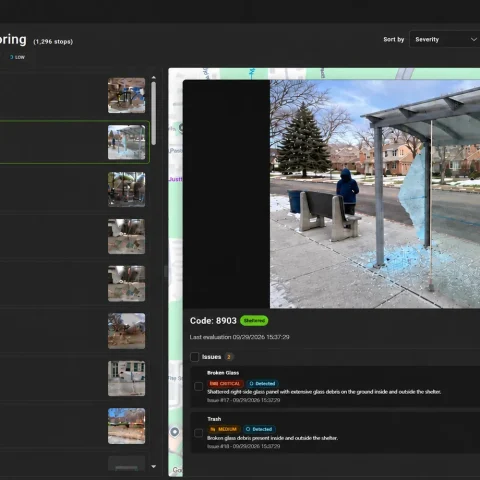
The images are combined with location information and made available through Luminator’s mSET software. Agencies can search for individual locations or use a map to access the latest available images for each stop.
AI-assisted analysis is used to identify visible conditions including graffiti, trash and broken glass. Images are displayed together with AI-interpreted information, after which agency personnel can review and prioritize flagged issues through mSET workflows. Luminator says the ability to route identified issues to responsible parties will be expanded over time.
The system covers stops both with and without shelters. Luminator also identifies maintenance prioritization, asset management, accessibility review and passenger environment monitoring among the applications envisaged for TEI.
The use of buses as mobile observation points recalls Californian’s startup Hayden AI’s North American applications, where bus-mounted cameras and AI are used to detect potential traffic and parking violations around transit infrastructure. Luminator’s TEI applies a similar combination of onboard image collection and AI analysis to a different task: monitoring the physical condition of stops and shelters.
Mobile video, mSET and AI integrated into a single workflow
Transit Environment Intelligence builds on Luminator’s existing mobile video systems and mSET platform, combining image collection, geographic information and AI-assisted analysis in the same operating environment.
The technology uses visual information generated while vehicles perform scheduled services rather than requiring separate inspection vehicles or dedicated data-collection operations. The resulting images provide a network-wide record of visible conditions at stops and shelters visited by equipped buses.
TEI forms part of the company’s digital ecosystem combining mobile video, mSET and artificial intelligence. The company currently reports more than 850 employees and over 3,000 customers in 85 countries.
The Transit Environment Intelligence capability is available for agencies to pilot.
In brief
- What is Luminator Transit Environment Intelligence?
An AI-assisted capability using images captured by buses in service to monitor visible conditions at stops and shelters. - What can the system identify?
Luminator lists visible issues including graffiti, trash and broken glass. - Which technologies does TEI use?
It combines Luminator mobile video systems, location data, mSET software and AI-assisted analysis. - Is the technology commercially available?
Luminator says TEI is currently available for pilot deployments with transit agencies.
Magnus Friberg, Chief Executive Officer of Luminator, said: “Agencies have never had a practical way to see the condition of every stop and shelter across a network, and that is exactly the kind of problem our digital ecosystem strategy is built to solve. Transit Environment Intelligence turns buses already in service into eyes on the network and uses AI to turn what they see into action. We believe it is the first capability of its kind in transit, and it reflects Luminator’s role as a total solutions partner, not simply a supplier of hardware.”