Germany’s e-bus subsidy cuts could mean 1,500 fewer electric buses by 2030, PwC study finds
Germany’s draft federal budget for 2027 envisages reducing electric bus subsidies from €403 million in 2026 to €130 million, a 68% cut that could put around 1,000 jobs at risk, according to a new PwC study commissioned by the German public transport association VDV and Klima-Allianz Deutschland. The study, published on 15 October 2026, estimates […]
Germany’s draft federal budget for 2027 envisages reducing electric bus subsidies from €403 million in 2026 to €130 million, a 68% cut that could put around 1,000 jobs at risk, according to a new PwC study commissioned by the German public transport association VDV and Klima-Allianz Deutschland.
The study, published on 15 October 2026, estimates that the German urban bus sector generates between €1.6 billion and €2 billion in annual economic value added, supporting between 10,300 and 12,600 jobs across vehicle manufacturing, component suppliers and related infrastructure activities.
According to the Verband Deutscher Verkehrsunternehmen (VDV), the proposed reduction of €273 million in federal funding would affect the procurement of electric buses and the domestic manufacturing supply chain.
A coalition of organizations representing industry, business, civil society and trade unions has called on the Bundestag to reverse the proposed reductions during the ongoing federal budget negotiations.
Germany’s electric bus subsidy framework has undergone several changes in recent years. In early 2024, the federal government halted its electric bus funding programme, raising concerns over the development of the zero-emission bus market. At the time, VDV warned that the decision put the conversion of 10,000 buses to zero-emission propulsion at risk. The government subsequently launched a new funding call for electric buses, while the draft 2027 federal budget introduced indeed plans for another reduction in subsidies.
Germany’s electric bus market: 48% of new city buses are electric
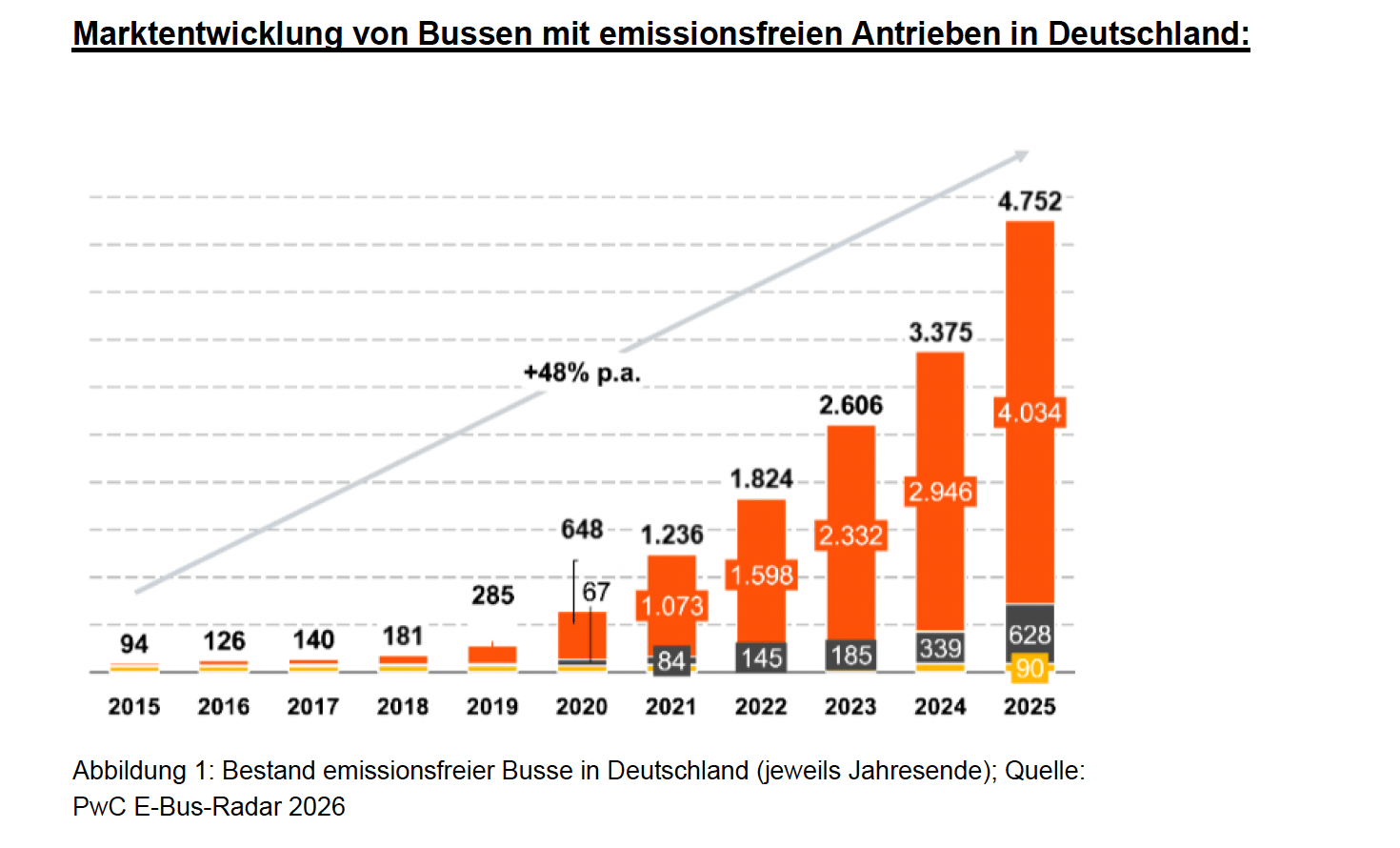
According to the PwC study, Germany had approximately 4,750 zero-emission buses in operation at the end of 2025, including battery-electric buses, fuel cell buses and trolleybuses. The report indicates that the zero-emission fleet grew at an average annual rate of approximately 48% over the preceding years.
In 2025, 1,397 of approximately 2,900 newly registered city buses were electric, representing a market share of 48%.
The study also states that approximately 70% of the electric bus fleet operating in Germany at the end of 2025 had received federal financial support.
VDV provides a more recent figure, stating that more than 6,000 locally zero-emission buses were in service as of 1 July 2026, corresponding to approximately 12% of Germany’s scheduled-service bus fleet.
The PwC report identifies Daimler Buses and MAN as the leading manufacturers in the German electric bus market, alongside Iveco, which also has production activities in Germany.
The association states that approximately 72% of electric buses in Germany come from Daimler Buses, MAN and Iveco, with European manufacturers accounting for more than 85% of the market, according to the PwC study.
The study estimates that the domestic urban bus industry generated between €1.6 billion and €2 billion in economic value added in 2025, including indirect effects across the supplier network. Employment associated with these activities is estimated at between 10,300 and 12,600 jobs.
Electric buses cost up to €370,000 more than diesel
The PwC study also provides figures on the acquisition cost differential between electric and diesel buses.
According to the analysis, a standard battery-electric bus costs approximately €580,000, compared with €310,000 for a diesel equivalent, representing an additional investment of €270,000 per vehicle. For articulated buses, the respective figures are €780,000 and €410,000, a difference of €370,000.
The study also identifies additional expenditure for charging infrastructure, grid connections, maintenance facilities and depot conversion, which is not included in these vehicle purchase prices.
Under the Clean Vehicles Directive and Germany’s corresponding procurement legislation, 65% of newly procured urban buses must qualify as clean vehicles, with half of that proportion required to be zero-emission. PwC estimates that this corresponds to approximately 950–1,900 electric buses annually.
Germany’s federal climate protection programme sets a target for 50% of urban buses to be electric by 2030, which the study translates into approximately 2,550 electric bus purchases per year.
The report also refers to the European heavy-duty vehicle CO2 standards, which establish a 90% zero-emission target for newly registered urban buses from 2030. PwC associates this requirement with approximately 2,900 electric buses annually.
PwC compares three electric bus funding scenarios through 2030
The PwC analysis examines three funding scenarios for the period 2027–2030, comparing the planned federal budget reduction with the continuation and expansion of existing subsidies.
Under the 2027 draft budget scenario, funding would decrease to €130 million in 2027, with reductions also envisaged in future spending commitments through 2030.
The second scenario, described as Transformation, assumes the continuation of the 2026 funding level of €403 million in 2027, with subsequent commitments following the existing financial planning framework.
The third scenario, Lead market, envisages an expansion of funding by approximately 25%, to €511 million annually between 2027 and 2030.
According to PwC’s modelling, Germany’s electric bus fleet would develop differently under the three scenarios.
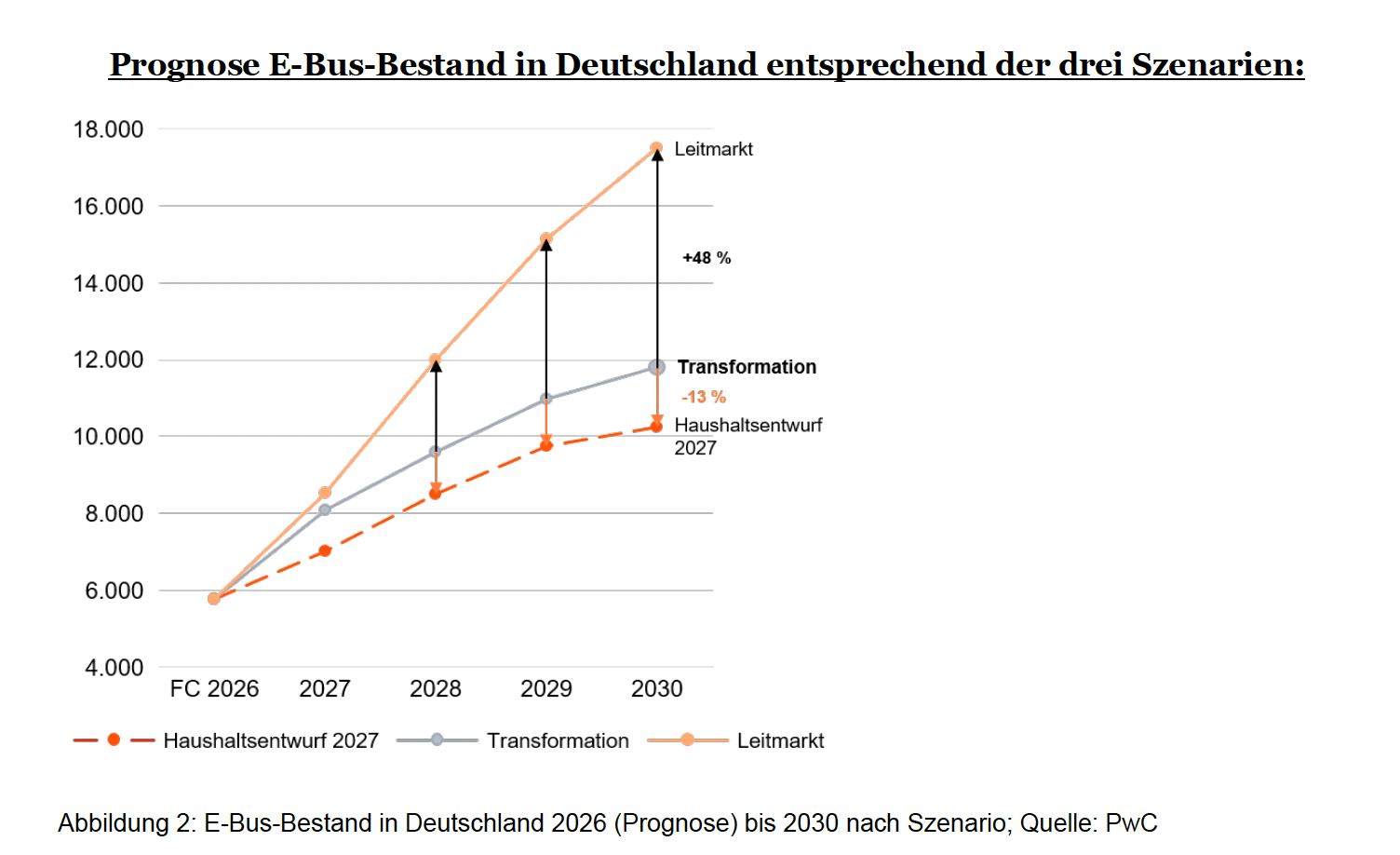
Starting from an estimated fleet of 5,750 electric buses in 2026, the study projects approximately 10,250 vehicles by 2030 under the draft budget scenario, compared with 11,800 under the Transformation scenario and 17,500 under the “Lead market“ scenario.
The corresponding average annual additions are approximately 1,100, 1,500 and 2,900 electric buses, respectively.
The study’s procurement calculations indicate that, under the draft budget scenario, approximately 6,000 new diesel buses would be purchased between 2027 and 2030.
Compared with the Lead market scenario, this would correspond to approximately 7,200 fewer electric buses purchased, a difference of around 60%. Against the Transformation scenario, the difference would amount to approximately 1,500 vehicles.
PwC notes that its calculations are based on modelling assumptions concerning the responses of transport operators and contracting authorities. These include extending the operation of existing diesel vehicles, purchasing new diesel buses, sourcing lower-cost electric buses from outside the European Union or financing European electric buses through municipal resources.
Economic impact: PwC estimates €150 million in annual value added at risk
The study also quantifies the potential economic effects of the proposed reduction in subsidies.
Compared with the Transformation scenario, PwC estimates that the draft 2027 budget would be associated with approximately €150 million less annual gross value added in Germany, with around 1,000 jobs potentially affected.
In brief
- How much does Germany plan to cut electric bus funding? The 2027 draft budget reduces subsidies from €403 million to €130 million, approximately 68%.
- How much more expensive are electric buses than diesel buses? PwC estimates an additional €270,000 for standard buses and €370,000 for articulated buses, excluding infrastructure.
- How many electric buses could be affected? PwC projects 7,200 fewer electric bus purchases by 2030 under the draft budget scenario compared with its expanded-funding scenario.
- How many jobs could be affected? The study estimates around 1,000 jobs potentially affected and €150 million less annual gross value added compared with continued funding.
Paul Hemkentokrax, Vice-President of VDV, stated: “As of 1 July 2026, more than 6,000 locally zero-emission buses were already in operation in Germany, representing around 12% of all scheduled-service buses operating in the country. By 2030, at least 65% of newly procured buses must be zero-emission. This cannot be achieved without support from the federal and state governments in the form of subsidies for this important transformation. If the federal government actually reduces its funding by more than two-thirds from this year to next, electric bus procurement will be slowed down and many transport operators will have no choice but to purchase diesel buses again. At a time like this, it is important that we invest in future technologies in Germany to strengthen the country’s industrial base and secure jobs”.