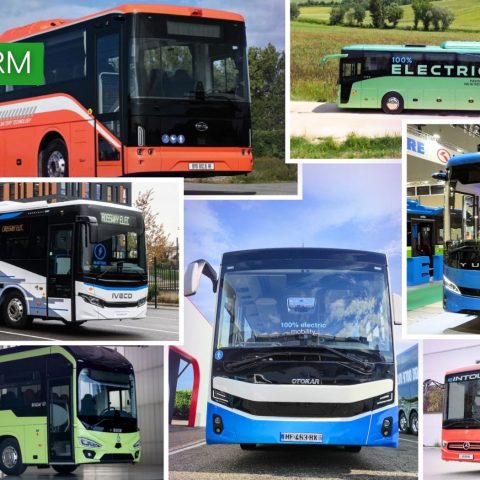
Intercity electric buses, which models are available on the European market?
Intercity electric buses represent a growing segment in the passenger transportation market. In 2025, nearly 600 battery-electric intercity buses were registered in Europe, a stark contrast to the over 11,000 city battery electric bus registrations. Despite this nascent stage, advancements in technology and regulatory changes are paving the way for broader adoption. The product offering […]
By
Editorial Staff
Intercity electric buses represent a growing segment in the passenger transportation market. In 2025, nearly 600 battery-electric intercity buses were registered in Europe, a stark contrast to the over 11,000 city battery electric bus registrations. Despite this nascent stage, advancements in technology and regulatory changes are paving the way for broader adoption.
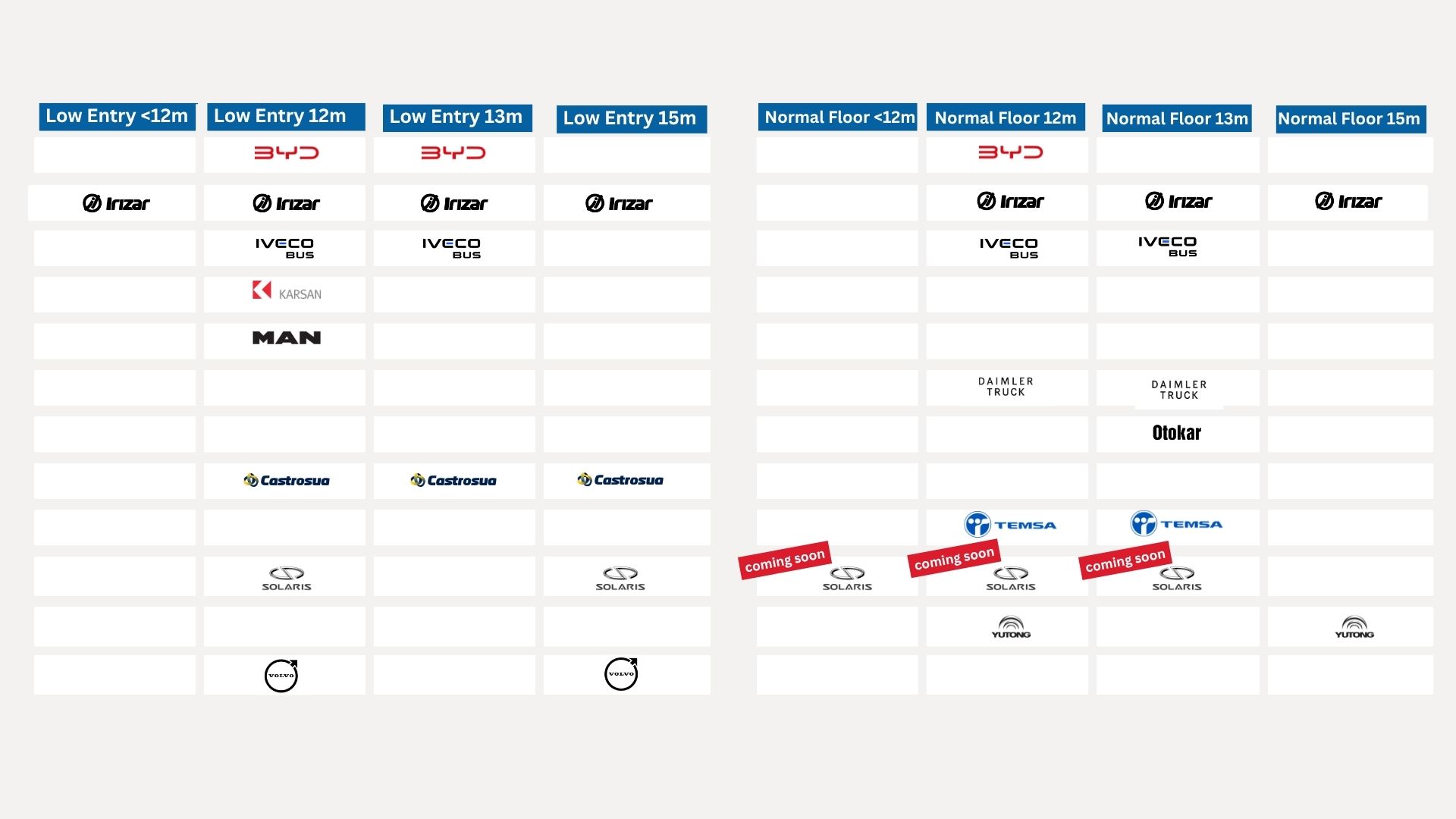
The product offering has been expanding rapidly: as of mid-2026, we calculated that manufacturers offer seven dedicated Normal Floor battery-electric intercity bus platforms, available in 12 variants, with further launches already announced and expected to increase the market to eight platforms and 15 variants by early of 2027.
Zero emission Class 2 buses commercially available in Europe. Sustainable Bus elaboration as of July 2026
Intercity electric buses in Europe: the context
The European Union has set in 2023 ambitious targets for reducing CO2 emissions from heavy-duty vehicles. While city buses will have to be 90% zero emission in 2030 and 100% zero emission in 2035, Intercity buses fall into the same category as coaches and trucks. By 2030, new registrations must achieve a 45% reduction in emissions, with targets escalating to 65% by 2035 and 90% by 2040.
It became evident in late 2025 that intercity electric buses are representing the fastest-evolving segments of the European zero-emission bus market. While registrations still remain well below those of urban battery-electric buses, the number of available models has expanded rapidly since 2024, with virtually all major manufacturers now offering or developing dedicated Class II battery-electric vehicles.
According to ACEA estimates, around 20,000 electric intercity buses and coaches are expected to enter the European market between 2025 and 2030, alongside some 48,000 urban e-buses. Such deployment, the organization stressed, would require approximately 30,000 dedicated charging points for long-distance operations, highlighting the importance of charging infrastructure alongside vehicle development. As mentioned above, 2025 registrations for intercity electric buses totalled nearly 600 new BEV vehicles.
Beyond newly registered factory-built vehicles, the market also includes battery-electric coaches introduced through retrofit programmes. According to repowering specialist Retrofleet, the electric retrofit segment adds more than 300 battery-electric Class 2 intercity coaches to the European market. The French company states it deployed around 150 retrofitted electric coaches across Europe in 2025, followed by more than 100 additional vehicles during the first half of 2026, bringing its cumulative total to more than 300 converted and delivered vehicles for public passenger transport. Across France, other companies active in the electric coach retrofit sector have collectively deployed around 30 vehicles to date.
As of mid-2026, we calculated that manufacturers offer seven dedicated Normal Floor battery-electric intercity bus platforms, available in 12 variants, with further launches already announced and expected to increase the market to eight platforms and 15 variants by early of 2027.
Looking at the market context, the European intercity bus market traditionally accounts for around 8,000 to 10,000 registrations per year (vehicles above 8 tonnes). It remains a highly fragmented segment, spanning Low Entry and Normal Floor vehicles as well as school buses in markets such as France, while sharing several operational characteristics with coaches.
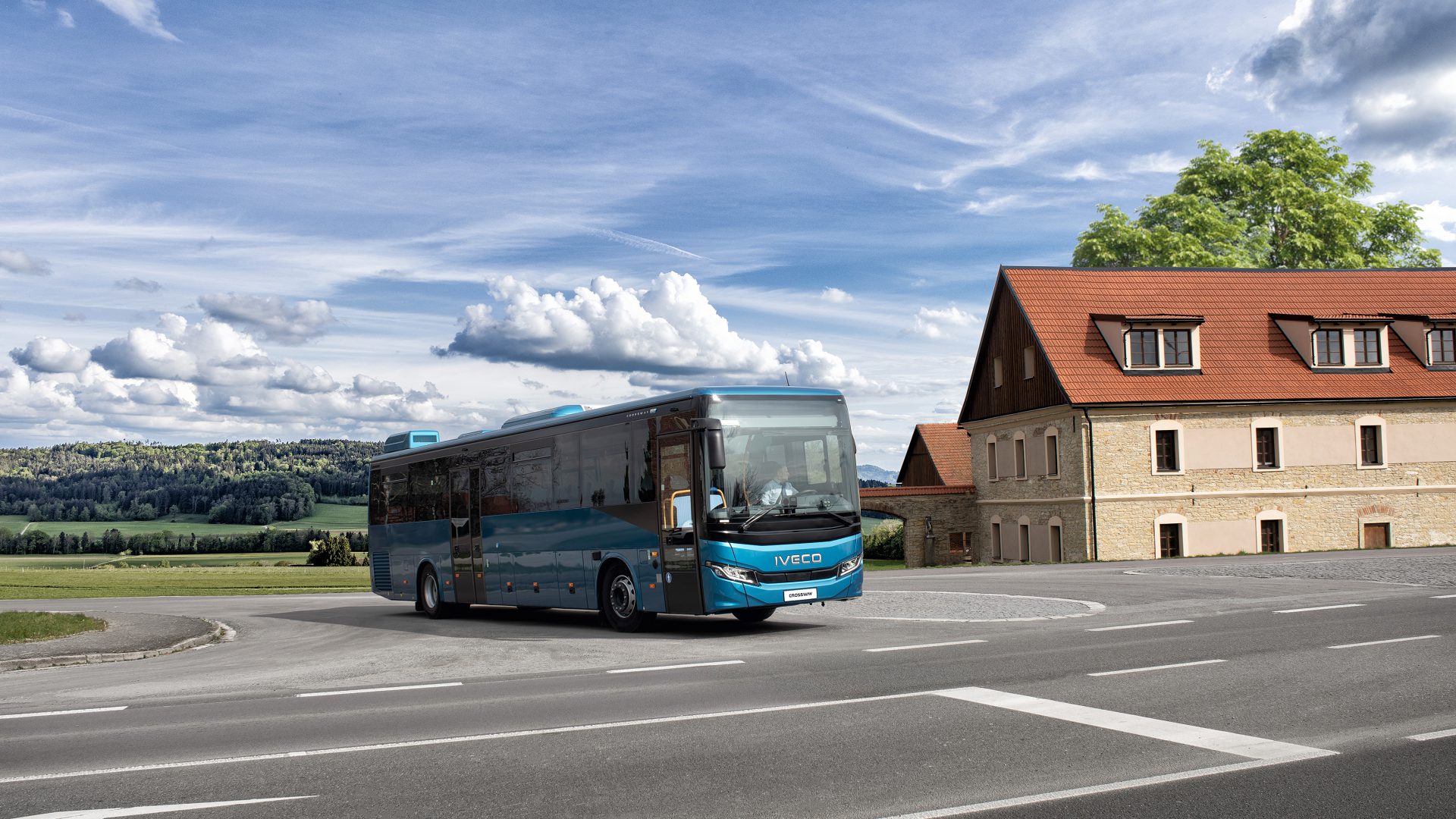
The Iveco Crossway continues to dominate the market, representing approximately 45-50% of total registrations, equivalent to more than 4,500 units annually.
Intercity electric buses: normal floor models are coming!
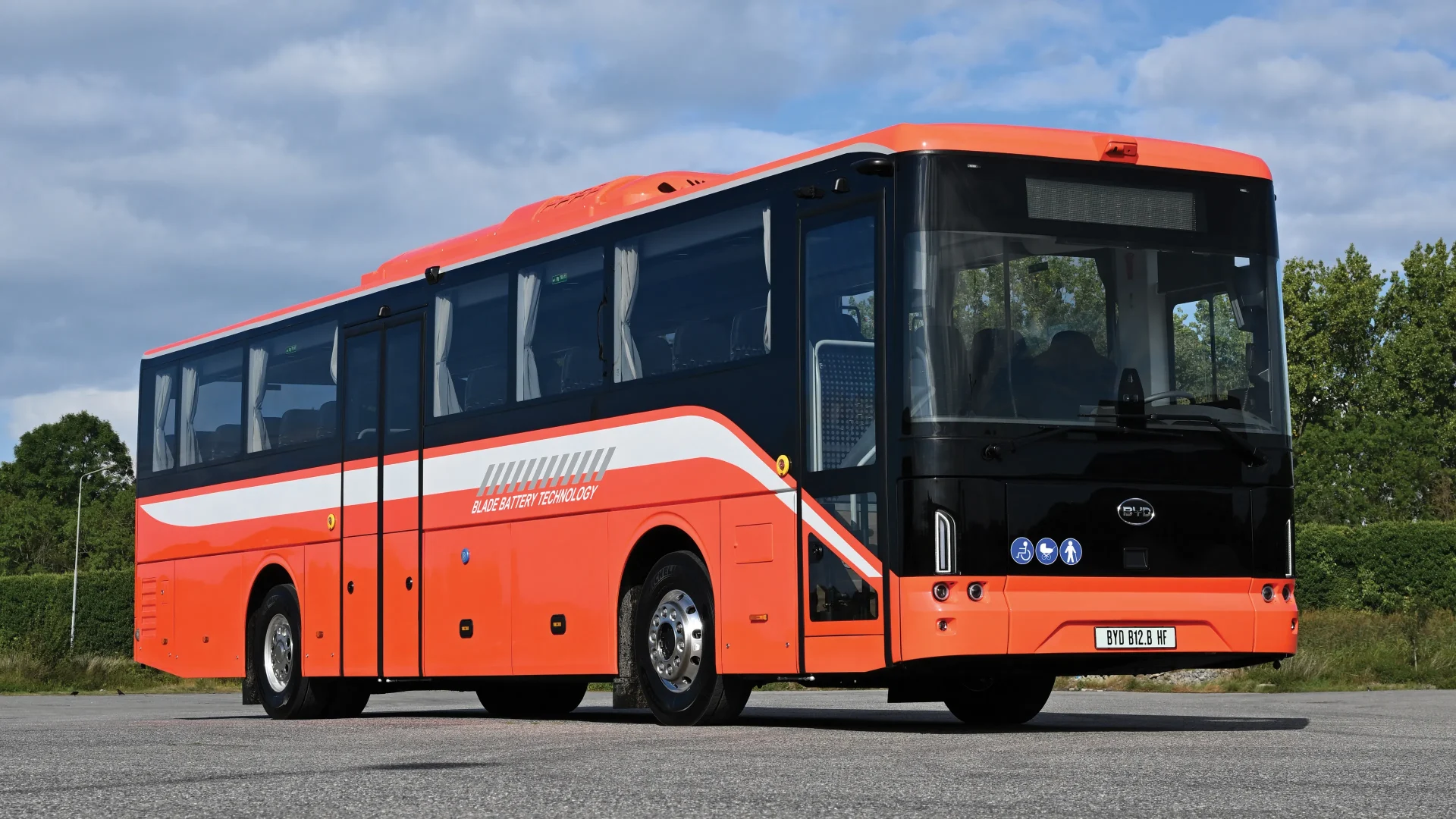
BYD B12.b HF
Following the presentation of the B13.b Low Entry at UITP Summit 2025, BYD entered the European high-floor intercity electric bus segment at Busworld Europe 2025 with the launch of the B12.b HF. Built on the manufacturer’s eBus Platform 3.0, the Class II vehicle is available with three Lithium Iron Phosphate Blade Battery capacities (311, 429 and 495 kWh), offering a maximum declared range of up to 650 km on the SORT III cycle.
The 12-metre model supports AC, DC and pantograph charging, with dual-gun charging power reaching 520 kW, and features a 5.7 m³ luggage compartment enabled by the high-floor layout. The electric driveline combines dual wheel hub motors with a Silicon Carbide-based 6-in-1 controller, while the vehicle is equipped as standard with ADAS functions including emergency braking, lane departure warning, blind-spot monitoring and driver drowsiness detection.
The Platform 3.0 of BYD was launched in 2025. As of late 2025, the bus family based on this platform included the B12.b LF, B12.b LE, B12.b HF, B13.b and the articulated B18.b. In an interview with Sustainable Bus published in November 2025, BYD Europe Managing Director of the Commercial Vehicle Business Center Henry Zhang stressed that “BYD intends to produce the full product range in Hungary as in China, this offering sufficient capacity to our customers’ needs in this fast-growing European e-bus market. BYD is now rolling out the BYD eBus Platform 3.0 to all the buses offered in Europe. The novelties will mainly fall into the intercity category“.
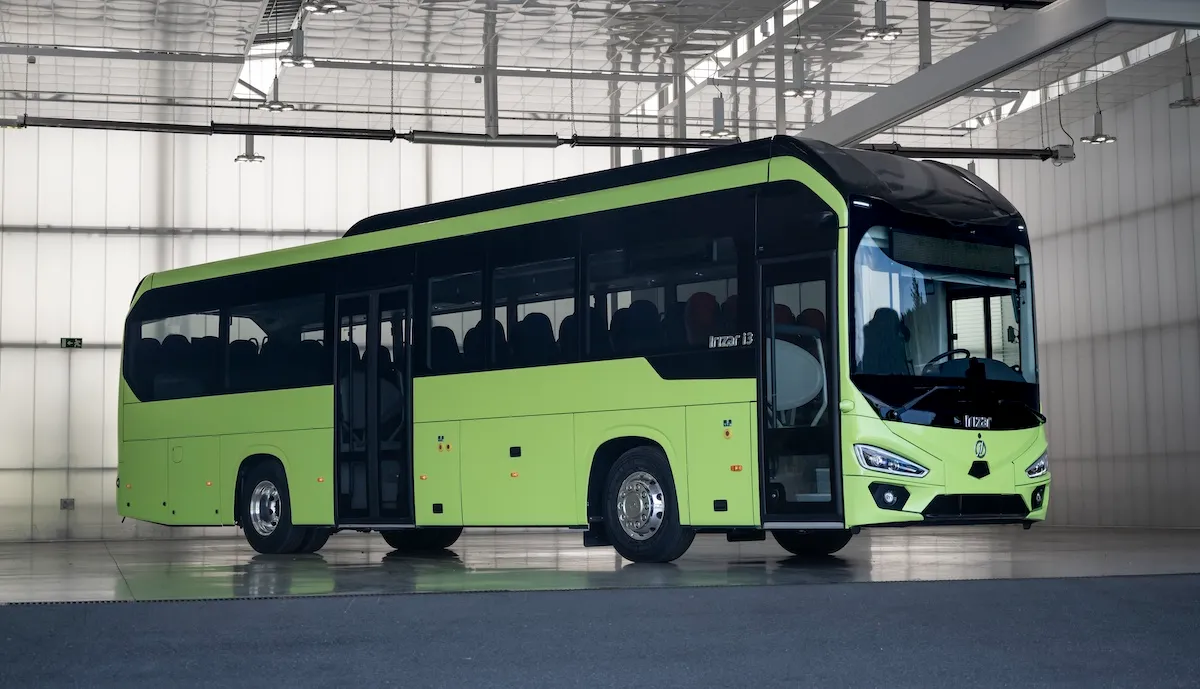
Irizar i3 Normal Floor
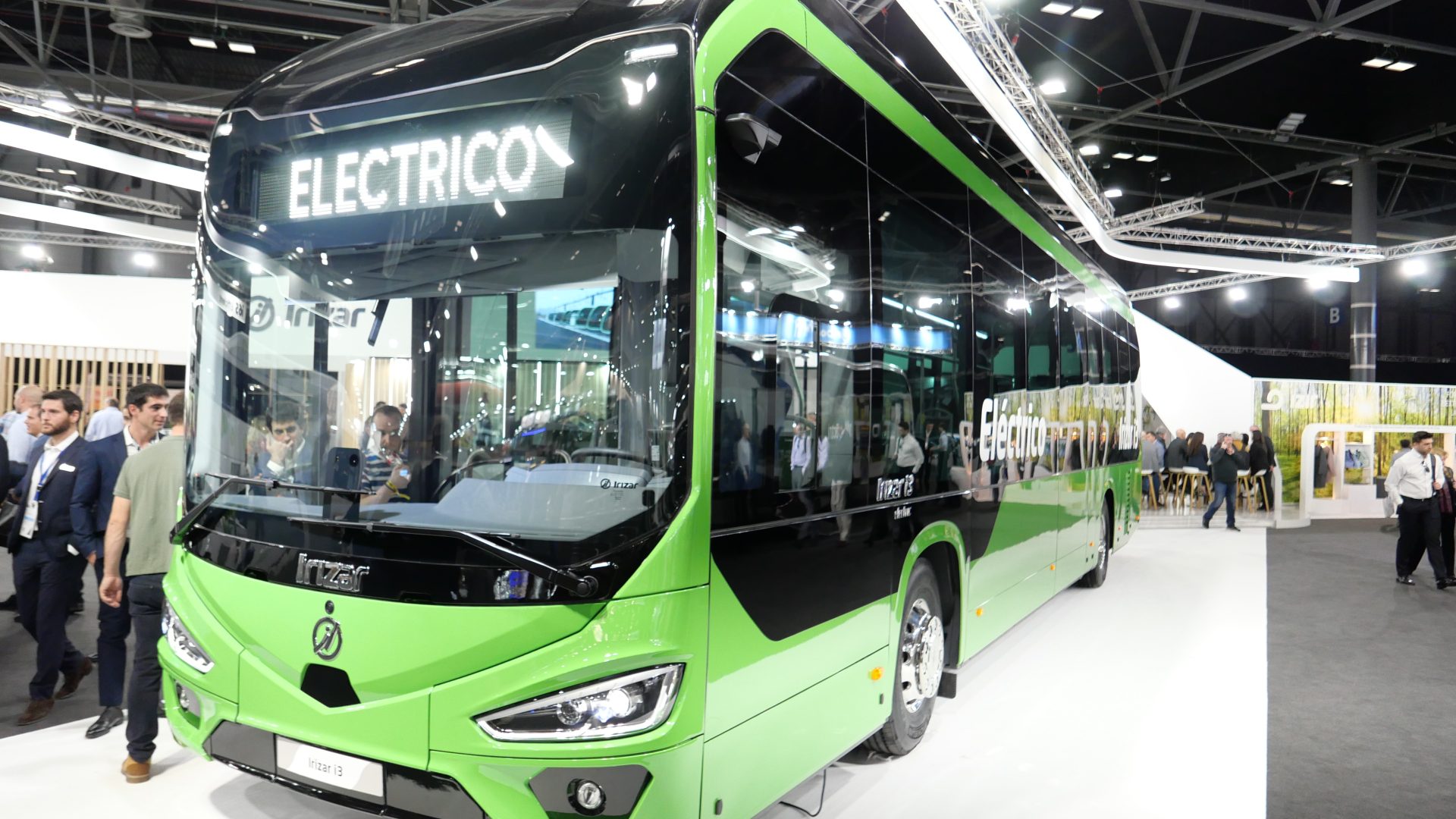
Following the launch of the Low Entry electric Irizar i3 in 2024, Irizar completed its battery-electric intercity bus portfolio at Busworld Europe 2025 with the introduction of the i3 Normal Floor. The integral Class II model is designed for regional and intercity operations and features a redesigned body with lighter materials, allowing a weight reduction of around 1,000 kg compared with the previous generation.
According to the manufacturer, the vehicle offers a driving range of up to 450 km on a single daily charge and provides more than 7 m³ of luggage capacity, depending on the vehicle length and configuration.
The new i3 Normal Floor shares most exterior components with the Low Entry version, enabling commonality of spare parts and maintenance procedures across the electric intercity range.
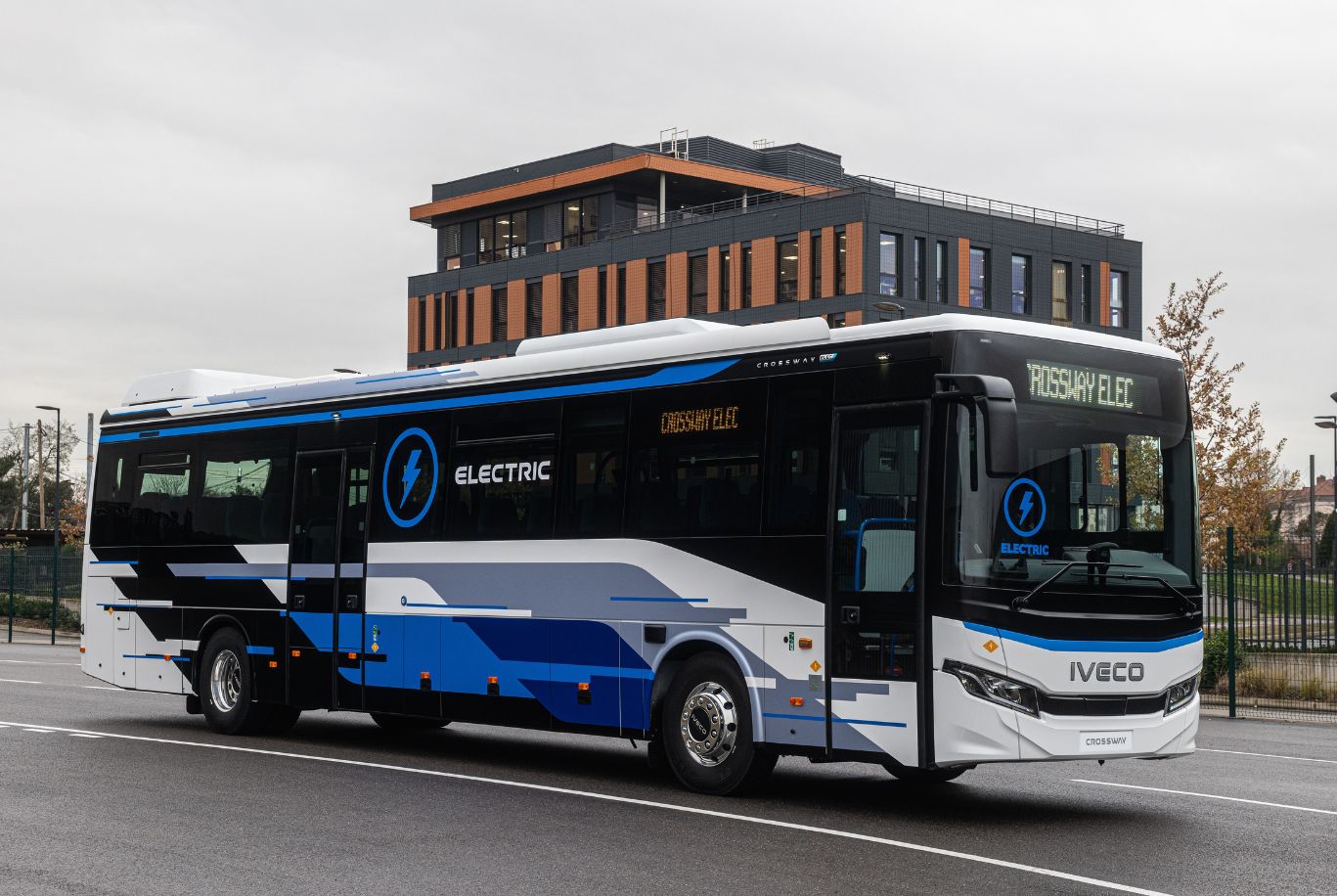
The Iveco Crossway Elec features a maximum declared autonomy of 500 kilometers, thanks to 69 kWh battery packs each with high energy density and assembled by FPT Industrial, which use NMC chemistry; the life cycle of the modules, guaranteed for 10 years, is 15 years.
Depending on the needs, 3 to 6 battery packs are planned, allocated to the roof and the rear if three or four; if, instead, five or six modules are planned, they are planned to be placed in one of the side luggage racks.
Motor is by Siemens, Elfa III model with 290 kW of power and 3,000 Nm torque. Two length variants are planned: 12 and 13 meters. In the first case, the passenger load capacity is 57 people, which increases to 63 in the long version.
Mercedes eIntouro is coming in 2026
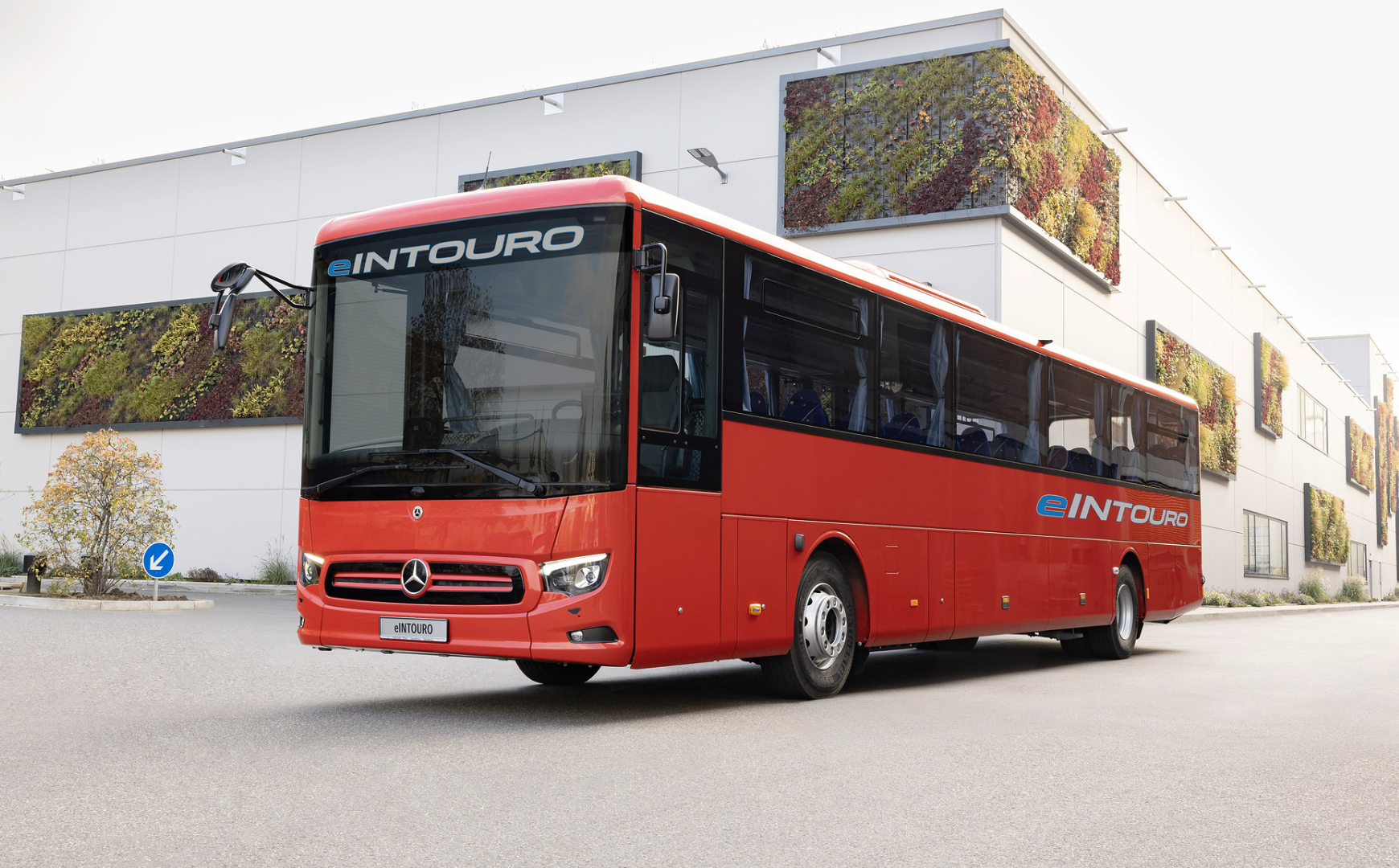
The Mercedes eIntouro was unveiled in November 2024 and has been available for orders in first quarter of 2025, with deliveries beginning in 2026, following official launch at Busworld Europe 2025. Production sites? France and Istanbul.
Interestingly enough, it’s equipped with a different set of battery and driveline than the eCitaro range, made of LFP batteries and central motor by ZF. It’ll be produced in the OEM’s plants in Turkey and in France.
Two lengths are available: the 12.18-metre eIntouro and the 13.09-metre eIntouro M. Seating variants from 50 to a maximum of 63 seats are covered.
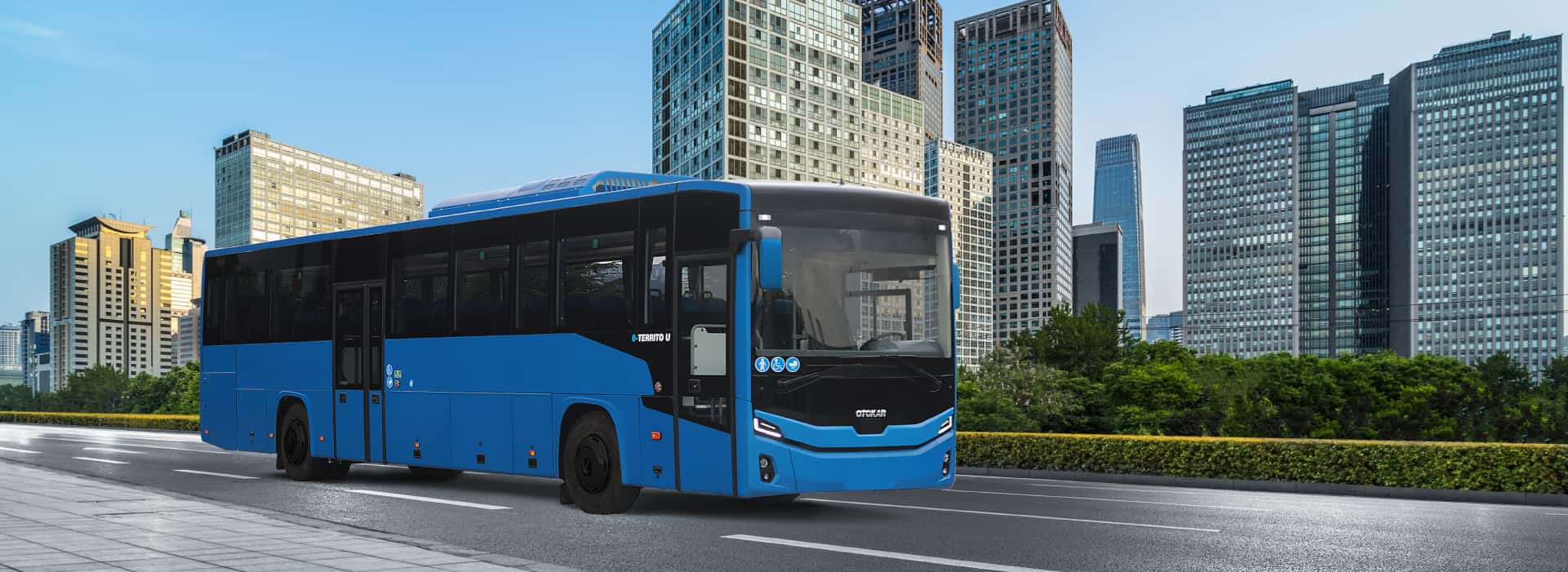
The electric intercity segment also sees the presence of Otokar, which offers the high-floor e-Territo U. The model, moreover, is built on a platform that can also accommodate hydrogen technology. The e-Territo U is already in production and ready for order in 2025. It is a Class II with a length of 13 meters, maximum power of 410 kW and passenger capacity of up to 63 people.
The vehicle is one of the very few intercity battery-electric models on the European market as of today.
The Adana-based manufacturer’s Class II intercity bus is available in two length variants – 12,365 and 13,080 millimetres, with up to 63 seats on the longest version (the one that we had the opportunity to video test drive in July 2024). Batteries are assembled in house and equipped with the Temsa Battery Management System. The chemical formula is NMC (Nickel-Manganese-Cobalt) and they are available in three different capacities: 210, 280 and 350 kWh (6, 8 or 10 modules).
See our video test drive with the Temsa LD SB E. The vehicle joins a zero-emission line-up that already includes the urban battery-powered Temsa Avenue Electron and the electric version of the MD9.
Yutong IC12E
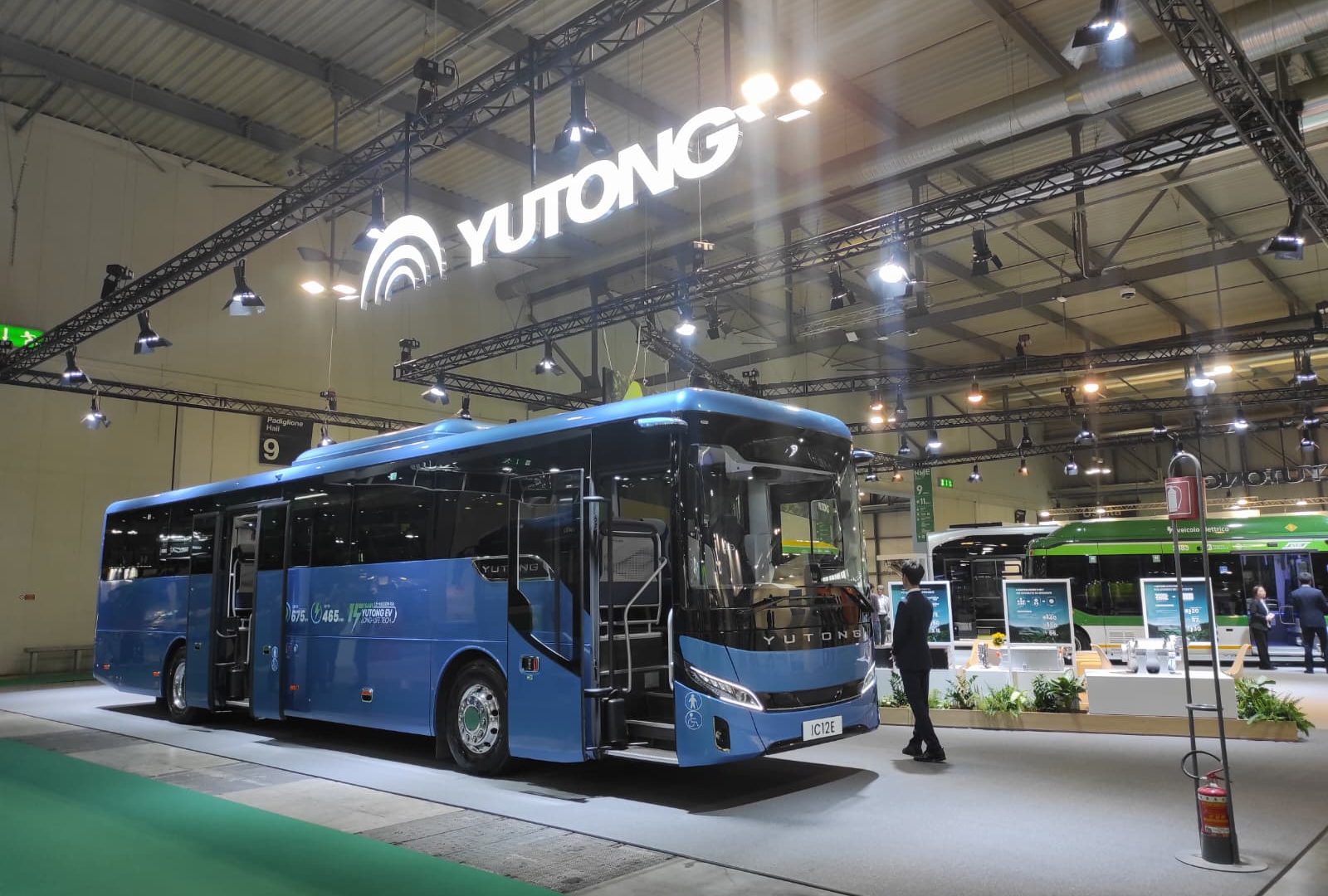
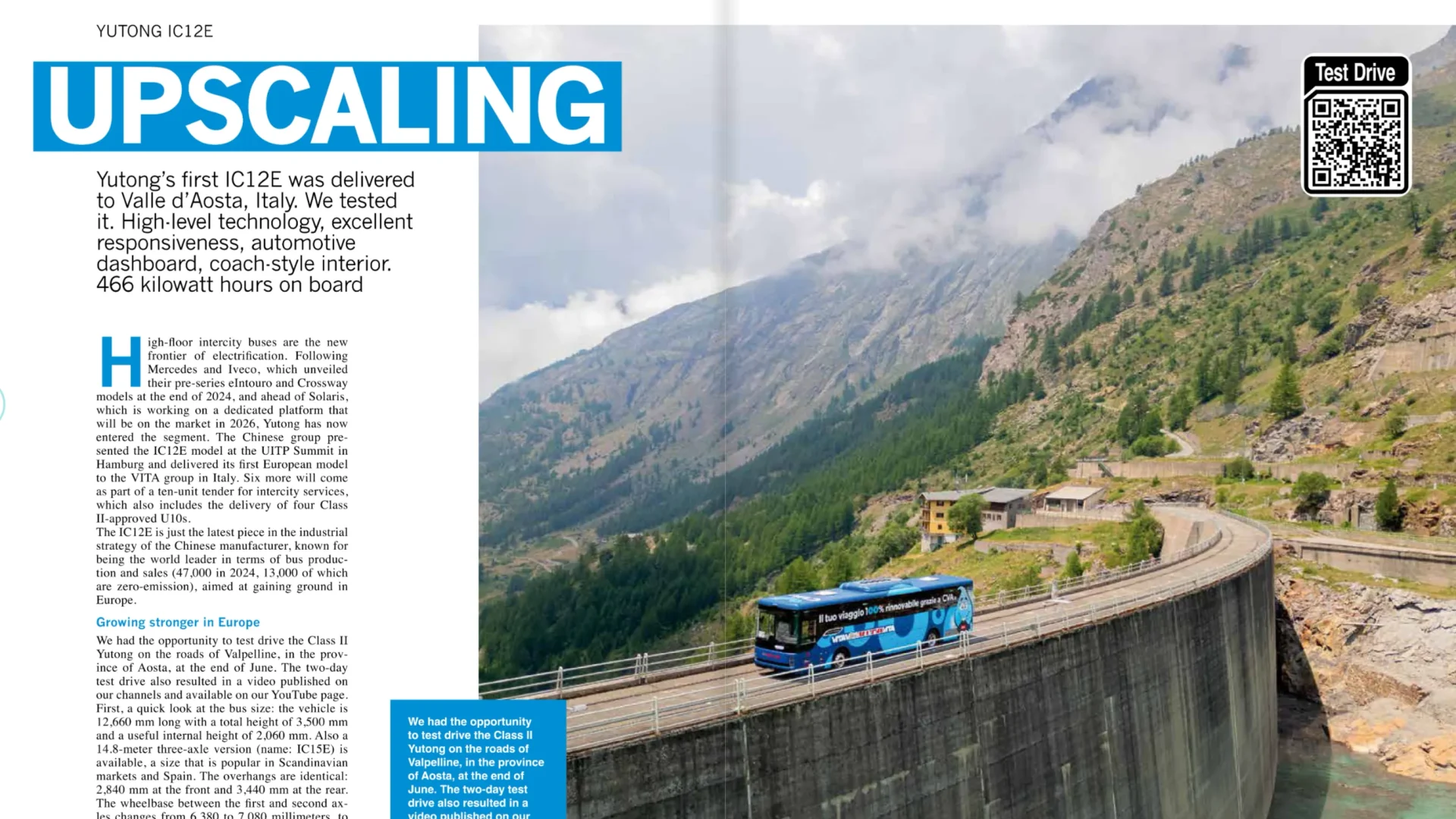
Yutong announced in early 2025 (sharing some nice renderings on social media) the upcoming introduction of the IC12E model, a battery-electric intercity bus designed for long-range operations.
The standard battery configuration is 400 kWh, with an optional 466 kWh pack. Yutong offers a guarantee of 1.5 million kilometers or 15 years, with minimal battery degradation over this period.
The Yutong IC12E measures 12,660 mm in length, 2,550 mm in width, and 3,500 mm in height. It has a maximum seating capacity of 59 passengers, plus space for luggage with a boot volume of 4.5 cubic meters.
The coach features air suspension, a luggage compartment with up to 4.5 m³ of capacity, and a Cling electric heating and cooling air conditioning system. The model is also offered in a 15-metre variant, expanding the range for operators requiring higher passenger capacity.
The same model was showcased publicly at UITP Summit 2025 in Hamburg and, in October 2025, at Busworld Europe 2025 with a new front layout.
Following its official debut in Hamburg, the IC12E was put to the test on a 1,272 km journey through Germany, Denmark, Sweden and Norway. According to a Yutong press release, the aim of the initiative was to assess the vehicle’s real-world range, charging performance, and energy efficiency under typical operating conditions.
We wrote about the Yutong IC12E on September 2025’s issue. Read it HERE
Solaris intercity e-bus platform is in preparation!
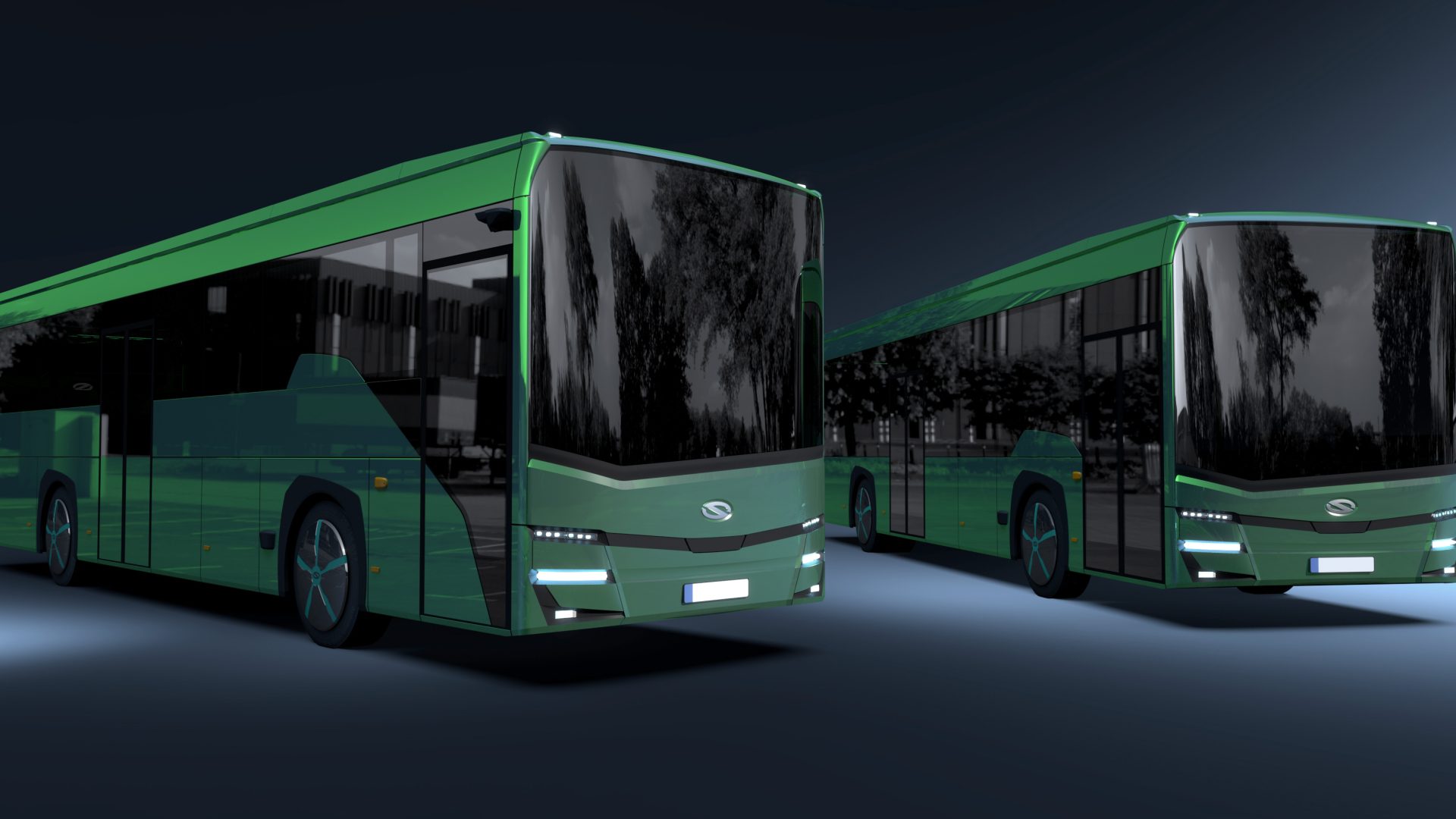
Solaris planned to launch a dedicated high-floor intercity electric bus platform by 2026. According to the most recent updates, the launch will actually happen in late 2026 or early 2027.
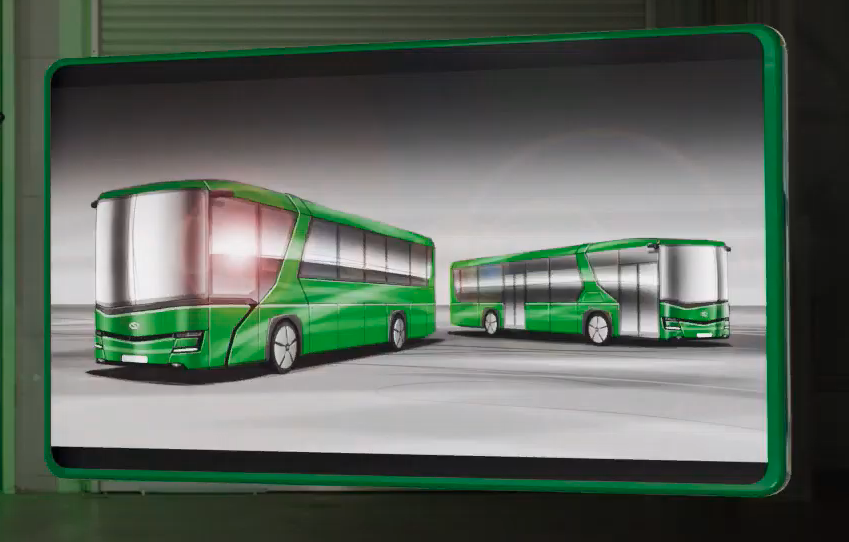
The Polish OEM showed during its 2024 press conference, held in March 2024, the first renderings of the future intercity bus platform (picture on the left), set to be “ready for commercial activities in 2026“, as said Solaris CEO Javier Iriarte. The renderings have been then showed in a updated version (on the right) during its 2025 presentation (on Solaris 2024 results).
Over the next few years, Solaris states it will introduce a new zero-emission intercity platform in three different lengths: 10.9, 12.2 and 13 meters. It is worth noting that each of these models will be available as both battery and hydrogen vehicles. Developing Solaris high floor intercity electric bus platform is an activity headed by Luca Cordiviola that in September 2023 year joined Solaris in the new position of Interurban Platform Director.
It should be however be noted that Solaris offers possibility of homologation in Class II on its LE e-bus family, consisting of the Urbino 9 Low Entry Electric and the 15-meter Low Entry launched in October 2020.
Intercity electric buses: Low Entry in the spotlight
Paving the way for intercity electric buses…
Low Entry configurations are set to become increasingly popular in the Class II segment, due to two main factors: accessibility and the energy transition. The partially lowered floor design facilitates fast passenger handling and requires only a practical, quick manual ramp for wheelchair access, enhancing overall accessibility.
Moreover, Low Entry buses offer greater flexibility for accommodating alternative drive technologies. These technologies, often positioned on the roof, can leverage a specially modified load-bearing structure to maintain acceptable overall height. This design allows for the integration of new electric technologies without significantly altering the bus’s profile.
However, there are trade-offs. Low Entry buses must sacrifice some seating and luggage space to maintain overall passenger capacity. Additionally, they are generally more expensive than their normal floor counterparts, positioning themselves just behind fully lowered buses in terms of cost.
Despite these challenges, the increasing emphasis on ecological factors is likely to drive growth in this segment.
Irizar i3 intercity e-bus at FIAA 2024
Irizar has launched the new i3 intercity e-bus model at FIAA in Madrid. On show there are: also a new generation Irizar i6S Efficient unit, an i6S Efficient Hydrogen, and an Irizar ie tram urban electric vehicle.
The bodywork of the new electric Irizar i3 is available in an integral self-supporting configuration and with different electric chassis.
The new class II electric low entry Irizar i3 features “a totally renewed design, in addition to a range of vehicles with a new generation of lighter, more comfortable integral Irizar chassis with up to 50% lower consumption. The vehicles also have the most stringent safety and cybersecurity systems on the market, an improved cockpit with a redesigned dashboard, weight reductions and improvements in consumption and emissions”, Irizar states.
Iveco Bus Crossway Low Entry Elec
Iveco has been a pioneer in the intercity electric bus market with its Crossway Low Entry model. The Iveco Crossway is the most sold intercity bus in Europe, and has broken a new production record as the 60,000th unit rolled off the assembly line last year since its launch in 2006. Together with the Setra MultiClass, the Iveco Crossway LE is the most popular LE bus available in Europe (see our technical focus).
The new Iveco Crossway Low Entry Elec is available in both urban (Class I) and intercity (Class II) variants, with options for 12-meter and 13-meter lengths. Powered by a central electric motor delivering 330 kW of power and a maximum torque of 2,200 Nm (by Siemens/Accelera by Cummins), the bus relies on NMC lithium-ion batteries assembled by FPT, offering high energy density (180 kW/kg).
The Class I version can be equipped with five, six, or seven battery packs, providing respective energy capacities of 346 kWh, 416 kWh, and 485 kWh. The Class II version features 416 kWh or 485 kWh capacities.
The intercity e-bus launch is in line with the brand roadmap of having a full electric bus range in 2023. Iveco is also working on developing high-floor intercity vehicles, which are essential for longer routes and more demanding operational conditions. The company’s ongoing investments in electric bus technology underscore its commitment to sustainable transportation.
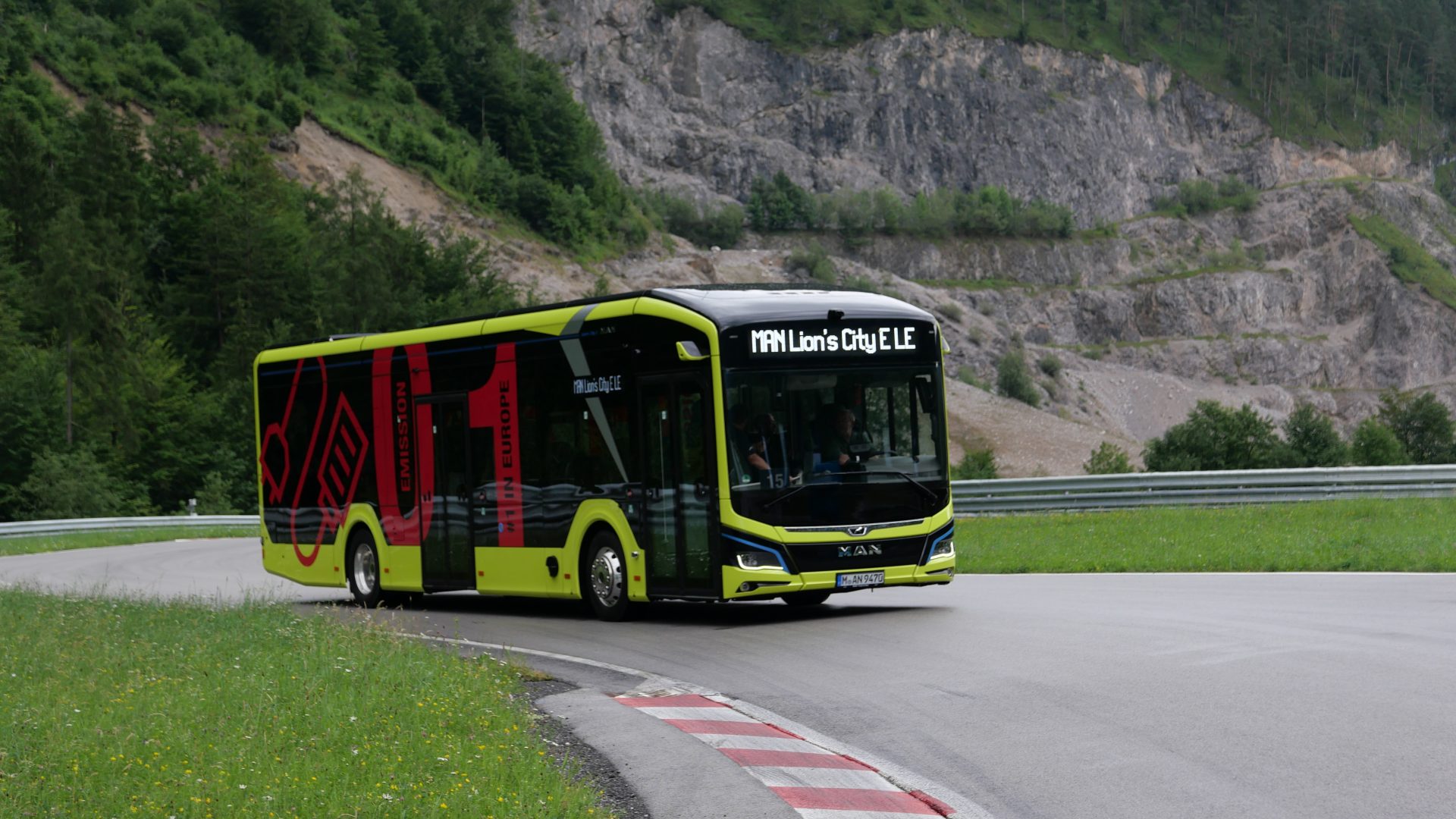
As Barbaros Oktay, Head of Bus at MAN Truck & Bus, told Sustainable Bus in an interview published in September 2025, the manufacturer does not currently see a compelling business case for dedicated high-floor Class II battery-electric buses. Its product strategy prioritizes the transition from urban and Low Entry buses directly to Class III electric coaches. As Oktay put it, “Our main focus is shifting from Class I directly to Class III.”
Standing capacity in MAN Low Entry electric bus varies depending on the configuration and the number of batteries installed, that can range from a minimum of four (320 kWh) to a maximum of six (480 kWh).
The bus uses NMC (Nickel Manganese Cobalt) batteries, arranged in 80 kWh modules across the roof. Each module features a Battery Management System (BMS) that balances the state of charge and maintains optimal thermal conditions around 25°C. Future upgrades, expected by the end of next year, include 90 kWh battery modules with a Depth of Discharge (DoD) of 90%, increasing usable energy by approximately 20%.
The propulsion system consists of a centrally mounted permanent magnet synchronous motor, developed within the Traton Group. This motor, connected to the drive axle via a transmission shaft, delivers a continuous power output of around 160 kW, with peaks over 230 kW and a maximum torque of 2,100 Nm. The motor is equipped with an internal oil-based lubrication and cooling system, ensuring efficient performance and longevity.
Volvo 8900 Electric, with MCV
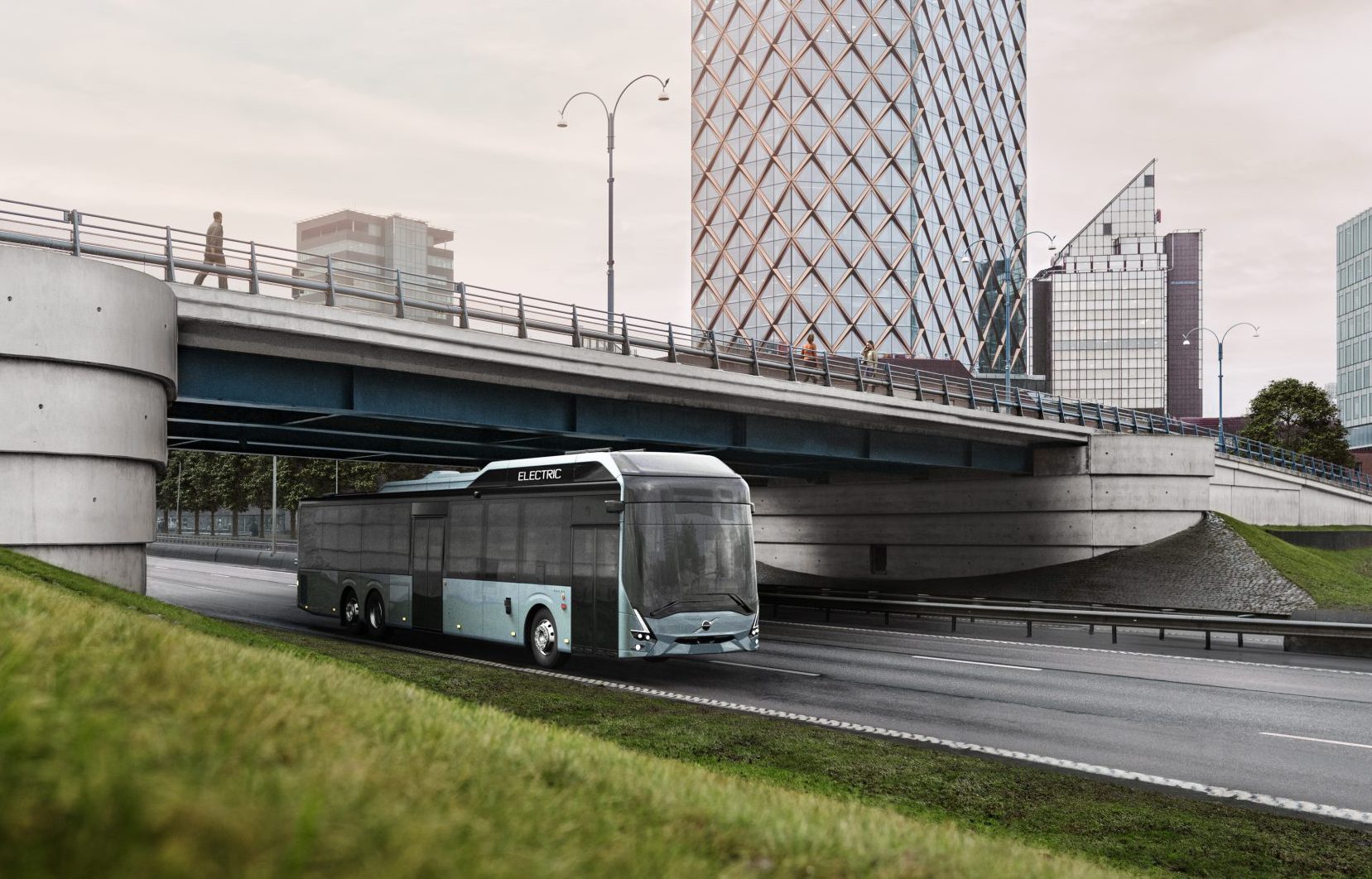
Volvo Buses has entered the intercity electric bus market with its BZR platform, launched in March 2024, which is set to join the already available BZL platform in the Swedish company’s offering. The Volvo BZR platform is designed to meet a diverse range of transportation needs, including commuting, intercity travel, and coach applications, from Low Entry to High Floor, with options for two or three axles and various battery configurations.
Also a first concept version of the 8900 Electric with BZR chassis and Volvo bodywork has been showed in Gothenburg at the showcase event, although the series production of the model will happen in Egypt through bodybuilder partner MCV.
The Volvo 8900 Electric is available in 12.3-metre (4×2) and 14.9-metre (6×2) versions, accommodating up to 88 and 110 passengers respectively. It is powered by dual electric motors delivering 2×200 kW peak power and can be equipped with four to six NCA battery packs, for a maximum installed capacity of 450 kWh on the two-axle version and 540 kWh on the three-axle model.
Important orders were announced in Sweden, with Bergkvara placing an order for vehicles operating in Skåne and Svealandstrafiken selecting the model for regional services (over 100 units).
Volvo Buses is in the midst of a significant transition. Two years after announcing a major shift in its European business model, the company is now moving into series production with a new partner, reshaping its manufacturing footprint, and adjusting its market focus to secure long-term profitabili…
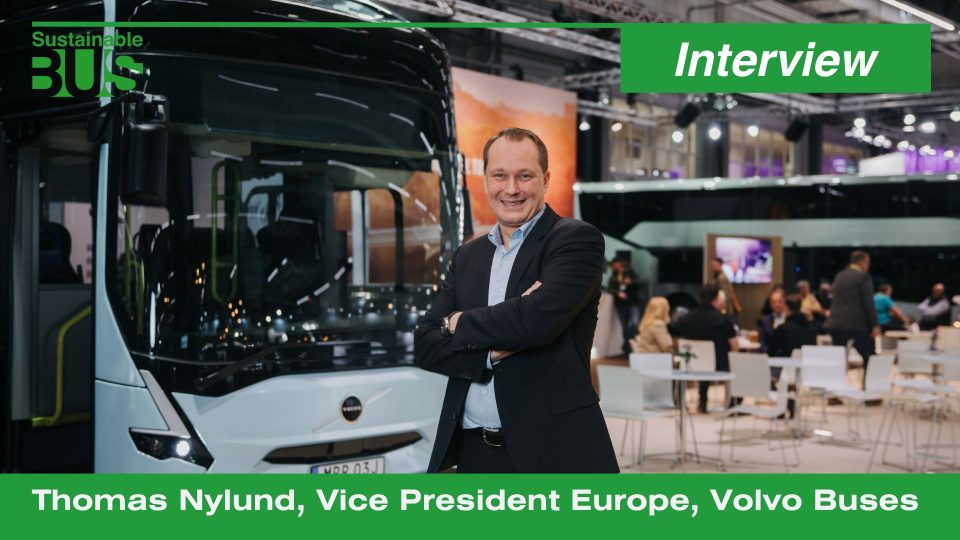
As mentioned by Thomas Nylund, Vice President Europe – Business Unit Chassis at Volvo Buses, in an interview with Sustainable Bus conducted in April 2025, the 8900 Electric is the third model in the production ramp-up with MCV, following the 7900 Electric and the articulated 7900 Electric, while the manufacturer has identified the Nordic and Benelux markets among its priorities for city and intercity electric buses.
Scania Castrosua
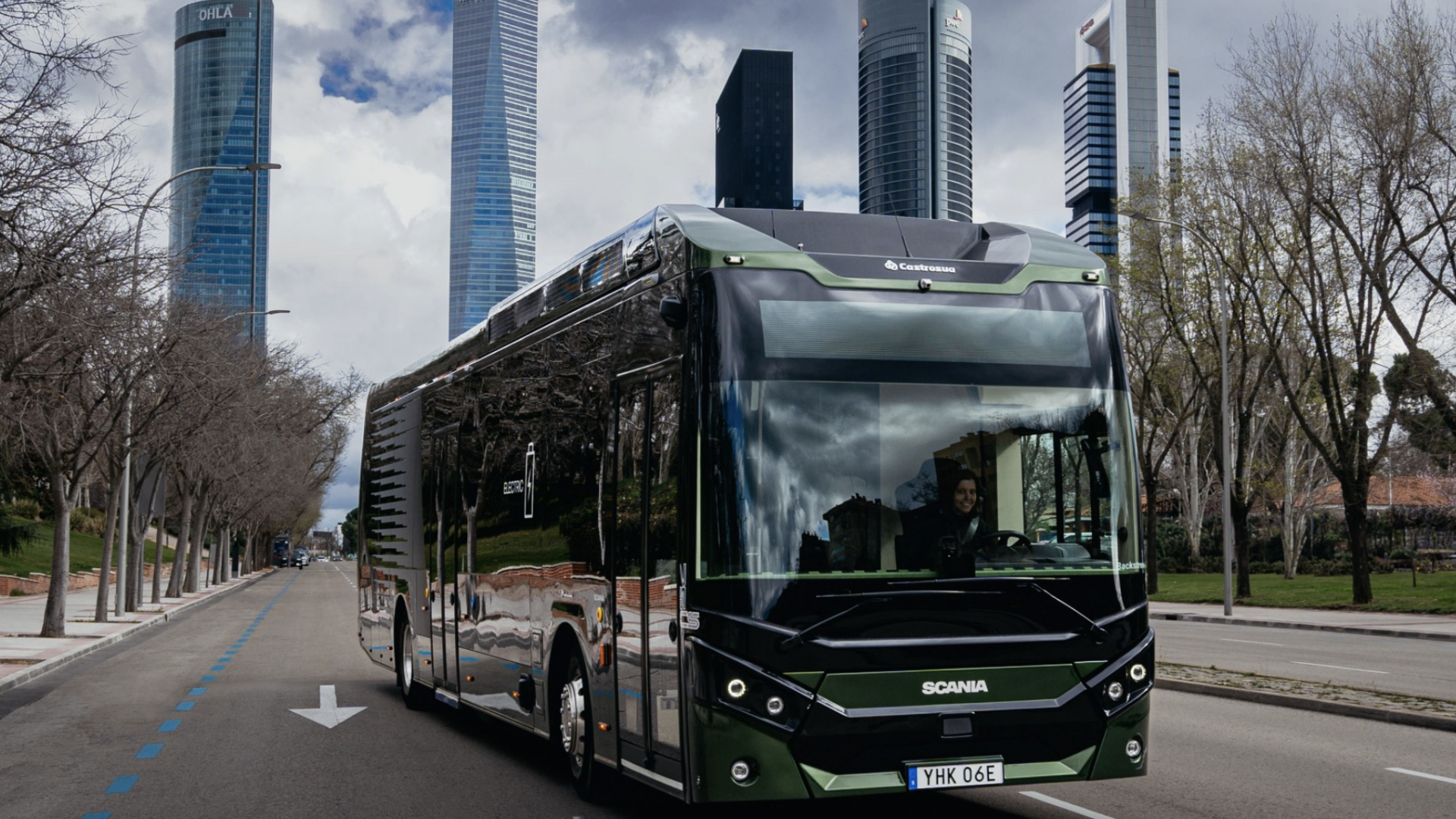
Scania is also making inroads into the intercity electric bus sector with the introduction of a low-entry 4×2 e-bus model. Scania platform is coupled with Castrosua 75CS body. Batteries offer energy storage capacity of up to 520 kWh.
The model, presented at Busworld 2023, will be available in two performance steps – a four-battery variant with an installed capacity of 416 kWh and a five-battery variant with an installed capacity of 520 kWh.
The vehicle features a continuous power output of 250 kW at 1,750 rpm. Batteries are designed and produced in cooperation with Northvolt at Scania’s battery factory in Södertälje, Sweden. The batteries are fast-charging, Scania states, with a full charge in 150 minutes, more sustainable and with a lifetime of 1.5 million kms.
VDL Citea new generation, also for regional operations
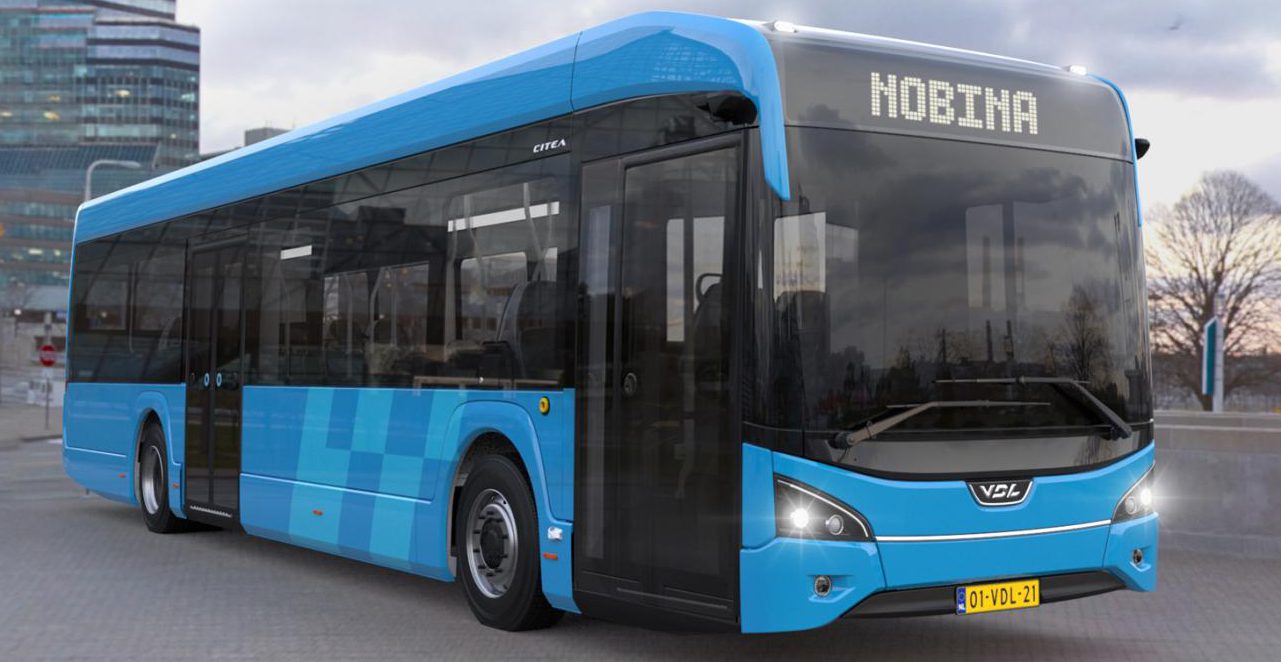
Although VDL has not stated any specific projects so far concerning intercity vehicles, it’s true that the new generation Citea e-bus range has LE versions and can be homologated also in Class 2.
The new product family is the outcome of a new concept entirely developed on an electric driveline. And, for the first time, it houses batteries in the floor (in the standard version of 306 kWh). Maximum battery capacity is 490 kWh, with the kWh exceeding 306 put on the roof. Battery modules are assembled in-house by the VDL group. Formula is NMC, supplier not mentioned. What is interesting is passenger capacity: 110 people can be welcomed on the version with standard battery capacity.
Autonomous driving will gain further space at Mobility Move 2027, while electric mobility will remain one of the main pillars of the Berlin event, scheduled for 16-18 March.
Following a 2026 edition that attracted more than 1,600 participants and 110 exhibitors, preparations are already under way f...
On 18 March 1895, at 6:25 in the morning, the world’s first motor bus line opened between Siegen, Netphen and Deuz. The vehicle was a Benz Landauer. It had eight seats, a one-cylinder engine of five horsepower, and fifteen kilometres of bad road ahead of it. On the steepest hill, the passengers had ...
The transition to zero-emission buses is expanding procurement and industrial decisions beyond the vehicle itself, bringing batteries, infrastructure, services, financing and partnerships into the discussion between manufacturers, suppliers and operators. The topic was at the centre of the Sustainab...
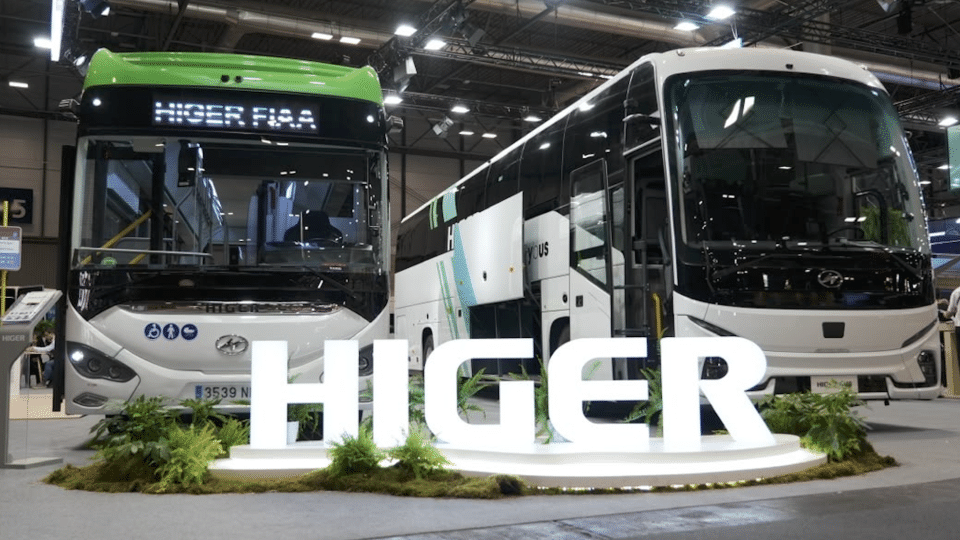
Sponsored by Higer Higer Bus is showcasing four products at FIAA 2026 in Madrid, including the 9-metre Azure battery-electric city bus and two products from its Fencer electric range. The Chinese manufacturer is displaying the V13 coach, Azure 9 electric city bus, Fencer f6 Integral EV bus and Fence...
Thermal management supplier Songz announces it has obtained Volvo HVAC Compatibility Certification for its LMD-VI electric bus HVAC family, while its systems for electric double-decker buses have received TfL 2.5 approval for applications in London.
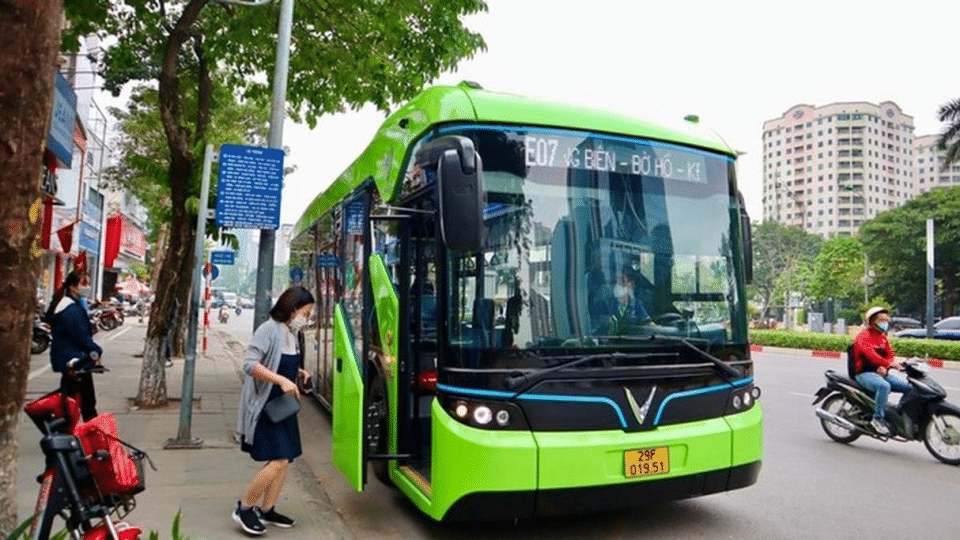
Hanoi public transport operator Transerco has introduced 53 new VinFast electric buses on four routes on 5 and 6 October 2026, replacing diesel vehicles as the Vietnamese capital pursues full conversion of its public bus fleet to electric and green-energy vehicles by 2030. The deployment comprises 2...
Romanian capital city Bucharest has secured €87.44 million in non-repayable funding from the Modernisation Fund for the procurement of 40 battery-electric buses, 45 trolleybuses and 10 trams, as part of a new fleet renewal programme for municipal public transport operator STB. The investment has bee...
Ebusco has secured €5.86 million in production support from shareholder Gotion to complete its remaining Rouen bus order, but warns that additional short-term funding is required to sustain its operations. The Dutch electric bus manufacturer announced the development on 9 October 2026, ahead of its ...
APTA TRANSform & EXPO 2026 in Chicago brought new market entries and vehicle concepts in a context that showed a clear focus on conventional and hybrid propulsion technologies, as U.S. federal funding priorities have shifted toward a broader mix of bus powertrains. The exhibition at McCormick Pl...
This Website uses cookies, small text files placed by the site on the computer or mobile device, which automatically collect some information that the user does not provide directly. Cookie Policy ACCEPTCookie settings
Manage consent
Privacy Overview
This website uses cookies to improve your experience while you navigate through the website. Out of these cookies, the cookies that are categorized as necessary are stored on your browser as they are essential for the working of basic functionalities of the website. We also use third-party cookies that help us analyze and understand how you use this website. These cookies will be stored in your browser only with your consent. You also have the option to opt-out of these cookies. But opting out of some of these cookies may have an effect on your browsing experience.
Necessary cookies are absolutely essential for the website to function properly. These cookies ensure basic functionalities and security features of the website, anonymously.
Cookie
Duration
Description
cookielawinfo-checkbox-advertisement
1 year
Set by the GDPR Cookie Consent plugin, this cookie is used to record the user consent for the cookies in the "Advertisement" category .
cookielawinfo-checkbox-analytics
11 months
This cookie is set by GDPR Cookie Consent plugin. The cookie is used to store the user consent for the cookies in the category "Analytics".
cookielawinfo-checkbox-functional
11 months
The cookie is set by GDPR cookie consent to record the user consent for the cookies in the category "Functional".
cookielawinfo-checkbox-necessary
11 months
This cookie is set by GDPR Cookie Consent plugin. The cookies is used to store the user consent for the cookies in the category "Necessary".
cookielawinfo-checkbox-others
11 months
This cookie is set by GDPR Cookie Consent plugin. The cookie is used to store the user consent for the cookies in the category "Other.
cookielawinfo-checkbox-performance
11 months
This cookie is set by GDPR Cookie Consent plugin. The cookie is used to store the user consent for the cookies in the category "Performance".
JSESSIONID
session
The JSESSIONID cookie is used by New Relic to store a session identifier so that New Relic can monitor session counts for an application.
PHPSESSID
session
This cookie is native to PHP applications. The cookie is used to store and identify a users' unique session ID for the purpose of managing user session on the website. The cookie is a session cookies and is deleted when all the browser windows are closed.
viewed_cookie_policy
11 months
The cookie is set by the GDPR Cookie Consent plugin and is used to store whether or not user has consented to the use of cookies. It does not store any personal data.
Functional cookies help to perform certain functionalities like sharing the content of the website on social media platforms, collect feedbacks, and other third-party features.
Cookie
Duration
Description
bcookie
2 years
LinkedIn sets this cookie from LinkedIn share buttons and ad tags to recognize browser ID.
bscookie
2 years
LinkedIn sets this cookie to store performed actions on the website.
lang
session
LinkedIn sets this cookie to remember a user's language setting.
lidc
1 day
LinkedIn sets the lidc cookie to facilitate data center selection.
UserMatchHistory
1 month
LinkedIn sets this cookie for LinkedIn Ads ID syncing.
__cf_bm
30 minutes
This cookie, set by Cloudflare, is used to support Cloudflare Bot Management.
__sharethis_cookie_test__
session
ShareThis sets this cookie to track which pages are being shared and by whom.
Performance cookies are used to understand and analyze the key performance indexes of the website which helps in delivering a better user experience for the visitors.
Cookie
Duration
Description
_uetsid
never
Bing Ads sets this cookie to engage with a user that has previously visited the website.
_uetvid
never
Bing Ads sets this cookie to engage with a user that has previously visited the website.
Analytical cookies are used to understand how visitors interact with the website. These cookies help provide information on metrics the number of visitors, bounce rate, traffic source, etc.
Cookie
Duration
Description
CONSENT
2 years
YouTube sets this cookie via embedded youtube-videos and registers anonymous statistical data.
vuid
2 years
Vimeo installs this cookie to collect tracking information by setting a unique ID to embed videos to the website.
_ga
session
The _ga cookie, installed by Google Analytics, calculates visitor, session and campaign data and also keeps track of site usage for the site's analytics report. The cookie stores information anonymously and assigns a randomly generated number to recognize unique visitors.
_gat_gtag_UA_161600929_7
2 hours
Set by Google to distinguish users.
_gat_gtag_UA_27868640_1
2 hours
Set by Google to distinguish users.
_gat_UA-120282270-1
session
A variation of the _gat cookie set by Google Analytics and Google Tag Manager to allow website owners to track visitor behaviour and measure site performance. The pattern element in the name contains the unique identity number of the account or website it relates to.
_gid
session
Installed by Google Analytics, _gid cookie stores information on how visitors use a website, while also creating an analytics report of the website's performance. Some of the data that are collected include the number of visitors, their source, and the pages they visit anonymously.
Advertisement cookies are used to provide visitors with relevant ads and marketing campaigns. These cookies track visitors across websites and collect information to provide customized ads.
Cookie
Duration
Description
advanced_ads_browser_width
1 month
This cookie is set by Advanced ads plugin.This cookie is used to measure and store the user browser width for adverts.
fr
3 months
Facebook sets this cookie to show relevant advertisements to users by tracking user behaviour across the web, on sites that have Facebook pixel or Facebook social plugin.
IDE
1 year 24 days
Google DoubleClick IDE cookies are used to store information about how the user uses the website to present them with relevant ads and according to the user profile.
MUID
1 year 24 days
Bing sets this cookie to recognize unique web browsers visiting Microsoft sites. This cookie is used for advertising, site analytics, and other operations.
test_cookie
15 minutes
The test_cookie is set by doubleclick.net and is used to determine if the user's browser supports cookies.
VISITOR_INFO1_LIVE
5 months 27 days
A cookie set by YouTube to measure bandwidth that determines whether the user gets the new or old player interface.
YSC
session
YSC cookie is set by Youtube and is used to track the views of embedded videos on Youtube pages.
yt-remote-connected-devices
never
YouTube sets this cookie to store the video preferences of the user using embedded YouTube video.
yt-remote-device-id
never
YouTube sets this cookie to store the video preferences of the user using embedded YouTube video.